The Best Dog Harnesses for Puppies
A puppy harness is a consumable. The dog will double in girth before the webbing is even broken in, so the specification that matters is not denier or load rating - it is how many inches of adjustment you get before you are buying another one.
The verdict
Buy the Blue-9 Balance Harness. It has six points of adjustment— more than anything else here — which is the single feature that decides how long a puppy harness lasts, and it has front and back leash rings on every size, so the same harness works for a dog that is still learning not to pull and for the same dog once it has. The budget pick is the Auroth tactical vest: it is the cheapest harness on this page by a clear margin and it still has two metal quick-release buckles and two metal leash points, which is more hardware than most harnesses twice its price. If your puppy is a small breed that objects to being wrapped in structure, the Ruffwear Hi & Light is the minimal option and is honest about being one. One warning before you shop: the PetSafe 3 in 1 advertises a car-restraint function, and it is not crash certified— a tether point is not a restraint, and no harness on this page is certified by the Center for Pet Safety. Prices come from our live price layer as of November 23, 2026.
Quick picks
The short answer, ranked and scored against our published durability rubric. Where a manufacturer does not publish a spec, we say so rather than estimating it.
| # | Photo | Product | Adjustment and hardware | Durability | Price |
|---|---|---|---|---|---|
| 1 | 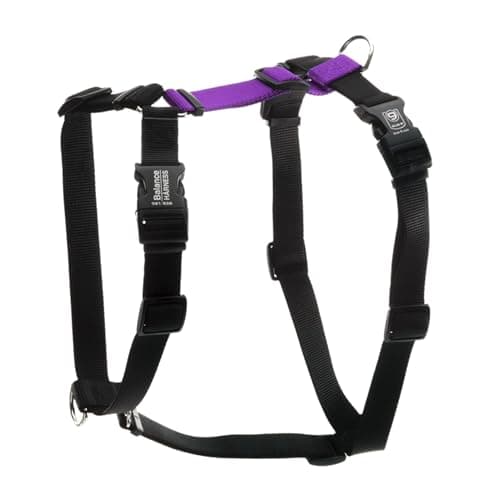 | Blue-9 Balance HarnessFit — if you can live with a brand that publishes almost nothing |
| 60/100 | $45.95 · Amazon |
| 2 | 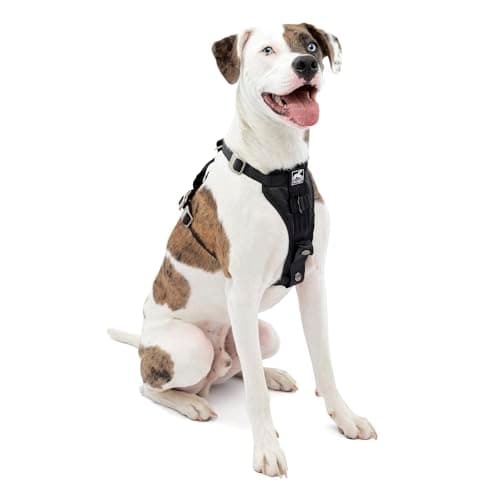 | Kurgo Enhanced Strength Tru-Fit HarnessBuyers who want the longest warranty in the category |
| 69/100 | $39.95 · Amazon |
| 3 | 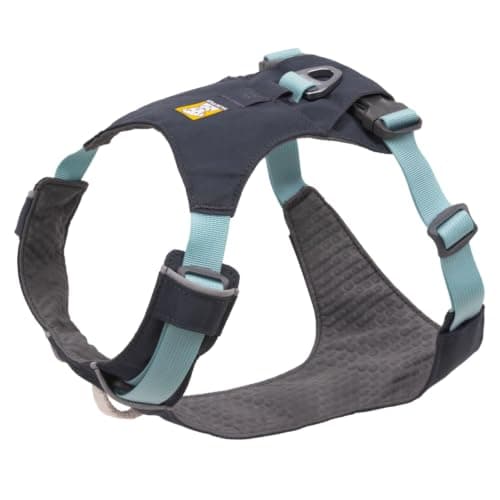 | Ruffwear Hi & Light HarnessA minimal harness for a small dog that objects to bulk |
| 62/100 | $37.49 · Amazon |
| 4 | 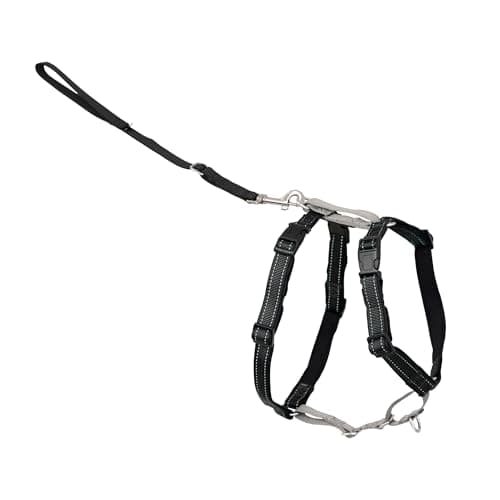 | PetSafe 3 in 1 HarnessA budget harness that also does duty as a car restraint tether point |
| 42/100 | $29.99 · Amazon |
| 5 | 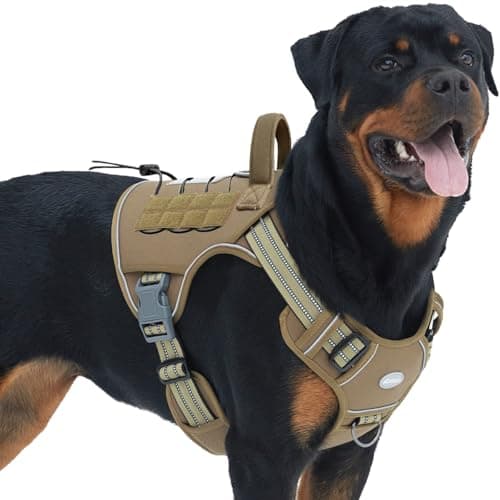 | Auroth Tactical Dog HarnessThe default budget tactical vest, with the biggest track record |
| 56/100 | $16.52 · Amazon |
Tap any row to jump to the full review. Specs are the manufacturer's own published figures; where a maker does not publish one we say "not published" rather than estimating it. Prices are pulled live from Amazon as of November 23, 2026; where we have no verified live price we show none rather than a stale number. #ad — how our links work.
Adjustment range is the specification
Every other page on this site ranks harnesses on durability, because for an adult dog the harness has to outlast years of use. A puppy harness has a different job. A Labrador puppy at twelve weeks has a chest girth somewhere around 16 inches; by nine months it is past 26. The harness is not going to wear out. It is going to stop fitting, twice, and the only question worth asking is how long each one lasts before that happens.
That reframes the whole purchase. Points of adjustment is the figure to read: every independent strap is another dimension that can grow with the dog, and the difference between four points and six is usually the difference between two harnesses and three over the first year. The Blue-9 wins this page on that one number.
The practical consequence is that a puppy harness should be cheap or adjustable, and ideally both. Spending ninety dollars on a harness your dog wears for fourteen weeks is not thrift, and it is not kinder to the dog either. We would rather see the money go on the harness the adult dog will live in — which is the field covered by the durable harness roundup and, if the dog pulls, the no-pull roundup.
Measure the dog, every six weeks
Harness sizing is done on chest girth, measured around the deepest part of the ribcage just behind the front legs, not on the dog’s weight. Weight bands on packaging are a convenience for the manufacturer; two 30 lb dogs can be four inches apart in girth. Our measuring guide has the method, and the instruction that matters most for a puppy is to re-measure every six weeks rather than waiting for the harness to look tight.
Two fit rules for a growing dog. You should be able to get two fingers flat under every strap, and you should check that at the chest strap as well as the neck — the chest is where a puppy fills out first. And resist buying a size up to grow into: a loose harness is an escape risk and it chafes at the armpit, where a puppy’s skin is thinnest. Buy the size that fits now, at the loose end of its range.
The car-restraint claim you should ignore
The PetSafe 3 in 1 is on this page because three functions at a low price is genuinely useful for a puppy, and because one of those three functions needs to be addressed directly. PetSafe sells it as a walking harness, a front-clip no-pull harness and a car restraint attachment. The first two are real. The third is a tether point, and a tether point is not a restraint.
To be specific rather than vague about it: the Center for Pet Safety has not certified this harness, and it does not appear on the CPS certified list. Only three dog harnesses have ever passed independent CPS crash certification, and we keep the current list on the crash-tested harness page. None of them is on this page, because none of them is a sensible puppy purchase — a certified harness is certified at a specific dog weight, and a growing puppy moves out of the tested weight band faster than it outgrows the straps.
The honest answer for a puppy in a car is a crate or a carrier, correctly sized, not a harness you will replace in three months. We compare the two approaches on harness versus crate.
Teething versus warranties: read the exclusion
A puppy harness has one failure mode an adult harness does not: the dog chews it, usually while wearing it, usually at the chest strap it can reach. This is where warranties get interesting, because it is the one thing most of them exclude.
Kurgo’s lifetime warrantyon the Tru-Fit is the longest in this hub and it does not require registration — but like every warranty here it covers manufacturing defects, not a dog eating the product. Blue-9 is more explicit about it than anyone: chew damage is not covered by default, and Blue-9 sells a separate one-year chew warranty as a paid add-on for a few dollars. On a puppy harness, that add-on is one of the better value propositions in this whole category, and it is worth knowing it exists before you buy.
Ruffwear’s warranty, for the record, states no duration at all and explicitly excludes chewing. That is not a reason to avoid the Hi & Light; it is a reason not to buy it expecting a replacement when a four-month-old puppy gets to it.
Front clip, back clip, and what to use when
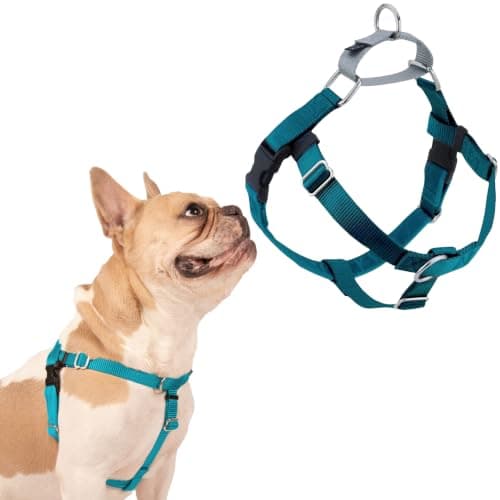
A puppy that has never been walked will pull, because pulling is what dogs do until taught otherwise. A front leash ringturns the dog’s own forward pressure into a gentle redirect to the side, which buys you the attention you need to actually train the behavior. A back ring is for a dog that already walks politely, and for anything where you want the dog to be able to pull freely.
This is the second reason the Blue-9 leads: both rings on every size, so one harness covers the learning phase and the trained phase. The Auroth also has two metal attachment points front and back, which at its price is genuinely unusual. What a front clip is not is a training method on its own — we go through what the hardware can and cannot do on whether harnesses help with pulling.
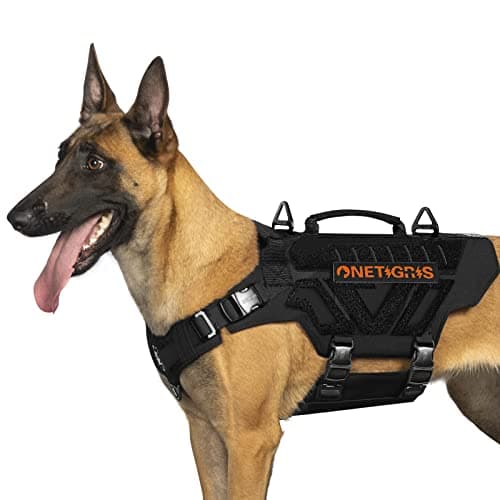
One note on the tactical-looking budget pick, because it needs saying: the MOLLE webbing and the styling on the Auroth are irrelevant to a puppy. What is not irrelevant is the hardware those vests ship with. Two metal quick-release buckles, two metal leash points and a published 900D shell, at the lowest price on this page, is a better hardware story than several harnesses that cost three times as much and publish nothing. Buy it for the buckles and ignore the aesthetic.
The picks, ranked
1. Blue-9 Balance Harness
Durability score 60/100Best for: Fit — if you can live with a brand that publishes almost nothing
The best-fitting harness here and the worst-documented — a real problem when durability is the thing you are buying.
- Material
- Washable soft-touch nylon
- Adjustment
- Six points
- Attachment
- Front and back rings
- Buckle material
- Not published
- Ring type (welded or split)
- Not published
- Load rating
- Not published
Pros
- Six points of adjustment — the most in this roundup, and the reason trainers reach for it
- Front and back attachment on every size
- Genuinely washable
Cons
- Blue-9 is the thinnest-specified brand we looked at: no buckle material, no ring type, no load rating anywhere on its product page
- Chewing is not covered by default — Blue-9 sells a $4 one-year chew warranty as an add-on
- You cannot substantiate a single durability claim about this harness from the manufacturer's own site
How we assessed it: on published materials, hardware specs and construction — not long-term chew-tested. We say so because it is true, and because a claim we cannot back is worth nothing to you.
#ad Price as of November 23, 2026; Amazon prices change often, so check before you buy. How our links work.
2. Kurgo Enhanced Strength Tru-Fit Harness
Durability score 69/100Best for: Buyers who want the longest warranty in the category
A lot of warranty and a lot of published methodology for the money — but read our crash-testing page before you rely on it as a car restraint.
- Construction
- Ripstop fabric; five points of adjustment (Amazon listing)
- Buckles
- Steel (Amazon listing)
- Denier
- Not published
- Crash testing
- Kurgo tested v3 at Calspan to FMVSS 213 (June 2018) — see the caveat below
- Warranty
- Lifetime, against manufacturing defects
Pros
- Kurgo's lifetime warranty is the longest in this hub, and it does not require registration
- Kurgo publishes its crash-test methodology in full — the facility, the standard, and the dog weights
- Five-point adjustment and a steel buckle at a genuinely low price
Cons
- Kurgo does not publish a denier for the ripstop, so the fabric cannot be compared like-for-like
- An earlier version of the Tru-Fit was crash-tested independently by the Center for Pet Safety and did not pass: CPS recorded a catastrophic failure in the small and large sizes
- Kurgo's own testing is not the same as an independent CPS certification, and this harness does not carry one
How we assessed it: on published materials, hardware specs and construction — not long-term chew-tested. We say so because it is true, and because a claim we cannot back is worth nothing to you.
#ad Price as of November 23, 2026; Amazon prices change often, so check before you buy. How our links work.
3. Ruffwear Hi & Light Harness
Durability score 62/100Best for: A minimal harness for a small dog that objects to bulk
The lightweight option, and honest about being one. Do not ask it to do the Flagline's job.
- Construction
- Minimalist webbing-led build
- Reflectivity
- Reflective trim
- Weight
- Lightest harness in Ruffwear's line
- Adjustment
- Published by Ruffwear per size
- Load rating
- Not published
Pros
- Genuinely minimal — the right answer for a small dog where a structured harness is more garment than the dog needs
- Reflective trim as standard
- Packs down to nothing, which makes it a good travel spare
Cons
- Minimal construction means less escape resistance than a three-strap design — this is not the harness for a determined reverser
- No load rating published
- Little padding, so it is not the harness for a dog that pulls hard
How we assessed it: on published materials, hardware specs and construction — not long-term chew-tested. We say so because it is true, and because a claim we cannot back is worth nothing to you.
#ad Price as of November 23, 2026; Amazon prices change often, so check before you buy. How our links work.
4. PetSafe 3 in 1 Harness
Durability score 42/100Best for: A budget harness that also does duty as a car restraint tether point
Reasonable value as a walking harness. Do not read the car-restraint function as a safety claim — it is not certified and we would not use it as one.
- Functions
- Walking harness, no-pull front clip, and car restraint attachment
- Webbing
- Nylon; denier not published
- Crash certification
- None — not CPS certified
- Hardware
- Not published
Pros
- Three functions in one at a low price, including a front clip for pulling
- Widely available in a full size run
Cons
- The car-restraint function is NOT crash certified — the Center for Pet Safety has not certified this harness, and a tether point is not a restraint
- No published webbing or hardware specification
- Two-strap construction offers less escape resistance than a three-strap design
How we assessed it: on published materials, hardware specs and construction — not long-term chew-tested. We say so because it is true, and because a claim we cannot back is worth nothing to you.
#ad Price as of November 23, 2026; Amazon prices change often, so check before you buy. How our links work.
5. Auroth Tactical Dog Harness
Durability score 56/100Best for: The default budget tactical vest, with the biggest track record
The default budget tactical vest — metal buckles and a published 900D shell for almost nothing, but out-specced on paper by the slightly dearer rabbitgoo.
- Shell
- 900D nylon oxford (Auroth's published figure)
- Buckles
- Two metal quick-release buckles
- Leash points
- Two metal attachment points — front no-pull clip and back clip
- Adjustment
- Four adjustable straps (two shoulder, two chest); MOLLE strips
- Lining
- Padded, breathable air mesh
- Load rating
- Not published
Pros
- Two metal quick-release buckles and two metal leash points, front and back, at one of the lowest prices in this roundup
- 900D nylon oxford is a published shell figure — more than several rivals will give you
- MOLLE strips and a grab handle; it is one of the most-reviewed tactical harnesses on Amazon
Cons
- 900D is a lighter shell than the rabbitgoo's published 1050D, at a similar price
- Auroth publishes no buckle alloy, no ring type and no load rating
- Sold across several near-identical rebadged listings, so confirm the seller and size before you buy
How we assessed it: on published materials, hardware specs and construction — not long-term chew-tested. We say so because it is true, and because a claim we cannot back is worth nothing to you.
#ad Price as of November 23, 2026; Amazon prices change often, so check before you buy. How our links work.
What not to buy for a puppy
- A harness sized to grow into. Slack is how dogs get out of harnesses, and the armpit chafing from a loose chest strap is the most common reason a puppy starts objecting to being harnessed at all.
- An expensive adult harness. It will be outgrown before it is worn in. Keep the budget for the harness the adult dog lives in.
- Anything sold as a car restraint without certification. Covered above. Use a crate.
- A martingale collar as a puppy’s default.Different product, same shopping trip — and the answer is on our martingale-and-puppy page.
The bottom line
Buy for adjustment range, measure girth every six weeks, and accept that you are going to buy two or three of these in the first year. The Blue-9 gets the most months out of one harness; the Auroth gets the most hardware for the least money; the Hi & Light is the right answer for a small dog that does not want to wear a structure. Then, when the dog stops growing, buy the harness properly — the best harnesses under $50 is the sensible next page, and the escape-proof roundup is the one to read if your dog turns out to be a reverser.
Frequently asked questions
What is the best dog harness for a puppy?
The Blue-9 Balance Harness, because it has six points of adjustment - more than anything else we rank - and adjustment range is the specification that decides how long a puppy harness lasts. It also carries front and back leash rings on every size, so one harness serves the learning phase and the trained phase. Its honest limits: Blue-9 is the thinnest-specified brand we looked at, publishing no buckle material, no ring type and no load rating, and chew damage is not covered by default - Blue-9 sells a one-year chew warranty separately as a paid add-on.
What size harness does a puppy need?
Measure chest girth around the deepest part of the ribcage just behind the front legs, and buy the size that fits that measurement now, at the loose end of its range. Do not size up to grow into: slack is how dogs get out of harnesses, and a loose chest strap chafes the armpit, where a puppy's skin is thinnest. You should be able to slide two fingers flat under every strap, checked at the chest as well as the neck. Re-measure every six weeks rather than waiting for the harness to look tight.
How many harnesses will a puppy go through?
Usually two or three in the first year, depending on the breed and on how far the harness adjusts. A Labrador puppy is around 16 inches of chest girth at twelve weeks and past 26 by nine months, which no single harness covers. This is why we rank on adjustment points rather than durability for this one page - the harness will stop fitting long before it wears out, and a six-point harness typically gets you through a growth stage that a four-point one does not.
Can I use a puppy harness as a car restraint?
No. The PetSafe 3 in 1 on this page advertises a car-restraint attachment, and that attachment is a tether point rather than a restraint: the Center for Pet Safety has not certified this harness and it does not appear on the CPS certified list. Only three dog harnesses have ever passed independent CPS certification, and none of them is a sensible puppy purchase, because certification is issued at a specific dog test weight and a growing puppy leaves that weight band quickly. For a puppy in a car, use a correctly sized crate or carrier.
Front clip or back clip for a puppy?
Both, which is why the harnesses with two rings lead this page. A front ring turns a pulling dog's own forward pressure into a sideways redirect, which buys you the attention needed to train the behavior - useful for a puppy that has never been walked. A back ring is for a dog that already walks politely. A front clip is not a training method on its own; it is a tool that makes training possible.
Do harness warranties cover a puppy chewing it?
Almost never, and it is worth reading the exclusion before you buy. Kurgo's lifetime warranty is the longest in this category and requires no registration, but like the rest it covers manufacturing defects rather than the dog eating the product. Ruffwear's warranty states no duration at all and explicitly excludes chewing. Blue-9 is the most transparent: chew damage is not covered by default, and it sells a separate one-year chew warranty as a low-cost add-on - which on a puppy harness is one of the better value propositions in the category.
Sources
Every spec on this page traces to one of these. Where a manufacturer does not publish a figure, we say “not published” rather than estimating it.
- Blue-9 - Balance Harness product page: six points of adjustment, front and back attachment, washable soft-touch nylon. No buckle material, no ring type and no load rating are published, and chew coverage is sold separately as a paid add-on
- Kurgo - lifetime warranty terms, covering manufacturing defects with no registration requirement. The pages for the Tru-Fit and Quantum state steel buckles and five-point adjustment but publish no denier and no hardware ratings
- Ruffwear - product pages for the Chain Reaction collar and the Hi & Light and Web Master harnesses: named hardware (ITW Nexus buckles, anodized 6061-T6 aluminum V-rings, an aluminum chain loop) and the shell deniers. Ruffwear states no warranty duration and excludes chewing damage
- Center for Pet Safety - 2013 harness crash-test study results: the independent testing that recorded a catastrophic failure of an earlier Kurgo Tru-Fit in the small and large sizes, and the reason this site never treats a manufacturer's own test as a certification
- Center for Pet Safety - the CPS Certified list: the complete, current set of certified harnesses, crates and carriers. Nothing on this page appears on it