Heavy-Duty Dog Collars for Pit Bulls
The breed's reputation sells 2-inch webbing and spiked hardware. The real problem with a short, thick, tapering neck is simpler and less marketable: a flat collar can slide straight off over the head.
The verdict
Buy a limited-slip collar, not a wider flat one. On a pit bull type the neck is often as thick as or thicker than the skull and it tapers forward, so a flat collar loose enough to be comfortable is frequently loose enough to come off over the ears — which is why the first pick here is the Ruffwear Chain Reaction: a martingale-style limited-slip collar with a metal chain control loop and an aluminum V-ring, so it tightens just enough to stop the dog reversing out and no further. For a dog that swims and rolls in filth, the Viper BioThane is the material answer and the only collar on this page with any published strength figure at all. If you want a buckle that is not plastic at the lowest sensible price, the Max and Neo MAX is it. Two things no honest page can give you: not one collar in this category publishes a load rating, and a martingale must never be left on an unsupervised or crated dog.
Quick picks
The short answer, ranked and scored against our published durability rubric. Where a manufacturer does not publish a spec, we say so rather than estimating it.
| # | Photo | Product | What the maker publishes | Durability | Price |
|---|---|---|---|---|---|
| 1 | 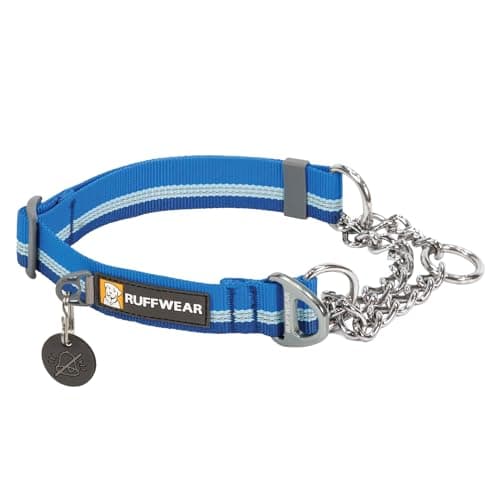 | Ruffwear Chain Reaction CollarA dog that backs out of a flat collar |
| 70/100 | $29.99 · Amazon |
| 2 | 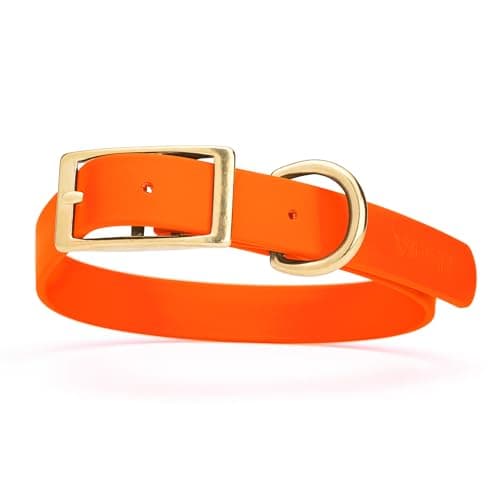 | Viper BioThane Waterproof CollarA dog that swims, rolls, and stinks up a nylon collar |
| 72/100 | $24.99 · Amazon |
| 3 | 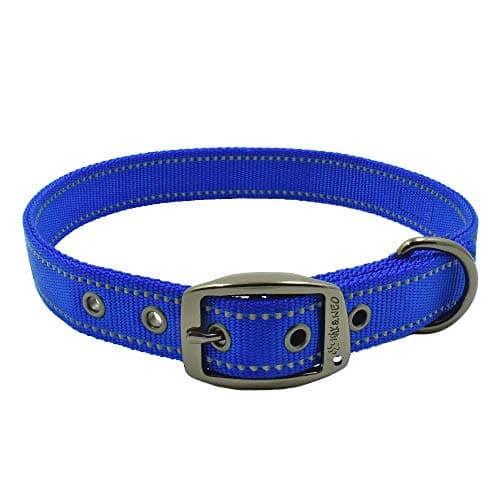 | Max and Neo MAX Reflective Metal Buckle CollarA metal-buckle nylon collar that funds a rescue |
| 61/100 | $15.99 · Amazon |
| 4 | 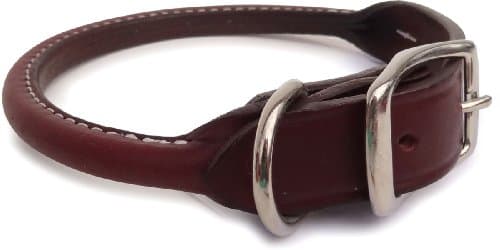 | Auburn Leathercrafters Rolled Leather CollarThe buy-it-for-life leather collar |
| 78/100 | $67.00 · Amazon |
| 5 | 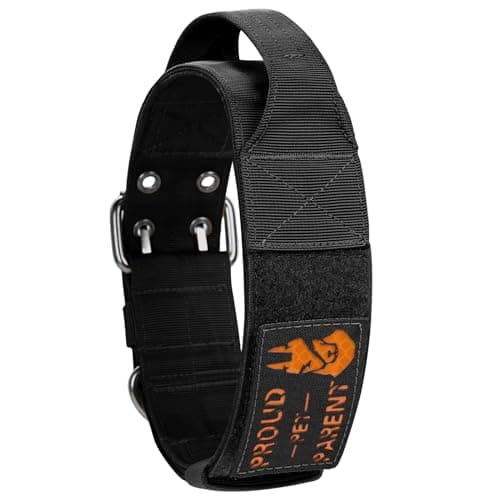 | OneTigris Tactical Dog CollarA control handle on the collar itself |
| 64/100 | $18.99 · Amazon |
Tap any row to jump to the full review. Specs are the manufacturer's own published figures; where a maker does not publish one we say "not published" rather than estimating it. Prices are pulled live from Amazon as of October 18, 2026; where we have no verified live price we show none rather than a stale number. #ad — how our links work.
The breed problem is the shape of the neck, not the strength of the dog
Search this category and you will be sold width and hardware theatre: two-inch webbing, oversized D-rings, studs. Width and strength are not the thing that fails. The thing that fails is geometry.
A pit bull type — and the same applies to a Staffordshire bull terrier, an American bully and most of the molosser-influenced builds — carries a neck that is short, thick and muscled, often measuring as large around as the head, and it tapers forwardrather than flaring behind the skull the way a Shepherd’s does. A flat buckle collar relies entirely on the head being wider than the neck. When it is not, the collar has two settings: tight enough to stay on, or comfortable. You cannot have both, and the dog finds that out the first time it braces, drops its chin and backs up hard.
That single fact reorders the whole spec sheet. Escape resistance comes first, hardware material second, webbing width a distant third. It is also why the breed-cut answer here is genuinely different from the one on our German Shepherd collar page, where a pronounced occiput does most of the retention work for you and the ranking can lead on material instead.
What a limited-slip collar does, and what it is not
A martingale or limited-slip collar is two loops: a main loop that sits on the neck and a smaller control loop that the leash clips to. Pull on the leash and the control loop draws the main loop closed to a stop— sized correctly, that stop is snug, not choking. Release the leash and it opens again. The dog cannot reverse out of it under tension, and it is not a slip lead and not a choke chain: a correctly fitted martingale has a hard mechanical limit built into its length.
Two rules come with it, and both are absolute:
- Never leave a martingale on an unsupervised dog.The control loop is a snag hazard on a crate bar, a fence, a branch or another dog’s jaw. Off-leash at home, the dog wears a flat collar with its ID, or nothing.
- Fit it to the stop, not to the slack.Closed, the main loop should be snug on the neck — not tight. If a closed martingale still lets you slide a flat hand under the webbing, it is too long and it will come off.
Hardware is where the money goes, and nobody publishes a number
Here is the finding that governs this entire page: not one collar in our registry publishes a load rating.Not Ruffwear, not Max and Neo, not OneTigris — which is notable, because OneTigris does publish rated hardware on its X-Armor harness and declines to do it on its collars. Any page that ranks collars by strength for a strong breed is ranking on an invented number.
What you can judge is material, and the BioThane data sheet makes the point better than any marketing copy. Standard 1-inch Beta 520 webbing carries a published break strength of 1,000 lb. The published buckle pull strength on the same material spec is 200 lb. The strap is five times stronger than the thing holding it shut. BioThane also states plainly that the tensile strength comes from the polyester core, not from the coating — so a thicker, glossier coating buys you waterproofing and nothing else.
Carry that forward and the shopping rule writes itself: the buckle is the failure point, so get off plastic. That is the entire argument for the Max and Neo at its price, and it is why a traditional leather buckle-and-tongue closure — no spring, no plastic tab, nothing to crack in the cold — remains a defensible choice on a dog that pulls hard.
Why the two-inch collar is often the wrong purchase
| Width | What it actually buys | The cost on a short neck |
|---|---|---|
| 3/4–1 in | Lightest; fits a rolled or limited-slip design cleanly | Concentrates load on a narrow band |
| 1–1.5 in | The practical range: spreads load, still articulates | None worth worrying about |
| 2 in | Looks substantial; carries a handle well | Eats most of a short neck, rides up under the jaw, and the stiff panel can lever the collar forward when the dog braces |
On a dog with four or five inches of neck between shoulder and jaw, a two-inch collar is not a stronger collar, it is a shorter neck. It still has a real use — a two-inch panel is what lets a collar carry an integrated control handle, which is a genuinely useful thing to have on a reactive dog in a tight spot — but buy it for the handle, not for the number.
The case for rolled leather, and the one spec that decides it
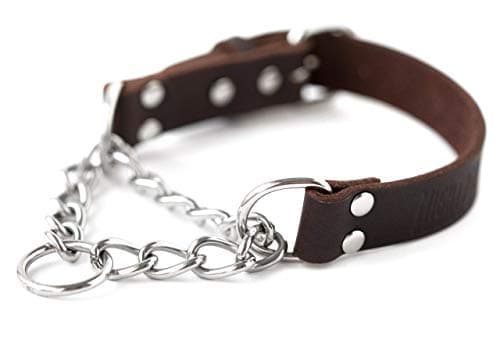
A rolled collar is a cylinder of leather rather than a flat strap. On short-coated dogs the practical argument for rolled construction — that it does not mat the coat — matters less than it does on a retriever, but the material argument still stands: leather softens and conforms to the dog over years instead of degrading, and a buckle-and-tongue closure has no plastic in the load path.
The spec that decides a leather collar is the grade, and almost nobody publishes it. Auburn Leathercrafters names full-grain bridle leather, states its hardware (bright nickel-plated buckle and dee, smooth capped rivets), describes its edge work and tells you where it is made. Soft Touch and Mendota both make good collars and neither will state a grade on the listing. We cover why that single word carries so much weight in the collar materials guide, and the trade-off against synthetics in leather against nylon. Auburn’s honest limitation: nickel plating wears through eventually, and it publishes no break strength either.
What to look for, in order
- A closure the dog cannot reverse out of. On this build, limited-slip first. Everything else is secondary.
- A buckle that is not plastic. Metal buckle, or leather buckle-and-tongue. The published BioThane figures tell you exactly where the load path is weakest.
- Stainless or solid metal rings, welded rather than split. A split ring opens under a sideways load; it is the cheapest part of a collar and the one that fails.
- 1 to 1.5 inches of width. Wider only if you specifically want a handle.
- A material that matches the dog’s life. Coated webbing for a swimmer, named-grade leather for a dry-land dog, nylon for a budget.
- No weight placed on any strength claim.Nobody publishes one. Treat “heavy duty” as a product name.
The picks, ranked
1. Ruffwear Chain Reaction Collar
Durability score 70/100Best for: A dog that backs out of a flat collar
The right answer for a dog that slips its collar, with the standard martingale caveat: not for unsupervised wear.
- Design
- Martingale-style limited-slip with a chain control loop (Amazon listing)
- Hardware
- Metal chain loop, aluminum V-ring
- Load rating
- Not published
Pros
- The limited-slip loop tightens just enough to stop a dog reversing out of it
- Metal control loop instead of a fabric one
Cons
- A martingale must never be left on an unsupervised dog — the loop is a snag hazard
- No published load rating
How we assessed it: on published materials, hardware specs and construction — not long-term chew-tested. We say so because it is true, and because a claim we cannot back is worth nothing to you.
#ad Price as of October 18, 2026; Amazon prices change often, so check before you buy. How our links work.
2. Viper BioThane Waterproof Collar
Durability score 72/100Best for: A dog that swims, rolls, and stinks up a nylon collar
The right collar for a dog that lives in water and filth — just understand that the 1,000 lb number belongs to the strap, not to the buckle holding it shut.
- Material
- Coated webbing: polyester core with a TPU or PVC coating
- Core break strength
- BioThane Beta 520 PET, 1 in standard: 1,000 lb (material maker's published figure)
- Buckle pull strength
- 200 lb on the same material spec — the hardware, not the strap, is the limit
- Cleaning
- Soap and water; disinfects with 10% bleach solution
Pros
- Genuinely waterproof and, per BioThane's own FAQ, stinkproof — the reason working and hunting owners buy it
- The polyester core carries a published 1,000 lb break strength in the standard 1 in profile
- Wipes clean; no absorbed mud, lake water or dead-thing smell
- Stays flexible in cold weather
Cons
- The coating adds no strength at all — BioThane says plainly that the tensile strength comes from the polyester webbing inside
- The material spec puts buckle pull strength at 200 lb, five times lower than the webbing. The buckle is the failure point, and Viper does not publish theirs
- Stiffer than nylon and it can feel slick
How we assessed it: on published materials, hardware specs and construction — not long-term chew-tested. We say so because it is true, and because a claim we cannot back is worth nothing to you.
#ad Price as of October 18, 2026; Amazon prices change often, so check before you buy. How our links work.
3. Max and Neo MAX Reflective Metal Buckle Collar
Durability score 61/100Best for: A metal-buckle nylon collar that funds a rescue
The cheapest honest way to get off plastic buckles.
- Buckle
- Metal (Amazon listing)
- Webbing
- Nylon, reflective stitching (Amazon listing)
- Load rating
- Not published
Pros
- A metal buckle at a price where almost everything is plastic
- Max and Neo donates a collar to a rescue for each one sold
Cons
- No published load rating or webbing spec
- Reflective stitching, not reflective webbing
How we assessed it: on published materials, hardware specs and construction — not long-term chew-tested. We say so because it is true, and because a claim we cannot back is worth nothing to you.
#ad Price as of October 18, 2026; Amazon prices change often, so check before you buy. How our links work.
4. Auburn Leathercrafters Rolled Leather Collar
Durability score 78/100Best for: The buy-it-for-life leather collar
The one collar here that names its leather grade, and that alone puts it ahead of every unlabeled 'genuine leather' collar on the market.
- Leather
- Full-grain bridle leather
- Hardware
- Bright nickel-plated buckle and dee ring; smooth capped rivets
- Construction
- Beveled and hand-polished edges; extended D-end pattern on large sizes
- Sizes
- 10–34 in; widths 1/2 to 1-1/4 in
- Made in
- Central New York State, USA
Pros
- Full-grain bridle leather — the top of the grade hierarchy, and Auburn names it, which almost no collar seller does
- Rolled construction resists matting the coat on long-haired dogs
- Capped rivets and beveled edges are real construction detail, not marketing
Cons
- Nickel-plated hardware, not solid stainless — plating wears through eventually
- No published break strength
- Sold in single-collar quantities at a real premium over mass-market nylon
How we assessed it: on published materials, hardware specs and construction — not long-term chew-tested. We say so because it is true, and because a claim we cannot back is worth nothing to you.
#ad Price as of October 18, 2026; Amazon prices change often, so check before you buy. How our links work.
5. OneTigris Tactical Dog Collar
Durability score 64/100Best for: A control handle on the collar itself
A genuinely useful control handle; just note the published-spec discipline OneTigris shows elsewhere does not extend to this one.
- Design
- Padded collar with an integrated control handle (Amazon listing)
- Width
- 2 in, stated in the listing title — the only dimension OneTigris publishes for it
- Denier
- Not published for this model
- Load rating
- Not published for this model
Pros
- The handle gives you immediate close control without reaching for the leash
- Heavier webbing than a typical flat collar
Cons
- OneTigris publishes load ratings on its X-Armor harness but not on this collar
- The handle adds bulk that some dogs will not tolerate
How we assessed it: on published materials, hardware specs and construction — not long-term chew-tested. We say so because it is true, and because a claim we cannot back is worth nothing to you.
#ad Price as of October 18, 2026; Amazon prices change often, so check before you buy. How our links work.
A collar is not the answer to pulling
Worth saying plainly, because this query is often really about control. A collar’s job is identification and attachment. If the actual problem is a 70 lb dog dragging you down the street, the equipment answer is a harness and the rest of the answer is training — and on this build a harness also removes the escape geometry entirely. Start with the escape-proof harnesses and the no-pull harnesses, and read whether harnesses actually help with pulling before you spend anything. For the leash half of the same job, we have a dedicated breed cut: heavy-duty leashes for pit bulls.
The bottom line
Buy for the shape of the neck, not for the reputation of the breed. A limited-slip collar in the one-to-one-and-a-half-inch range, with metal hardware and welded rings, fitted so the closed loop is snug rather than slack, solves the only failure mode that actually happens. Take the collar off when the dog is crated or unsupervised, and put a flat ID collar on instead. Spend the money you did not spend on two-inch webbing on a harness.
Frequently asked questions
What is the best heavy-duty collar for a pit bull?
A limited-slip (martingale-style) collar rather than a wider flat one, because on a short, thick, forward-tapering neck the failure mode is the collar coming off over the head, not the webbing breaking. Our first pick is the Ruffwear Chain Reaction: a metal chain control loop and an aluminum V-ring, so it closes to a stop and the dog cannot reverse out of it. For a dog that swims, the Viper BioThane collar is the material answer and the only collar here with any published strength figure. Note two limits honestly: no collar in this category publishes a load rating, and a martingale must never be left on an unsupervised or crated dog.
How wide should a pit bull's collar be?
One to one and a half inches for almost every dog of this build. A two-inch collar is marketed as stronger, but width is not what fails, and on a dog with only four or five inches between shoulder and jaw a two-inch panel eats most of the neck, rides up under the jaw and can lever forward when the dog braces. The one genuine reason to buy two inches is an integrated control handle, which needs the width to sit flat - buy it for the handle, not for the implied strength.
Can a pit bull slip out of a collar?
Yes, and it is the most common equipment failure on this build. The neck is often as thick as the skull and tapers forward, so a flat collar set loose enough to be comfortable can pass over the ears when the dog drops its chin and reverses. A limited-slip collar closes to a mechanical stop under leash tension and removes that escape route. Fit is what makes it work: closed, the loop should be snug on the neck, and if you can still slide a flat hand under the webbing it is too long.
Are spiked or studded collars better for strong dogs?
No. Studs and spikes add weight and cost and change nothing about the two things that actually decide a collar: whether the dog can get out of it and what the buckle is made of. They also create snag points. If you want visible deterrence that is your choice to make, but understand you are buying appearance - none of the studded collars we have assessed publishes a load rating any more than the plain ones do.
Is a martingale collar cruel?
A correctly sized martingale is not a choke collar. It has a hard mechanical limit built into the length of its control loop: it closes to a stop that should be snug, then stops, and it opens again as soon as leash tension comes off. That is a different device from a slip lead or a choke chain, which have no limit. The real hazard is not the tightening, it is the control loop as a snag point - which is why it comes off the moment the dog is crated, left alone or playing with another dog.
What should the collar hardware be made of?
Metal, and welded rather than split. BioThane's published material data makes the reasoning concrete: standard 1 in Beta 520 webbing breaks at 1,000 lb while buckle pull strength on the same spec is 200 lb, so the hardware is the limit by a factor of five - and the coating contributes no strength at all. In practice that means a metal buckle (the Max and Neo is the cheapest honest route off plastic), a leather buckle-and-tongue, or a chain control loop. A split ring is the single cheapest part of any collar and it opens under a sideways load.
Sources
Every spec on this page traces to one of these. Where a manufacturer does not publish a figure, we say “not published” rather than estimating it.
- BioThane — Beta 520 PET material data: the 1,000 lb break strength for standard 1 in webbing, the 200 lb buckle pull strength, and the statement that tensile strength comes from the polyester core rather than the coating
- Auburn Leathercrafters — rolled collar product page: full-grain bridle leather, bright nickel-plated buckle and dee, capped rivets, 10-34 in sizes, made in Central New York
- Ruffwear — warranty terms: defects in materials and craftsmanship; chewing, normal wear and alterations excluded