What Size Crate Does My Dog Need?
Stand up, turn around, lie down. That is the rule, it takes two measurements, and there is exactly one situation in which following it is dangerous.
The rule is that a dog must be able to stand up fully without its head touching the top, turn around completely, and lie down stretched out on its side. Everything else is detail.
The detail is worth having, though, because two of the four measurements people take are the wrong ones, and there is one situation — the car — where following this rule will get a dog hurt.
The two measurements that matter
Length: nose to base of tail, plus 2–4 inches
Measure from the tip of the nose to the base of the tail, not to the end of it. The tail is not load-bearing and sizing to it produces a crate several inches too long.
Add two to four inches. Enough to lie stretched out; not so much that the dog can use one end as a bathroom and the other as a bed, which is the specific failure mode an oversized crate produces in a puppy.
Height: floor to top of head when SITTING, plus 2–4 inches
This is the measurement people skip, and it is the one that decides whether the crate is actually big enough.
Measure the dog sitting, floor to the top of the skull — not shoulder height, which is what most owners reach for. A dog is considerably taller sitting than standing at the shoulder, and a crate sized to shoulder height is a crate the dog cannot sit up in.
For breeds with erect ears, measure to the ear tips. Airline container requirements are explicit about ears not touching the top, and it is a sound standard at home too.
Measure the crate internally, not externally
Crate dimensions are usually quoted externally. Frame thickness, door hardware and — on furniture crates especially — panel thickness all eat into the internal space, and the difference can be two inches per side.
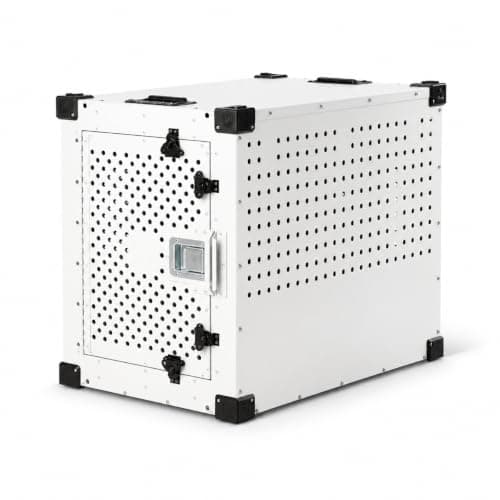
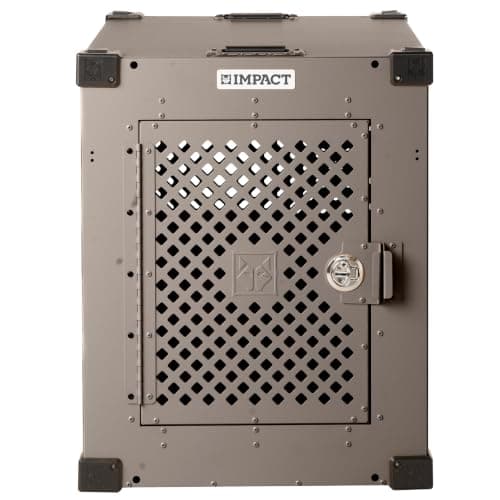
On a heavy-duty aluminum crate, the internal loss is significant. On a wooden crate table it is larger still. Ask for internal dimensions if they are not published, and if you are putting a cot inside the crate, subtract its height from your headroom too.
The puppy problem, and the divider
A puppy will outgrow three crate sizes. Buying three crates is wasteful; buying the adult size immediately gives a puppy a bathroom at one end.
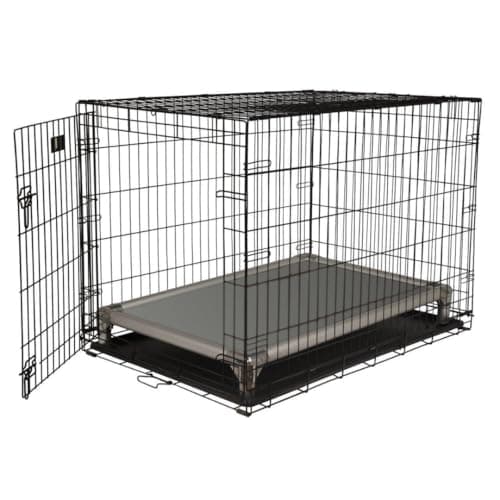
The standard answer is a divider panel: buy the adult-size crate and partition it down to the puppy’s current requirement, moving the divider as the dog grows. Most wire crates ship with one. Almost no heavy-duty aluminum crate does, which is one of several reasons not to buy a heavy-duty crate for a puppy.
Size the partitioned space to the same rule — stand, turn, lie down — at the puppy’s current size, and move it every few weeks rather than every few months.
Where the rule is wrong: the car
This is the exception that matters, and it is the opposite of everything above.
In a vehicle, spare room is a hazard. A dog with space to move inside a crate during an impact is a dog that accelerates inside that crate before hitting the wall of it. Crash-tested crates are certified with a dog of a specific weight in a specific crate size, and the fit is part of the certification rather than incidental to it.
So a home crate is sized generously and a car crate is sized snugly, and they are frequently not the same crate. Our crash-tested crate roundup covers what has actually been certified and at what dog weight, and what certification actually covers explains why the pairing is specific.
The third case is the airplane, where the rule runs the other way again — an undersized container is refused at the counter. That is covered in airline dog crate requirements.
Why bigger is not kinder
Owners consistently buy up a size out of sympathy, and it is worth explaining why that rarely helps.
- House-training relies on the dog not wanting to soil where it sleeps. Give a puppy two rooms and it will use one of them, and the training advantage of the crate disappears.
- A den is meant to feel enclosed. The reason crates work for many dogs is that a snug, covered space is where a dog chooses to sleep given the option. A cavernous crate is a room with bars.
- Bigger crates flex more. On a wire crate, a longer unsupported span is a weaker panel, which matters for a dog that leans on the door.
If the goal is space for the dog to move, the answer is time out of the crate rather than a bigger crate.
When the measurement is bigger than the market
There is one case where measuring correctly does not settle the question, and it catches giant-breed owners out: the number you arrive at is larger than anything the premium crate makers build. Above roughly 48 in the market thins dramatically, and the size letter is no help at all — one well-regarded aluminum maker’s largest crate is listed for dogs of 41 to 65 lb, and another brand’s “X-Large” has a published 38.75 in interior.
If your measurement lands past 48 in, work from the best dog crates for large dogs, which sets out what each maker’s published ceiling actually is rather than what the label says.
Quick reference
Rather than reproduce a manufacturer’s breed chart — every maker’s sizes differ and breed averages are a poor guide to an individual dog — here is the process:
- Measure nose to base of tail. Add 2–4 in. That is your minimum length.
- Measure floor to top of head, sitting. Add 2–4 in. That is your minimum height.
- Find the crate whose internal dimensions clear both.
- If it is for a puppy, buy the adult size and use a divider.
- If it is for the car, ignore all of this and buy a certified crate at the certified size.
Five steps, one tape measure, no guessing — which is the whole point.
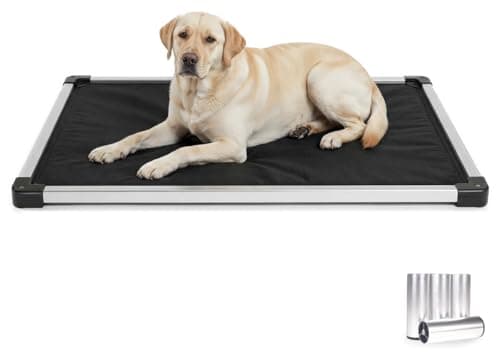
One step people take in the wrong order. Size the crate to the dog first, as above, and only then choose a bed for what is left — because bed depth is spent out of the same headroom budget, and a crate the dog could stand up in empty is not necessarily one it can stand up in with a mattress on the floor. The measuring sequence is on will a dog bed fit in a crate.
Frequently asked questions
What size crate does my dog need?
One in which the dog can stand up fully without its head touching the top, turn around completely, and lie down stretched out on its side. Practically: measure nose to base of tail and add 2–4 inches for the length, and measure floor to the top of the head while the dog is SITTING and add 2–4 inches for the height. Then check those against the crate's internal dimensions, not its external ones.
Should I measure my dog standing or sitting for a crate?
Sitting, floor to the top of the skull — and to the ear tips on a breed with erect ears. This is the measurement owners most often skip, usually substituting shoulder height, which is much lower. A dog is considerably taller sitting than it is at the shoulder, and a crate sized to shoulder height is a crate the dog cannot sit up in.
Is a bigger crate better for a dog?
No, and buying up a size out of sympathy usually backfires. House-training works because a dog does not want to soil where it sleeps; give a puppy two rooms and it will use one of them as a bathroom. A den is also meant to feel enclosed — a cavernous crate is a room with bars rather than the snug space dogs choose to sleep in. If the dog needs more space, the answer is more time out of the crate.
What size crate does a puppy need?
Buy the adult size and use a divider panel to partition it down to the puppy's current requirement, moving the divider every few weeks as the dog grows. Size the partitioned space by the same stand-turn-lie-down rule at the puppy's current size. Most wire crates include a divider; almost no heavy-duty aluminum crate does, which is one of several reasons not to buy one for a puppy.
Should a car crate be the same size as a home crate?
No — the rule reverses. In a vehicle, spare room is a hazard: a dog with space to move inside a crate during an impact accelerates before hitting the wall of it. Crash-tested crates are certified with a dog of a specific weight in a specific crate size, and the fit is part of the certification. A home crate is sized generously and a car crate snugly, and they are frequently not the same crate.
Why do crate dimensions not match what I measured?
Because crate dimensions are almost always quoted externally. Frame thickness, door hardware and panel thickness all eat into the usable space, and the difference can be two inches per side — more on furniture crates, where panel thickness is substantial. Ask for internal dimensions if they are not published, and if you are putting a cot inside the crate, subtract its height from your headroom as well.
Sources
Every spec on this page traces to one of these. Where a manufacturer does not publish a figure, we say “not published” rather than estimating it.