The Best Dog Lifting and Support Harnesses
You are lifting a wet, frightened, 80 lb dog on a handle whose strength nobody will state. That is the honest condition of this entire category.
Buy the Help ‘Em Up harness if your dog needs help every day. It is the only product here that supports front and rear independently, and the only one designed to be left on all day rather than fitted for each lift — which matters enormously when the dog needs assistance six times between breakfast and bed.
Buy the GingerLead for a recovery period, and the Ruffwear Web Master if what you need is occasional assistance over an obstacle rather than sustained support.
Nobody publishes a lift rating. Anywhere.
We looked, on every product in this roundup and several that are not, for a stated load the handle or the harness is rated to lift. There is not one.
Ruffwear sells the Web Master specifically as the harness for lifting a dog over terrain and publishes no lift rating for the handle. The Flagline has a load-dispersing chest and belly panel and no rating. The specialist mobility harnesses, built by companies that make nothing else, do not publish one either.
Compare that with any adjacent industry. A climbing sling is rated in kilonewtons. A lifting strap in a hardware catalog has a working load limit printed on the label. Even a three-dollar hardware-store bolt snap carries a published figure. The one product category where the load is a frightened animal and the consequence of failure is a fall is the category that has decided ratings are optional.
We cannot fix that. What we can do is refuse to invent a number, and score these on what is actually verifiable: where the support sits, how the load is spread, and whether the thing can realistically be worn all day.
Support geometry is the real differentiator
There are three distinct designs here and they solve different problems.
Rear-only sling (GingerLead): a padded band under the belly, forward of the hind legs, with a handle. It addresses hind-end weakness — the most common presentation, in hip dysplasia, degenerative myelopathy and post-operative cruciate recovery. It does nothing for a dog whose front end is also failing.
Full-body single piece (PetSafe CareLift, Ruffwear Web Master): one harness with handles fore and aft. Simpler to fit, and a compromise — a single structure cannot be optimized for both ends.
Two-piece front and rear (Help ‘Em Up): a shoulder harness and a separate hip lift, worn together. Each is positioned for its own job, and either can be used alone. It is the most capable arrangement here and it takes the most learning to fit.
Why all-day wear is the specification that matters most
This is the point owners understand only after a few weeks, so it is worth putting up front.
A dog with real mobility loss does not need lifting once. It needs help getting up from a nap, out of the door, off a step, into the car, back out, and up again after dinner. If the harness has to be fitted each time, the reality is that it will not be — you will lift the dog by the scruff and the belly, badly, because the harness is in the other room.
The Help ‘Em Up is designed to stay on. That is not a comfort feature; it is what makes the equipment actually get used, and it is the reason it wins this roundup despite being the most expensive and the fiddliest to fit.
Quick picks
The short answer, ranked and scored against our published durability rubric. Where a manufacturer does not publish a spec, we say so rather than estimating it.
| # | Photo | Product | Durability | Price |
|---|---|---|---|---|
| 1 | 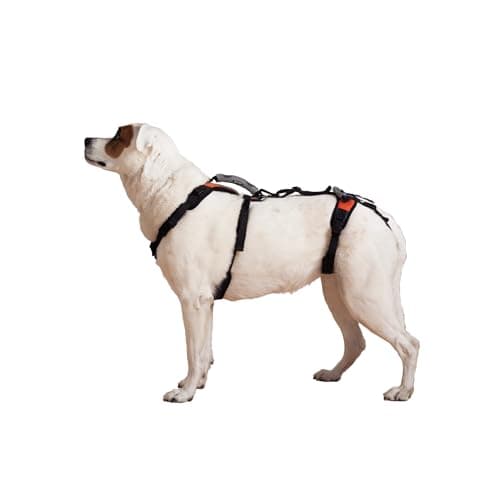 | Help Em Up Help 'Em Up HarnessA dog that needs support at both ends, worn all day | 79/100 | $125.00 · Amazon |
| 2 | 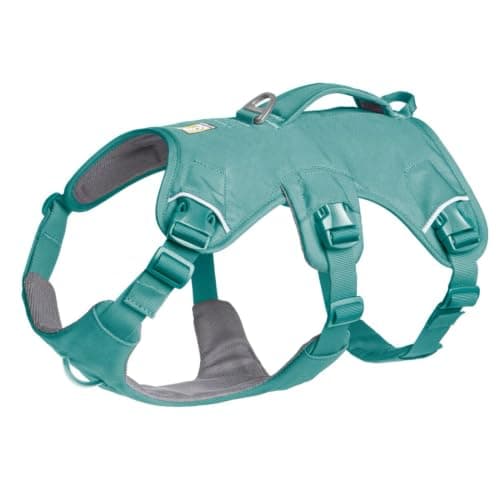 | Ruffwear Web Master HarnessLifting and controlling a dog over real terrain | 77/100 | $79.99 · Amazon |
| 3 | 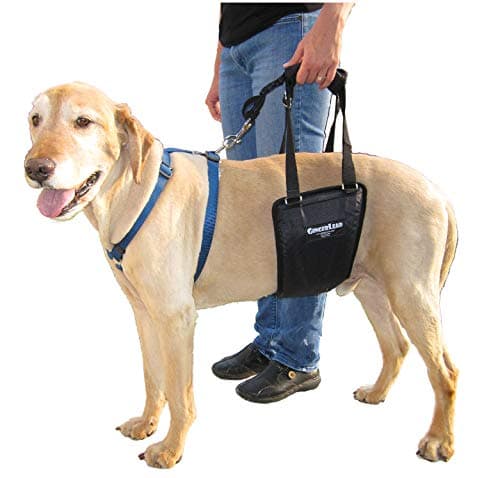 | GingerLead Dog Support SlingPost-operative and short-term rear-end support | 67/100 | $69.95 · Amazon |
| 4 | 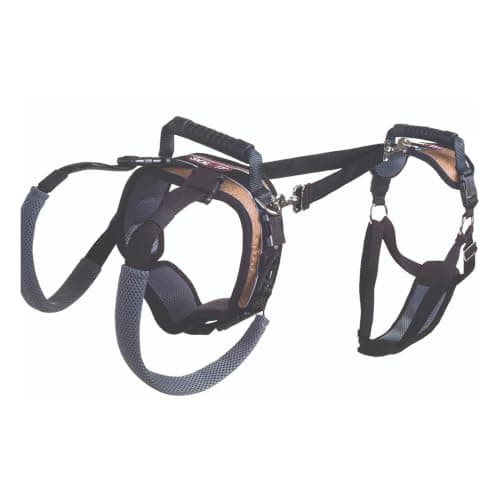 | PetSafe CareLift Support HarnessFull-body support at the lowest price here | 59/100 | $59.99 · Amazon |
Tap any row to jump to the full review. Prices are pulled live from Amazon as of October 18, 2026; where we have no verified live price we show none rather than a stale number. #ad — how our links work.
The picks, ranked
1. Help Em Up Help 'Em Up Harness
Durability score 79/100Best for: A dog that needs support at both ends, worn all day
The serious mobility-support harness, and the one to buy if the dog needs help every day rather than occasionally.
- Format
- Two-piece — shoulder harness and hip lift, worn together
- Handles
- Handles at both shoulder and hip
- All-day wear
- Designed to be left on, per the manufacturer
- Lift load rating
- Not published
- Sizing
- Published by measurement, per the manufacturer
Pros
- The only harness here that supports front and rear independently, which is what a dog with hind-end weakness actually needs
- Designed to be worn all day rather than fitted for each lift — which matters enormously when the dog needs help six times a day
- Handles positioned so a handler can lift without bending over the dog
Cons
- No published lift load rating, on a product whose entire purpose is lifting
- Two-piece system takes learning to fit correctly
- Expensive, and the sizing is unforgiving — measure carefully
How we assessed it: on published materials, hardware specs and construction — not long-term chew-tested. We say so because it is true, and because a claim we cannot back is worth nothing to you.
#ad Price as of October 18, 2026; Amazon prices change often, so check before you buy. How our links work.
2. Ruffwear Web Master Harness
Durability score 77/100Best for: Lifting and controlling a dog over real terrain
Buy it for the three-point structure and the handle — not for the shell, which is thinner than the harness Ruffwear sells for twenty dollars less.
- Shell
- 150D polyester ripstop, PU coating (40% recycled)
- Padding
- Closed-cell foam
- Webbing
- Polypropylene
- Buckles
- ITW Nexus Airloc
- Rear attachment
- Anodized 6061-T6 aluminum V-ring
- Sizes
- XXS–L/XL, 13–42 in girth
- Handle lift rating
- Not published
Pros
- Five points of adjustment and a three-strap design that is genuinely hard for a dog to reverse out of
- Named hardware — ITW Nexus buckles and an anodized 6061-T6 aluminum V-ring, not a generic stamped D-ring
- Reinforced handle makes it the tool of choice for lifting a dog over an obstacle
Cons
- The shell is 150D — literally half the denier of the cheaper Front Range's 300D. You are paying for structure, not fabric
- Ruffwear publishes no lift rating for the handle, on a harness sold specifically for lifting dogs
- Polypropylene webbing is less abrasion-resistant than the polyester Ruffwear uses on the Front Range
How we assessed it: on published materials, hardware specs and construction — not long-term chew-tested. We say so because it is true, and because a claim we cannot back is worth nothing to you.
#ad Price as of October 18, 2026; Amazon prices change often, so check before you buy. How our links work.
3. GingerLead Dog Support Sling
Durability score 67/100Best for: Post-operative and short-term rear-end support
The right tool for a recovery period. For a permanent condition, the two-piece Help 'Em Up is the better long-term answer.
- Format
- Padded sling with an integrated leash
- Support
- Rear end only, unless paired with a front harness
- Integrated leash
- Yes — one hand holds the sling and the leash together
- Lift load rating
- Not published
Pros
- The integrated leash is the design detail that makes it usable single-handed, which matters when the other hand is opening a door
- Padded belly band spreads load better than a towel, which is what it usually replaces
- Straightforward to fit — this is the sling a vet clinic hands you after surgery
Cons
- Rear support only, so it does nothing for a dog whose front end is also failing
- Not designed to be worn all day
- No published load rating
How we assessed it: on published materials, hardware specs and construction — not long-term chew-tested. We say so because it is true, and because a claim we cannot back is worth nothing to you.
#ad Price as of October 18, 2026; Amazon prices change often, so check before you buy. How our links work.
4. PetSafe CareLift Support Harness
Durability score 59/100Best for: Full-body support at the lowest price here
The accessible full-body option. Good value; less refined than the harnesses built by companies that only make mobility gear.
- Format
- Full-body support harness with handles
- Support
- Front and rear
- Padding
- Padded straps
- Lift load rating
- Not published
Pros
- Full-body support at roughly half the price of the specialist harnesses
- Widely available, which matters when you need it this week rather than next month
Cons
- Not intended for all-day wear the way the Help 'Em Up is
- No published load rating
- Less adjustment than the specialist products, so fit on an unusual body shape is harder
How we assessed it: on published materials, hardware specs and construction — not long-term chew-tested. We say so because it is true, and because a claim we cannot back is worth nothing to you.
#ad Price as of October 18, 2026; Amazon prices change often, so check before you buy. How our links work.
Lifting technique, which is not gear advice but matters more
We are not veterinarians and this is not rehabilitation advice — ask your vet, who knows your dog’s diagnosis. From a purely mechanical standpoint, though, three things are true of any lift:
- Support, do not suspend. The goal is to take weight off the affected limbs while the dog walks on the others, not to carry the dog. A dog held clear of the ground panics and thrashes, which is where handlers get hurt.
- Lift with your legs and keep the dog close. Reaching out over a dog and lifting with a bent back is how owners end up needing their own physiotherapy.
- Move at the dog’s pace. A dog that is unstable is also frightened, and a fast lift makes it worse. Slow is faster.
Inspecting a harness you are trusting with a fall
Because there is no rating, inspection is doing the job a specification would otherwise do. Check before every lift, in the two seconds it takes:
- Handle stitching. Any pulled thread, any puckering where the handle meets the body, and the harness is finished. This is the single highest-consequence component.
- Buckle closure. It must click positively. A buckle that opens under load on a mobility harness drops a dog that cannot catch itself.
- Webbing at the load points. Fuzz concentrated in one band, rather than spread along a strap, is a strap being sawn.
- The dog’s skin underneath. All-day wear means all-day pressure. Check daily for rubbed patches, and be prepared to adjust the fit as the dog’s muscle mass changes — which it will.
That inspection routine is the same one we set out in when to replace a harness, applied with more urgency because the consequence is different.
The rest of the picture
A support harness is one part of managing a dog with mobility loss. Two others sit next to it and are worth solving at the same time.
Getting into the car. A ramp removes the lift entirely, and a lift you do not have to do is better than a lift done well — see our ramp roundup, and note the advice there to teach the ramp before the dog needs it.
What it is lying on. A dog that struggles to stand struggles most from a soft, low, unsupportive bed. Firm and higher is easier to rise from, which we cover in the orthopedic bed roundup.
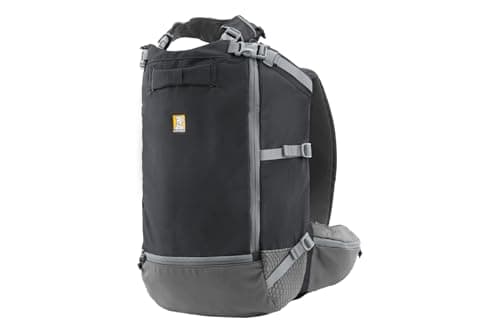
When lifting is no longer enough. A support harness keeps the dog on its own feet, which is the goal for as long as it is realistic. For the days it is not - a small dog that cannot manage the distance, or a dog that has to be carried out of somewhere - the tools are a carrier pack or an emergency sling, ranked in the dog carrier backpacks roundup.
One harness deserves a direct word here because it is so often bought for this job by mistake. The Ruffwear Web Master has a reinforced handle and Ruffwear’s own page advertises “balanced lifting” — and Ruffwear publishes no lift rating for it whatsoever. That gap, and where the harness genuinely does earn its place, is the subject of our Ruffwear Web Master review.
Frequently asked questions
What is the best lifting harness for a dog?
The Help 'Em Up harness, for a dog that needs help every day. It is the only product in the category that supports the front and rear independently — a shoulder harness and a separate hip lift worn together — and the only one designed to be left on all day rather than fitted for each lift. That last point is what makes the equipment actually get used.
How much weight can a dog lifting harness hold?
No manufacturer publishes a figure. We checked every product in this roundup and several outside it, including harnesses sold specifically for lifting dogs, and not one states a load rating for the handle or the harness. A climbing sling is rated in kilonewtons and a hardware-store lifting strap has a working load limit on the label; this category has decided ratings are optional. We are not going to invent one.
Is a rear sling or a full-body harness better?
It depends on which end is failing. A rear-only sling addresses hind-end weakness — hip dysplasia, degenerative myelopathy, post-operative cruciate recovery — and does nothing for a dog whose front end is also going. A full-body harness handles both but compromises on each. A two-piece front-and-rear system is the most capable arrangement and takes the most learning to fit correctly.
Can a dog wear a support harness all day?
Some are designed for it and most are not, and it is the specification that matters most in practice. A dog with real mobility loss needs help getting up from naps, out of doors, off steps and into cars — many times a day. If the harness has to be fitted each time, it will not be, and you will lift the dog badly by the scruff and belly instead. Check the skin underneath daily and re-fit as the dog's muscle mass changes.
How should I lift a dog with a support harness?
Support rather than suspend — the goal is to take weight off the affected limbs while the dog walks on the others, not to carry it clear of the ground, because a suspended dog panics and thrashes. Lift with your legs and keep the dog close to your body rather than reaching out over it. And move at the dog's pace: an unstable dog is a frightened one, and a fast lift makes that worse. Ask your vet about your dog's specific diagnosis; we review gear rather than practice medicine.
How do I know when a lifting harness needs replacing?
Because there is no published rating, inspection does the job a specification otherwise would. Check the handle stitching before every lift — any pulled thread or puckering where the handle meets the body means it is finished, and it is the highest-consequence component. Check that buckles close positively, and look for fuzz concentrated in one narrow band on the webbing rather than spread along a strap, which indicates a strap being sawn by a buckle edge.
Sources
Every spec on this page traces to one of these. Where a manufacturer does not publish a figure, we say “not published” rather than estimating it.
- Help 'Em Up — harness product and sizing information
- GingerLead — dog support sling product information
- Ruffwear — Web Master harness specs (no lift rating published for the handle)
- Ruffwear — warranty terms (chewing excluded; no duration stated)
- Ridgway (2026) — “Health implications of dog-worn equipment: a review of known and alleged physical risks”, Frontiers in Veterinary Science 13:1711781