Crates and Separation Anxiety
We sell crates. So it matters that we say this clearly: a stronger crate is the right answer to some problems and completely the wrong answer to this one.
This page exists because of a commercial conflict we would rather name than hide. Our escape-proof crate roundup is one of the most valuable pages on this site, and the most common reason someone reads it is a dog that breaks out of crates. For a meaningful share of those readers, a stronger crate is the wrong purchase.
Two problems that look identical from the doorway
You come home to a wrecked crate. There are two very different situations behind that, and the equipment answer only fits one.
Problem one: a bored, under-exercised, capable dog
A young working-breed dog with insufficient physical and mental work, left in a box with nothing to do. It dismantles the crate because dismantling the crate is the available activity, and it is quite good at it.
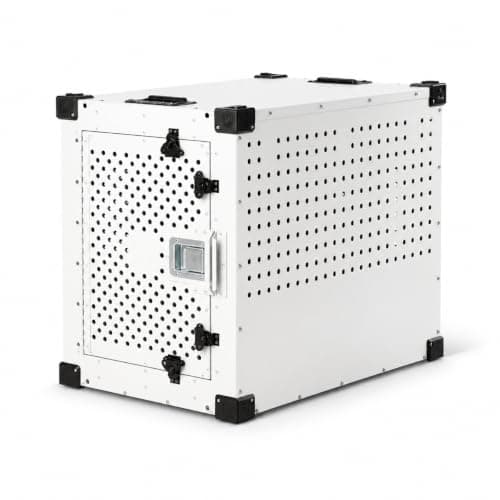
This is a gear problem, in part. A heavy-duty crate contains the dog safely while you fix the exercise and enrichment, and containing the dog is legitimate. Our heavy-duty crate roundup covers it.
Problem two: a dog in genuine distress
A dog experiencing panic when separated from its people. The destruction is concentrated at exit points — the door, the seam where the crate meets the wall — rather than distributed around the crate, and it is frequently accompanied by physical signs.
This is not a gear problem, and a stronger crate does not help. It contains a panicking animal more effectively, which is not the same thing as helping it.
The signs that tell you which one you have
Ogata’s 2016 review in the Journal of Veterinary Behavior lists the most commonly reported clinical signs of separation-related problems as vocalization, elimination and destructive behavior, and notes that dogs may additionally show:
- behavioral indicators of stress or anxiety — panting, pacing, trembling
- signs of depression — lethargy, listlessness
- physiological signs — salivation, anorexia, vomiting, diarrhea
The distinguishing features in practice are the physiological ones and the self-injury. A bored dog does not usually drool a puddle, break its nails on the door, or damage its mouth on the bars. A panicking dog does — and a dog that has injured itself trying to get out of a crate should not be put back into a stronger one without professional input.
Ogata also makes a point worth passing on: the diagnostic criteria may be too broad, which risks grouping together dogs with quite different underlying motivations. Which is another way of saying that this is a diagnosis rather than a guess from a product page.
Is the crate itself the problem?
Sometimes, and it is worth testing rather than assuming.
For many dogs a crate is genuinely a den and reduces anxiety by giving them a defined, safe space. For some, confinement itself is the trigger, and the same dog left loose in a room is far calmer than the same dog behind a door.
The cheap experiment: set up a camera and compare. Crate one day, a dog-proofed room the next, and watch what the dog actually does in the first thirty minutes — which is when separation-related behavior typically peaks. Video analysis is a standard method in this research area precisely because owners are, by definition, not present to observe it.
If the dog settles loose and panics crated, you have your answer and it costs nothing.
What the literature says helps
Reporting rather than advising, because this is not our field. Ogata’s review notes that behavior modification appears more effective when combined with appropriate behavioral medication, and that it has also been shown to be effective as a stand-alone treatment.
Two things follow from that sentence that are worth an owner knowing:
- Medication is a legitimate part of treatment, not a failure or a last resort — and it is a veterinary decision.
- Behavior modification is doing the work in either case. There is no version of this where equipment is the treatment.
Find a qualified behaviorist through your vet. This is one of the few areas of dog ownership where professional help genuinely changes outcomes, and it is also one where bad internet advice — punishment, flooding, “letting them cry it out” — reliably makes things worse.
What gear legitimately does in the meantime
Because you still have to leave the house on Tuesday. Containment while treatment happens is legitimate, provided it is safe containment.
- Remove injury risks. A crate a dog can damage itself on is worse than no crate. Smooth-edged, no gaps that trap a jaw or a paw, and nothing inside that can be swallowed.
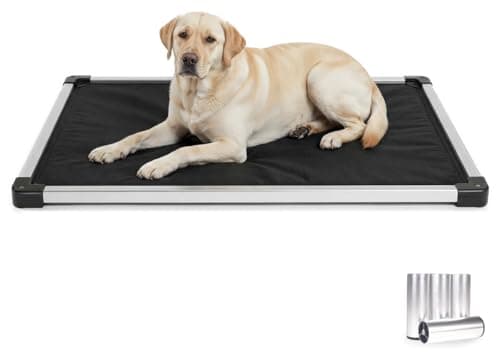
- Remove the destroyable object. A dog that shreds bedding when distressed should not have shreddable bedding. A low cot gives comfort with nothing to disembowel.
- Consider a room instead of a crate, gated rather than closed, if the camera says the dog does better with space. That is what gates are for.
- Do not use an outdoor kennel as the answer. Isolating a dog that is distressed by isolation is the wrong direction, and we say the same in our kennel roundup.
And one commercial note, stated plainly: if the honest answer for your dog is a camera, a vet appointment and a behaviorist, we would rather you spend the money there than on the most expensive crate we review.
Frequently asked questions
Will a stronger crate stop my dog escaping when I leave?
It depends which problem you have. A bored, under-exercised dog dismantling a crate because that is the available activity can legitimately be contained by a heavier crate while you fix the exercise and enrichment. A dog in genuine separation-related distress is a different case: a stronger crate contains a panicking animal more effectively, which is not the same as helping it, and a dog that has injured itself escaping should not simply be put into a stronger box.
How do I know if my dog has separation anxiety or is just bored?
Look for the physiological signs and self-injury. Ogata's 2016 review in the Journal of Veterinary Behavior lists vocalization, elimination and destructive behavior as the most commonly reported signs, with panting, pacing, trembling, lethargy, salivation, anorexia, vomiting and diarrhea also reported. A bored dog does not usually drool a puddle, break its nails on the crate door or damage its mouth on the bars. A panicking dog does. It is a diagnosis, so involve your vet.
Should a dog with separation anxiety be crated?
It genuinely varies, and it is worth testing rather than assuming. For many dogs a crate is a den and reduces anxiety; for some, confinement itself is the trigger and the same dog is calmer loose in a dog-proofed room. Set up a camera and compare the two setups over the first thirty minutes after you leave, which is when separation-related behavior typically peaks. Video is the standard research method here precisely because owners are not present to observe.
Does medication help separation anxiety in dogs?
Ogata's 2016 review reports that behavior modification appears more effective when used in conjunction with appropriate behavioral medication, and that behavior modification has also been shown to be effective as a stand-alone treatment. Two things follow: medication is a legitimate part of treatment rather than a failure or last resort, and behavior modification is doing the work in either case. Both are veterinary and behaviorist decisions, not gear decisions.
What bedding should a distressed dog have in a crate?
Nothing it can shred and swallow. A dog that destroys bedding when distressed should not be left with shreddable bedding, because ingested fabric and foam is a surgical problem on top of a behavioral one. A low cot gives a comfortable surface with nothing to disembowel. More broadly, remove injury risks: no gaps that can trap a jaw or a paw, and nothing inside that can be swallowed.
Can I use an outdoor kennel for a dog with separation anxiety?
We would not. Isolating a dog that is distressed by isolation moves the problem outdoors rather than solving it, and frequently makes it worse by adding physical isolation to the existing distress. If confinement indoors is not working, the more promising direction is usually a gated room rather than a smaller or more remote space — and the underlying treatment is behavioral rather than architectural.
Sources
Every spec on this page traces to one of these. Where a manufacturer does not publish a figure, we say “not published” rather than estimating it.
- Ogata (2016) — “Separation anxiety in dogs: What progress has been made in our understanding of the most common behavioral problems in dogs?”, Journal of Veterinary Behavior 16:28–35
- de Assis et al. / video analysis of separation-related behavior — descriptive studies of dogs diagnosed with separation anxiety (Applied Animal Behavior Science)
- Impact Dog Crates — Lifetime Dog Damage Guarantee (High Anxiety line only)
- AKC — crate training and crate sizing guidance for owners