Do Harnesses Help With Pulling?
There is actual measured evidence on this question, and it does not say what the internet says. Back-clip harnesses made pulling worse. Front-clip harnesses performed as well as a prong collar.
Short answer: a back-clip harness does not help and may make pulling worse. A front-clip harness genuinely does help. Those are not opinions — both have been measured with strain gauges in peer-reviewed work, and the numbers are more interesting than the marketing.
The study that found harnesses made it worse
Shih and colleagues, publishing in Frontiers in Veterinary Science in 2021, put a custom leash-tension meter on 52 shelter dogs (16–43 kg) and tested each dog with both a neck collar and a back-connection chest harness, in randomized order, with each dog acting as its own control.
Walking dogs towards food, the measured tensions were:
- Maximum leash tension: 16.87 N on the harness versus 6.97 N on the collar
- Mean leash tension: 5.3 N on the harness versus 3.14 N on the collar
- Proportion of time spent pulling: 0.67 on the harness versus 0.35 on the collar
That is not a marginal difference. Towards food, dogs pulled roughly twice as hard and nearly twice as often on the back-clip harness. Towards a toy, the authors found no significant difference between the two.
The mechanism is not mysterious, and anyone who has ever seen a sled team knows it: a back-clip harness is the shape you deliberately build when you want an animal to pull into it. It spreads load across the chest and gives the dog something comfortable to lean on. Comfort is exactly what removes the feedback.
The study that found the front clip worked
Johnson and Wynne, in PeerJ in 2024, took a different cut at the question. They tested 23 shelter dogs across four pieces of equipment — a martingale collar as the baseline, a front-connection harness, a Starmark polymer-prong collar, and a standard metal prong collar — measuring pull force on each.
The result:
Dogs pulled significantly more on the martingale than on any of the other three (p < 0.001 in each comparison), and there were no statistically significant differences among the three non-martingale types.
Read that carefully, because it is doing a lot of work. On measured pull force, the front-clip harness was indistinguishable from a metal prong collar. Whatever you think of prong collars, that is a substantial result for a piece of equipment that puts no pressure on the neck at all.
On welfare, the same paper analyzed 15 behavioral indicators and found only three occurred often enough to test. Lip licking was significantly higher on the harness than the martingale (p = 0.008); the authors concluded the data did not show “clear evidence of poorer welfare due to equipment type” and cautioned against over-generalizing from shelter dogs to ordinary pet walks. We will pass that caution on rather than launder it out.
Why the attachment point changes everything
A rear attachment sits behind the dog’s center of mass. Pull on it and the force runs straight down the spine into the shoulders — which is a line the dog can brace against. Opposition reflex does the rest: pressure on the chest produces pressure back into it.
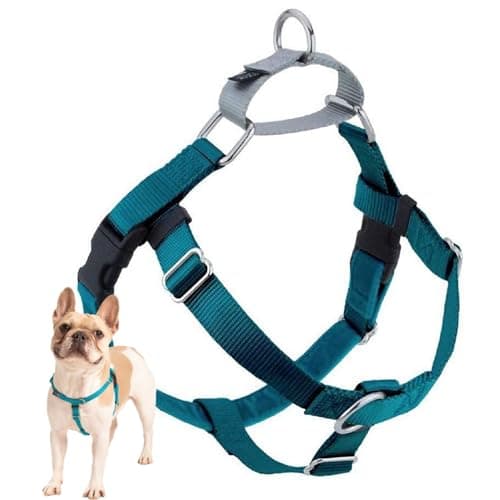
A front attachment sits at the sternum, ahead of the center of mass and off the midline of the pull. Load it and the dog does not get to brace; it gets turned. The dog is not corrected, punished or made uncomfortable — it is simply redirected back towards the handler, and forward progress stops being available. That is why it works, and it is also why it works on the first walk rather than after six weeks of training.
What a front-clip harness does not do
It does not train the dog. This is the part the category tends to skip, so we will say it plainly: a no-pull harness is a management tool. It changes the mechanics of the walk while it is on. It does not teach a loose-leash walk, and a dog that has worn one for two years will still pull on a flat collar, because it never learned anything — the equipment was doing the work.
That is not an argument against using one. Management is legitimate and a walk you can physically control is the precondition for any training at all. It is an argument against expecting the harness to be the training.
It also will not fix a dog that lunges at triggers. Reactivity is a behavior problem, and redirecting the head of a dog that has already committed to a lunge is a physics problem you will lose on a big dog. Equipment buys you control, not calm.
Two fitting errors that stop it working
- The chest strap riding low. The front ring needs to sit at the sternum, roughly level with the point of the shoulder. If it has slid down towards the elbows the leash runs under the dog’s legs, the redirect vanishes and the dog trips. This is the single most common reason an owner concludes “it does not work on my dog.”
- A leash that is too short. A front clip needs a little length to generate the turning angle. On a 4 ft leash held tight, the dog is simply being towed sideways. Six feet, with slack, is where the mechanism actually operates.
Both of those come back to fit, which we cover in full in the measuring guide. If you want the specific harnesses that do this well and are built to survive the dog doing it, that is our no-pull harness roundup.
One caveat we are obliged to report
The 2026 Frontiers in Veterinary Science review of dog-worn equipment found that all harness types studied altered gait, restricting thoracic excursion and changing shoulder extension — including designs marketed as non-restrictive. It also noted that the field has, in the author’s words, “a paucity of evidence regarding best designs and best practices.”
We are not going to pretend that away. The same review is equally direct in the other direction: it reports that the widely repeated claims of collar-related injury to the thyroid, trachea, jugular veins or carotid arteries from ordinary leash pulling are not supported in the literature. Both of those findings are inconvenient for somebody’s marketing, which is roughly why we think they are worth reading.
The same mechanics, used deliberately
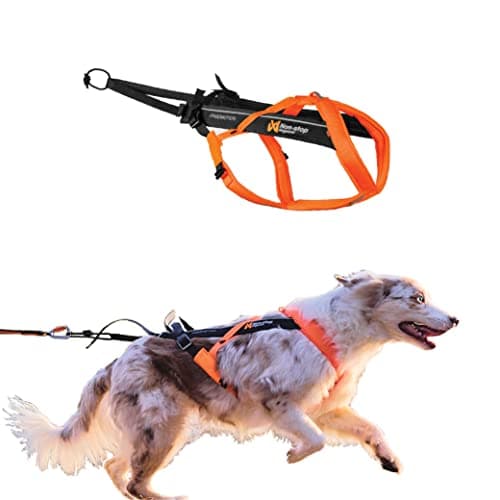
Everything above treats pulling as the problem. It is worth knowing that the mechanism which makes a back attachment bad for loose-leash walking — force running down the spine into a line the dog can brace against — is exactly what sled and joring gear is built to exploit. If what you want is a dog that pulls comfortably for an hour rather than one that stops, the pulling harness roundup covers that equipment: the line leaves above the base of the tail, the geometry is X-back or H-back, and the sizing measurement is back length rather than chest girth.
Frequently asked questions
Do dog harnesses stop pulling?
It depends entirely on where the leash attaches. Shih et al. (2021) measured leash tension on 52 dogs and found they pulled roughly twice as hard on a back-connection harness as on a collar — 16.87 N maximum tension versus 6.97 N. Johnson & Wynne (2024) measured pull force across four equipment types and found a front-connection harness performed no differently from a metal prong collar. A back clip does not help; a front clip does.
Why do dogs pull more on a back-clip harness?
Because a back-clip harness is the same shape used deliberately for sled and weight-pull work. The attachment sits behind the dog's center of mass, so the force runs down the spine into the shoulders — a line the dog can brace against comfortably — and opposition reflex does the rest. The comfort is the problem: it removes the feedback that pulling produces resistance.
Is a front-clip harness as effective as a prong collar?
On measured pull force in one peer-reviewed trial, yes. Johnson & Wynne (2024) tested 23 shelter dogs on a martingale, a front-connection harness, a Starmark polymer-prong collar and a metal prong collar. Dogs pulled significantly more on the martingale than on the other three (p < 0.001), with no statistically significant differences among the three. The authors cautioned against generalizing shelter-dog results to ordinary pet walking.
Will a no-pull harness train my dog not to pull?
No. It is a management tool: it changes the mechanics of the walk while it is on, and the dog learns nothing from it. A dog that has worn one for two years will still pull on a flat collar. That is a reason to pair it with training, not a reason to avoid it — physical control of the walk is the precondition for any training at all.
Why is my no-pull harness not working?
Two fitting errors account for most cases. First, the front ring has slid down towards the elbows instead of sitting at the sternum, level with the point of the shoulder — the leash then runs under the legs and the redirect disappears. Second, the leash is too short: a front clip needs slack to generate a turning angle, so a tight 4 ft leash simply tows the dog sideways instead of turning it.
Do harnesses hurt a dog's shoulders?
The 2026 Frontiers in Veterinary Science review reports that multiple studies found all harness types studied restrict thoracic excursion and alter shoulder extension during movement — including designs sold as non-restrictive — and that individual dogs respond differently. It stops short of describing this as injury, and the same review notes a general paucity of evidence on best design. Fit carefully rather than avoid harnesses.
Sources
Every spec on this page traces to one of these. Where a manufacturer does not publish a figure, we say “not published” rather than estimating it.
- Shih, Phillips, Mills, Yang, Georgiou & Paterson (2021) — “Dog Pulling on the Leash: Effects of Restraint by a Neck Collar vs. a Chest Harness”, Frontiers in Veterinary Science 8:735680
- Johnson & Wynne (2024) — “Comparing efficacy in reducing pulling and welfare impacts of four types of leash walking equipment”, PeerJ 12:e18131
- Ridgway (2026) — “Health implications of dog-worn equipment: a review of known and alleged physical risks”, Frontiers in Veterinary Science 13:1711781
- Pauli, Bentley, Diehl & Miller (2006) — “Effects of the application of neck pressure by a collar or harness on intraocular pressure in dogs”, J. Am. Anim. Hosp. Assoc. 42(3):207–11