Airline Dog Crate Requirements
Airlines do not write these rules; IATA does, and the airline adds its own on top. Here is what the container standard requires, and where the crate you already own will fail it.
Who actually writes the rules
The container standard for animals in air transport is the IATA Live Animals Regulations (LAR), and its container requirements are numbered. The one that applies to an ordinary dog is Container Requirement 1. There is a separate, much stricter requirement — CR82 — that applies where an airline classifies the animal as strong, dangerous or a known escape risk, and that requirement is where most of the confusion in this subject comes from.
The distinction matters commercially, because a CR82-compliant crate costs several times what a plastic kennel costs, and a great many articles blur the two into “airline approved.” There is no such phrase in the regulation. A crate either meets the container requirement the airline applies to your dog, or it does not.
Ventilation: the requirement that fails ordinary crates
This is where a normal pet-store kennel most often falls down, and the numbers are specific. The LAR requires that a container be “adequately ventilated on three sides, with the majority of the ventilation being provided on the upper part of the container.”
Reported alongside that requirement, the working figures are:
- Total ventilated area of at least 16% of the total surface of the four sides.
- Openings on all four sides, placed in the upper two thirds.
- Openings nose-and-paw-proof — a maximum of 25 mm × 25 mm for dogs.
Take a tape measure to a mass-market plastic kennel and check the third one first. Many have ventilation slots wider than 25 mm, and many have ventilation on two sides only, with the rear panel solid. Both are refusals.
We were not able to read the primary LAR text ourselves — IATA publishes the full regulations as a paid document and the summary PDF did not parse — so the figures above are reported from IATA’s own container guidance and from the freight and pet-shipping trade, not quoted from the numbered section. We would rather tell you that than imply we read a document we did not.
CR82: what changes when the airline says your dog is strong
Where an airline applies CR82 — commonly to breeds it classifies as strong or dangerous, including many bully-type mixes — the rules change materially. The headline change is construction:
No portion of the crate may be made of plastic. CR82 containers are built of wood, metal, synthetic materials, welded mesh or wire grate.
That single sentence eliminates every plastic kennel on the market regardless of size, ventilation or hardware. If your airline applies CR82 to your dog, you are buying or renting a purpose-built container, and there is no way around it.
Whether CR82 applies is the airline’s call, not IATA’s and not yours. Ask before you book, in writing, and ask about the specific breed or mix rather than in general terms.
Sizing: the rule that is not about comfort
The standing rule for air transport is that the animal must be able to stand up fully without its head or ears touching the top, turn around completely, and lie down in a natural position. This is not a comfort guideline; it is a compliance check that a handler will perform at the counter, and a dog whose ears brush the roof is a dog that does not fly that day.
This is also the exact opposite of the sizing logic for a car crate or a home crate. A travel crate that is too large is a real hazard in a vehicle, because a dog with room to be thrown is a dog that gets thrown; an airline crate that is too small is a refusal. The two requirements genuinely conflict, and the honest consequence is that an airline crate and a car crate are frequently not the same crate. Anyone telling you one box does both jobs is selling a box.
The hardware details that get crates rejected
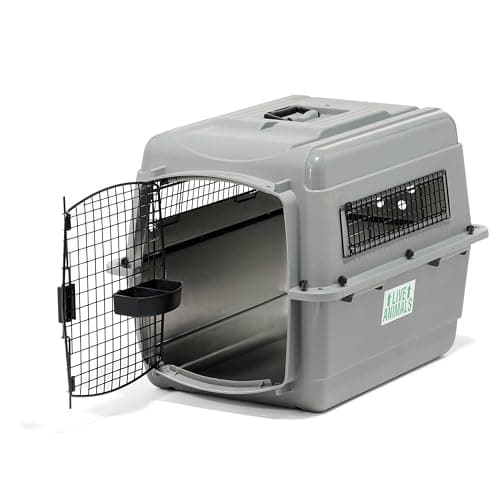
- Metal fasteners, not the plastic clips the crate shipped with. The standard expectation for a two-piece plastic kennel is that the halves are bolted with metal nuts and bolts all the way round. Many kennels ship with plastic wing nuts and are rejected on exactly that.
- No wheels, or wheels removed and retracted. A container that can roll on its own is a hazard on a moving deck.
- Food and water containers fixed inside, accessible from outside without opening the door, so a handler can water the dog on a delay.
- Live animal labeling and upright arrows, plus your contact details, on the container itself.
- Absorbent bedding — and specifically not straw, which is prohibited in many destinations on plant-health grounds.
Note what is not on this list: a lock. Containers must not be locked, because a handler may need to open the door in an emergency. Cable ties on the door corners are the usual accepted compromise.
Which crate to actually buy
The plastic double-door kennel category exists almost entirely for this job, and the Petmate Sky Kennel is the long-standing default. We are blunt about what it is in our heavy-duty crate roundup: it is an air-travel crate and nothing else. It is not a containment crate for a determined dog, and buying one for home use because it looks sturdy is a mistake.
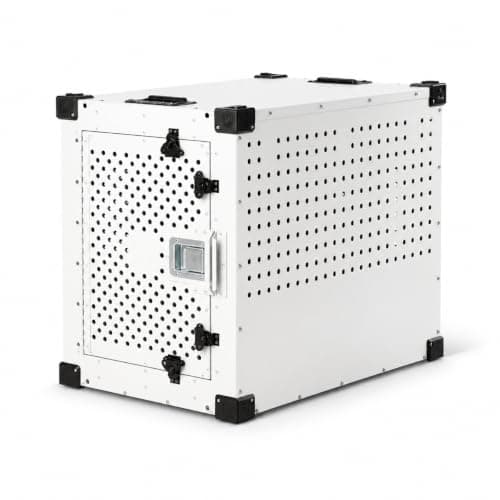
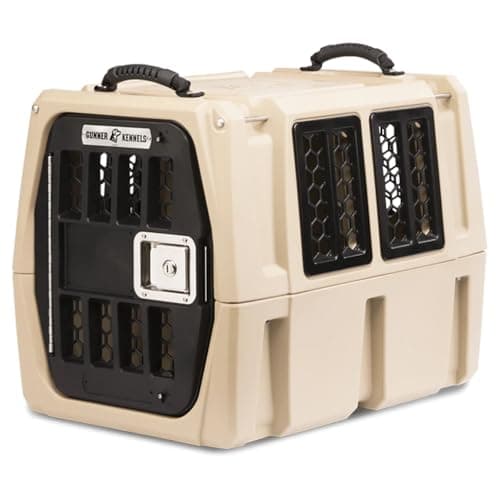
For CR82, or for a dog that has ever defeated a plastic kennel, you are into welded aluminum — the Impact and Gunner class of product, which we cover in the escape-proof crate roundup and, for their car-safety certification, in the crash-tested crate roundup. Note that crash certification and airline compliance are entirely different tests: a CPS-certified crate is not automatically LAR-compliant, and vice versa.
Four things to settle before you book
- Does this airline carry your dog at all, in this season, on this route? Temperature embargoes are common and they are absolute.
- Does the airline apply CR82 to your dog? Ask by breed or mix, in writing.
- Measure the dog standing, including ear tips. Then measure the crate internally, not externally.
- Confirm what the destination requires — import paperwork, microchip standard, rabies timing. That is a separate subject from the crate and it is the one that strands people.
None of that is gear advice, and we are not going to dress it up as gear advice. But it is the part that determines whether the crate you bought was the right purchase, so it belongs on the page.
Frequently asked questions
What are the IATA requirements for a dog crate?
The Live Animals Regulations require a container to be adequately ventilated on three sides with the majority of ventilation on the upper part. The working figures reported alongside that requirement are a total ventilated area of at least 16% of the surface of the four sides, openings on all four sides placed in the upper two thirds, and openings no larger than 25 mm × 25 mm so they are nose and paw proof. The dog must be able to stand fully without its ears touching the top, turn around completely and lie down naturally.
What is a CR82 crate?
CR82 is the IATA container requirement applied where an airline classifies an animal as strong, dangerous or an escape risk. Its defining rule is construction: no portion of the crate may be plastic, so CR82 containers are built from wood, metal, synthetic materials, welded mesh or wire grate. That eliminates every plastic kennel on the market regardless of size or hardware. Whether CR82 applies to your dog is the airline's decision, so ask in writing before booking.
Is a Petmate Sky Kennel airline approved?
There is no such status as 'airline approved' in the regulation — a crate either meets the container requirement the airline applies to your dog or it does not. The Sky Kennel is the long-standing default for the standard container requirement, and it exists essentially for that job. It will not satisfy CR82, because CR82 prohibits plastic entirely, and it is not a containment crate for a determined dog at home.
Can I use my car crate for a flight?
Usually not, and the two requirements genuinely conflict. Air transport requires enough room for the dog to stand fully, turn around and lie down naturally, and undersizing is a refusal. Car safety requires the opposite: a crate with spare room lets a dog be thrown inside it during an impact. A crash-certified crate is not automatically compliant with the Live Animals Regulations, and a compliant shipping crate is not automatically crash certified. They are different tests.
Should I lock my dog's crate for a flight?
No. Containers must not be locked, because a handler may need to open the door in an emergency. Cable ties through the door corners are the usual accepted compromise — they hold the door shut against a dog and can be cut instantly by a handler. Check with the specific airline, as some specify exactly what they will accept.
What bedding goes in an airline dog crate?
Absorbent bedding — but specifically not straw, which is prohibited on plant-health grounds at many destinations. The crate also needs food and water containers fixed inside and accessible from outside without opening the door, so a handler can water the dog during a delay, plus live-animal labeling, upright arrows and your contact details on the container.
Sources
Every spec on this page traces to one of these. Where a manufacturer does not publish a figure, we say “not published” rather than estimating it.