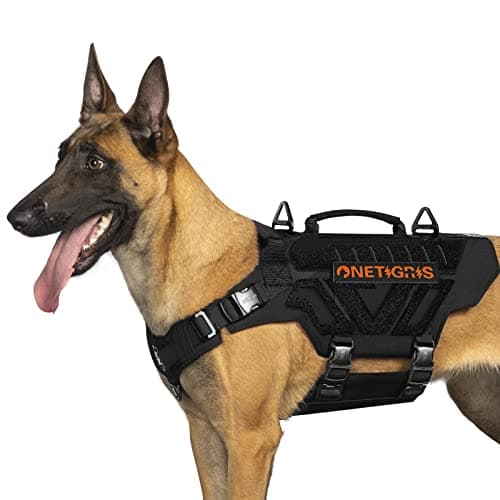
The Best Service Dog Harnesses
Every online 'service dog registry' is selling you something the law does not recognize. The harness is still worth choosing carefully, for reasons that have nothing to do with access rights.
Buy the Ruffwear Web Master. Its five-point adjustment and three-strap structure make it the hardest harness here to get out of, its buckles are named (ITW Nexus Airloc) and its rear attachment is an anodized 6061-T6 aluminum V-ring rather than an unnamed stamped D.
Buy the Julius-K9 IDC if the handler needs the harness on and off quickly and one-handed, and the OneTigris Aire Mesh if the dog works in heat.
What the ADA actually requires: nothing you can buy
This is the most useful thing on the page, and almost nothing that ranks for this query says it plainly.
- The ADA defines a service animal as a dog that has been individually trained to do work or perform tasks for a person with a disability. The task has to be directly related to the disability.
- No vest, harness, patch, cape or ID is required. The Department of Justice does not require a service dog to wear or carry anything.
- There is no federal registration or certification. The online “registries” selling certificates, ID cards and numbered vests are selling documents the DOJ does not recognize. Buying one gives you nothing legally.
- Staff may ask exactly two questions when it is not obvious what service the dog provides: is the dog a service animal required because of a disability, and what work or task has it been trained to perform. They may not ask about the disability, demand documentation, or require the dog to demonstrate the task.
- Emotional support animals are not service animals under the ADA’s public-accommodation rules. Comfort provided by an animal’s presence is not, in the DOJ’s framing, a trained task.
So why buy a harness at all? Because a visible, well-fitted working harness changes the behavior of the public, which is a practical benefit rather than a legal one: fewer people reach for the dog, fewer children run at it, fewer conversations start. That is worth real money to a working team. It is not a right you are purchasing.
The types, and which one you actually need
“Service dog harness” covers at least four different objects, and they are not interchangeable:
- A working vest or cape — fabric, patch panels, minimal structure. Its job is visibility and message. We compare the two shapes in service dog vest vs cape.
- A control harness — a real load-bearing harness with named hardware, used for handling and for secure attachment. This is what the five picks below are.
- A guide harness — the rigid U-handle used by guide dog teams. These are fitted and supplied through guide dog programs, not bought online, and we have no pick.
- A mobility or counterbalance harness — a rigid-handled harness a handler leans on for balance support. We do not recommend buying one off a marketplace. Counterbalance work puts static and dynamic load through a dog’s spine and shoulders, the fit has to be assessed on the individual dog, and no product in our registry publishes a load rating for a rigid handle. This is a conversation for a veterinarian and a specialist maker, not a product page.
Being clear about the fourth one matters. It is the category where getting it wrong hurts the dog, and it is the category where the marketplace listings are least honest.
What we scored, since nobody publishes a rating
Not one harness here publishes a load rating for its handle or its attachment ring. Ruffwear publishes no load rating anywhere in its line; Blue-9 does not state its buckle material or whether its rings are welded or split; Julius-K9 publishes neither materials nor ratings. That absence is the finding, and it is why our rubric gives 25% to hardware and rewards naming parts.
What can be judged:
- Number of adjustment points. Two is a size band. Five or six is a fit. On a dog that works all day, fit is the difference between a harness and a rub.
- Structure. The Web Master’s third strap behind the ribs is why it is the hardest to reverse out of; a single-buckle chest closure is fast and is also the whole harness.
- Named components. ITW Nexus buckles and 6061-T6 aluminum are checkable claims. “Heavy-duty metal hardware” is not.
- Shell weight. Ruffwear’s cheaper Front Range uses a 300D shell; the more expensive Web Master uses 150D. You are paying for structure on the Web Master, not fabric, and it is worth knowing that.
Quick picks
The short answer, ranked and scored against our published durability rubric. Where a manufacturer does not publish a spec, we say so rather than estimating it.
| # | Photo | Product | Durability | Price |
|---|---|---|---|---|
| 1 | 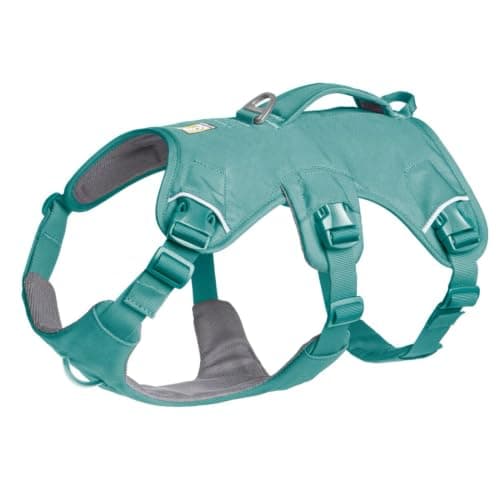 | Ruffwear Web Master HarnessLifting and controlling a dog over real terrain | 77/100 | $79.99 · Amazon |
| 2 | 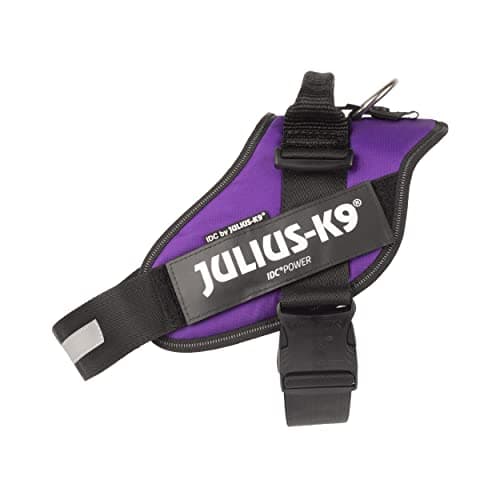 | Julius-K9 IDC PowerharnessQuick on, quick off, on a big working dog | 58/100 | $64.99 · Amazon |
| 3 | 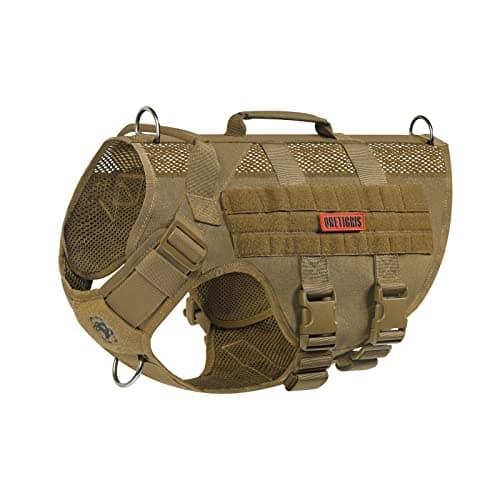 | OneTigris Aire Mesh Tactical HarnessHot-weather work, where breathability matters more than bulk | 55/100 | $43.98 · Amazon |
| 4 | 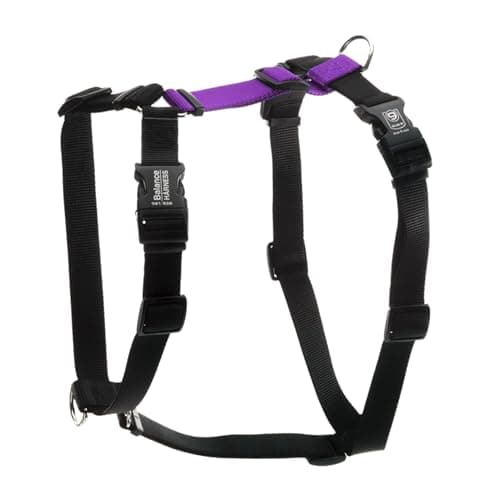 | Blue-9 Balance HarnessFit — if you can live with a brand that publishes almost nothing | 60/100 | $45.95 · Amazon |
| 5 | 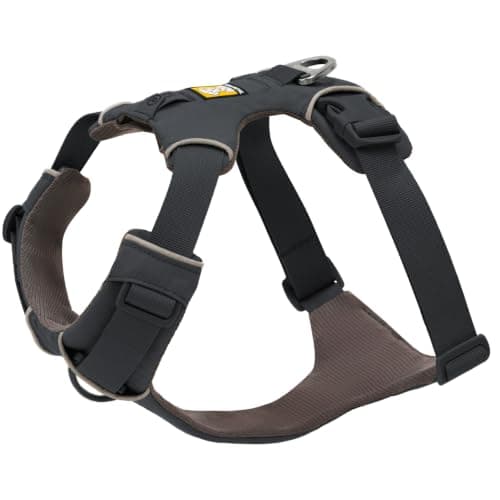 | Ruffwear Front Range HarnessThe everyday harness for a dog that does not pull hard | 77/100 | $59.99 · Amazon |
Tap any row to jump to the full review. Prices are pulled live from Amazon as of October 18, 2026; where we have no verified live price we show none rather than a stale number. #ad — how our links work.
The picks, ranked
1. Ruffwear Web Master Harness
Durability score 77/100Best for: Lifting and controlling a dog over real terrain
Buy it for the three-point structure and the handle — not for the shell, which is thinner than the harness Ruffwear sells for twenty dollars less.
- Shell
- 150D polyester ripstop, PU coating (40% recycled)
- Padding
- Closed-cell foam
- Webbing
- Polypropylene
- Buckles
- ITW Nexus Airloc
- Rear attachment
- Anodized 6061-T6 aluminum V-ring
- Sizes
- XXS–L/XL, 13–42 in girth
- Handle lift rating
- Not published
Pros
- Five points of adjustment and a three-strap design that is genuinely hard for a dog to reverse out of
- Named hardware — ITW Nexus buckles and an anodized 6061-T6 aluminum V-ring, not a generic stamped D-ring
- Reinforced handle makes it the tool of choice for lifting a dog over an obstacle
Cons
- The shell is 150D — literally half the denier of the cheaper Front Range's 300D. You are paying for structure, not fabric
- Ruffwear publishes no lift rating for the handle, on a harness sold specifically for lifting dogs
- Polypropylene webbing is less abrasion-resistant than the polyester Ruffwear uses on the Front Range
How we assessed it: on published materials, hardware specs and construction — not long-term chew-tested. We say so because it is true, and because a claim we cannot back is worth nothing to you.
#ad Price as of October 18, 2026; Amazon prices change often, so check before you buy. How our links work.
2. Julius-K9 IDC Powerharness
Durability score 58/100Best for: Quick on, quick off, on a big working dog
Fast and comfortable, but one buckle is the whole harness — think hard about that before trusting it with a strong dog.
- Design
- Single-buckle chest closure, padded handle (Amazon listing)
- Materials
- Not published
- Load rating
- Not published
Pros
- One buckle and it is on — genuinely fast
- Broad chest plate spreads load across the sternum
Cons
- No published denier, hardware spec or load rating
- The single closure buckle is a single point of failure by design
How we assessed it: on published materials, hardware specs and construction — not long-term chew-tested. We say so because it is true, and because a claim we cannot back is worth nothing to you.
#ad Price as of October 18, 2026; Amazon prices change often, so check before you buy. How our links work.
3. OneTigris Aire Mesh Tactical Harness
Durability score 55/100Best for: Hot-weather work, where breathability matters more than bulk
The warm-weather specialist: buy it to keep a working dog cool, not to win a durability contest — and note that even OneTigris will not rate this one the way it rates the X-Armor.
- Construction
- Breathable air-mesh vest with nylon webbing — built to run cool, not to be the heaviest fabric here
- Buckles
- Quick-release buckles — and, tellingly, OneTigris does not publish a load rating for them as it does on the X-Armor
- Attachment
- Front no-pull D-ring plus a back attachment point
- Handles
- Two padded grab handles, one horizontal and one vertical
- Load rating
- Not published (unlike the same brand's X-Armor)
Pros
- The air-mesh body is the coolest, most breathable harness in this roundup — the right tool for a dog working in heat
- Two padded grab handles, one of them vertical, for genuine close control
- It comes from the one brand here that proves it can publish real hardware ratings, so the build is a known quantity even where the numbers are withheld
Cons
- OneTigris publishes the X-Armor's buckle and D-ring load ratings but not the Aire Mesh's — the budget model does not inherit the flagship's evidence
- Mesh construction trades outright durability for airflow; this is not the vest for a determined chewer or a hard, constant puller
- Costs more than the budget nylon vests without carrying their heavier shells
How we assessed it: on published materials, hardware specs and construction — not long-term chew-tested. We say so because it is true, and because a claim we cannot back is worth nothing to you.
#ad Price as of October 18, 2026; Amazon prices change often, so check before you buy. How our links work.
4. Blue-9 Balance Harness
Durability score 60/100Best for: Fit — if you can live with a brand that publishes almost nothing
The best-fitting harness here and the worst-documented — a real problem when durability is the thing you are buying.
- Material
- Washable soft-touch nylon
- Adjustment
- Six points
- Attachment
- Front and back rings
- Buckle material
- Not published
- Ring type (welded or split)
- Not published
- Load rating
- Not published
Pros
- Six points of adjustment — the most in this roundup, and the reason trainers reach for it
- Front and back attachment on every size
- Genuinely washable
Cons
- Blue-9 is the thinnest-specified brand we looked at: no buckle material, no ring type, no load rating anywhere on its product page
- Chewing is not covered by default — Blue-9 sells a $4 one-year chew warranty as an add-on
- You cannot substantiate a single durability claim about this harness from the manufacturer's own site
How we assessed it: on published materials, hardware specs and construction — not long-term chew-tested. We say so because it is true, and because a claim we cannot back is worth nothing to you.
#ad Price as of October 18, 2026; Amazon prices change often, so check before you buy. How our links work.
5. Ruffwear Front Range Harness
Durability score 77/100Best for: The everyday harness for a dog that does not pull hard
The best-specified everyday harness here, and the rare case where the cheaper Ruffwear has the heavier fabric.
- Shell
- 300D polyester ripstop (100% recycled), PU coating + non-fluorinated DWR
- Padding
- PE foam
- Webbing
- Polyester (30% recycled)
- Buckles
- ITW Nexus Airloc side-release
- Rear attachment
- Anodized 6061-T6 aluminum V-ring
- Front attachment
- Nylon webbing in a TPU tube
- Sizes
- XXS–L/XL, 13–42 in girth
- Load rating
- Not published
Pros
- 300D recycled ripstop is a genuinely heavier shell than the Web Master's 150D, for less money
- Named, specified hardware — ITW Nexus Airloc buckles, anodized aluminum V-ring
- Two leash points, four points of adjustment
- Polyester webbing resists abrasion better than polypropylene
Cons
- No published load rating — a real gap for a premium brand
- Ruffwear's warranty states no duration at all and explicitly excludes chewing damage
- Hand wash, mild detergent, air dry
How we assessed it: on published materials, hardware specs and construction — not long-term chew-tested. We say so because it is true, and because a claim we cannot back is worth nothing to you.
#ad Price as of October 18, 2026; Amazon prices change often, so check before you buy. How our links work.
Fit, on a dog that wears this for eight hours
A pet harness is worn for forty minutes. A working harness is worn for a shift, and that changes what matters:
- Nothing in the armpit. The single most common rub point. A strap that crosses the axilla will take hair off, then skin. Check after the first full day, not the first week.
- Clear the shoulder. The chest strap should sit below the point of shoulder so the front legs swing freely. Ridgway’s 2026 review reports that all harness types studied alter gait and restrict thoracic excursion to some degree — which is an argument for taking fit seriously and for taking the harness off when the dog is off duty, not an argument against harnesses.
- Two fingers, everywhere. Under the chest strap, under the girth strap, under the neck opening.
- Take it off at home. Continuous wear is how pressure sores start. The harness is equipment, not clothing.
The measuring method — and the mistake that makes most girth measurements wrong — is in how to measure a dog for a harness.
Small dogs do this work too
A large share of the search traffic for this category is people looking for a service harness for a small dog, and the assumption that service work means a Labrador is wrong — medical alert, psychiatric and hearing work are done by small dogs every day.
Two of the picks below run genuinely small: Ruffwear publishes girth-based sizing from 13 in across the Web Master and Front Range lines. Our full treatment of the fit problems specific to small dogs is in the best harnesses for small dogs.
A working harness is not a no-pull harness
Worth separating, because they get conflated. A back-connection working harness is, mechanically, a pulling yoke — Shih et al. (2021) measured the highest maximum leash tension of anything they tested on a back-connection harness, 16.87 N against 6.97 N on a collar. That is a feature for a dog trained to work in one and a problem for a dog that has not been taught not to pull.
If pulling is the actual issue, the front-connection gear in our no-pull roundup is the answer, and the mechanism is explained in do harnesses help with pulling.
Frequently asked questions
Does a service dog have to wear a vest or harness?
No. The Department of Justice does not require a service animal to wear or carry anything — no vest, no harness, no patch, no ID card. A harness is worth having for a practical reason rather than a legal one: a visible, well-fitted working harness changes how the public behaves around the team, so fewer strangers reach for the dog. It buys you no access rights whatsoever.
Is there an official service dog registration or certification in the US?
No. There is no federal registration or certification for service animals, and the online registries selling certificates, ID cards and numbered vests are selling documents the DOJ does not recognize. Under the ADA a service animal is a dog individually trained to do work or perform tasks directly related to a person's disability — the training is the qualification, not a piece of paper.
What can staff legally ask about a service dog?
Exactly two questions, and only when it is not obvious what service the dog provides: is the dog a service animal required because of a disability, and what work or task has the dog been trained to perform. They may not ask about the person's disability, require medical documentation, demand a certificate or ID, or ask the dog to demonstrate the task.
What is the best harness for a service dog?
For control and security, the Ruffwear Web Master — five adjustment points and a third strap behind the ribs make it the hardest here to reverse out of, its buckles are named (ITW Nexus Airloc) and its rear attachment is an anodized 6061-T6 aluminum V-ring rather than an unnamed stamped D-ring. Note what nobody publishes: not one harness in this category states a load rating for its handle or attachment point, Ruffwear included.
Can I buy a mobility or counterbalance harness online?
We would not. A counterbalance harness puts static and dynamic load through a dog's spine and shoulders, the fit has to be assessed on the individual dog, and no marketplace product we have found publishes a load rating for its rigid handle. That makes it the one category here where getting it wrong hurts the dog. Work with a veterinarian and a specialist maker rather than a product page.
Are emotional support animals covered by the ADA?
Not under the ADA's public accommodation rules. The DOJ's position is that an animal whose sole function is to provide comfort by its presence is not performing a trained task, so it does not meet the service animal definition. Other laws can apply in other contexts — housing and air travel are governed separately — so this is specifically about ADA access to businesses and public spaces.
Sources
Every spec on this page traces to one of these. Where a manufacturer does not publish a figure, we say “not published” rather than estimating it.
- ADA.gov — Service animals (definition: a dog individually trained to do work or perform tasks for a person with a disability)
- ADA.gov — Frequently asked questions about service animals and the ADA (the two questions staff may ask; no certification or registration required)
- Ruffwear — Web Master specs (150D polyester ripstop, ITW Nexus Airloc buckles, anodized 6061-T6 aluminum V-ring, 13–42 in girth)
- Ruffwear — Front Range Harness specs and girth-based sizing (300D recycled polyester ripstop, ITW Nexus Airloc buckles)
- Ruffwear — warranty terms (chewing excluded; no duration stated)
- Shih et al. (2021) — “Comparison of Leash Tension When Walking Dogs Using Different Collars and Harnesses”, Frontiers in Veterinary Science 8:735680
- Ridgway (2026) — “Health implications of dog-worn equipment: a review of known and alleged physical risks”, Frontiers in Veterinary Science 13:1711781