How to Install a Dog Car Barrier
Two very different products share this name. One is engineered for your exact vehicle and takes fifteen minutes; the other is a pressure fit, and pressure fits are where installs go wrong.
Which of the two you actually bought
The installation is entirely different depending on the type, and this is the thing to establish before you open the box.
A vehicle-specific guard. One SKU per model and generation, shaped to the exact aperture, and it mounts to existing anchor points in the body — usually the seatbelt or luggage-anchor threads. Travall publishes over 800 vehicle-specific SKUs and states installation takes about 10–15 minutes with no drilling or modification. This is the strongest mount available, because the load goes into the car’s structure rather than into friction.
A universal barrier. Adjustable, fitted by tension between floor and ceiling, or hung from the headrest posts, or both. WeatherTech’s adjusts 30–46 in high and 39–66 in wide. This is where installations go wrong, and where most of the steps below apply.
If a vehicle-specific guard exists for your car, buy that one. The universal versions exist because most cars are not covered, not because they are equivalent.
Six steps for a universal barrier
Measure the opening before you buy — in three places. Width at the floor, width at the ceiling, and height at the center. Vehicle apertures taper and the adjustment ranges printed on the box assume a rectangle. Measure with the rear seats where you actually keep them, not where they were when you took the car out of the showroom.
Clear the cargo area and drop the seats you will be using. Fit it in the configuration you drive in. A barrier fitted with the seats up will be wrong the first time you fold them.
Assemble loosely, position, then tension. Build the frame with every fitting finger-tight, get it square in the opening, and only then work around it tightening. Tightening as you go pulls the frame out of square and you will not get it back.
Spread the load at every contact point. This is the step people skip. A tension barrier concentrates force on four small pads pressing into a headliner and a trim panel — neither of which is structural. Use the supplied feet and pads, and if the barrier presses on a plastic trim panel, put something between them. Headliners tear and trim clips break.
Push it. Hard. Both hands, from the cargo side, at the top and the middle. It should not walk, twist or pop out. If it moves under your hands it will move under a 70 lb dog with a run-up.
Check the mirror and the sightlines. Sit in the driver’s seat. A barrier that blocks the interior mirror or the over-shoulder view has created a road hazard to solve a dog problem, and in several states obstruction of the driver’s view is itself an offense — see dog car restraint laws by state.
Headrest-mounted barriers: the one thing to check
Many universal barriers hang from the rear headrest posts. Two failure modes are worth knowing before you rely on one:
- Not every car has removable rear headrests, and some have fixed integrated ones with no posts at all. If yours does, you need a floor-to-ceiling tension barrier instead — that is exactly the gap the pressure-mount products fill.
- Headrest posts are designed to take vertical load, not horizontal impact. A dog hitting a headrest-mounted barrier is applying force in a direction the post was never engineered for. This is a containment mount, and it should be treated as one.
What the specs tell you, and what they do not
This category is unusually opaque, with one exception. WeatherTech publishes a genuine materials sheet — a 1 in injection-molded resin main upright over a 3/4 in anodized aluminum internal upright, 5/8 in aluminum cross bars at 3-3/8 in spacing, 6.3 lb total. Nobody else in the category comes close to that.
What even WeatherTech does not publish is a load rating — and neither does Travall, MidWest, PetSafe, ZooKeeper or Kurgo. MidWest publishes a 2 in mesh opening, which is a spacing figure and not a gauge. So there is no number anywhere in this category telling you what force a barrier will hold, which is precisely why we describe them as containment rather than restraint. The full rankings are in the best dog car barriers.
Quick picks
The short answer, ranked and scored against our published durability rubric. Where a manufacturer does not publish a spec, we say so rather than estimating it.
| # | Photo | Product | Durability | Price |
|---|---|---|---|---|
| 1 | 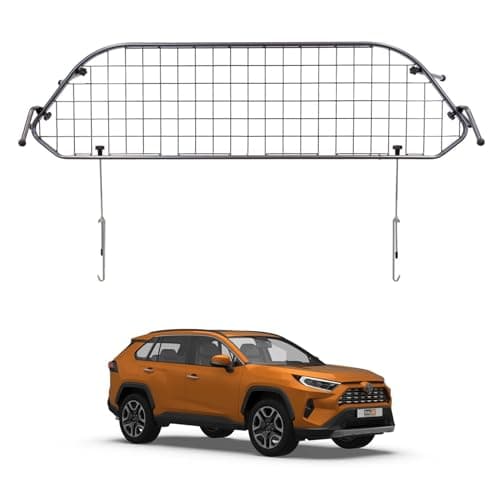 | Travall Guard (vehicle-specific)One exact vehicle, rather than a rough opening | 83/100 | $299.19 · Amazon |
| 2 | 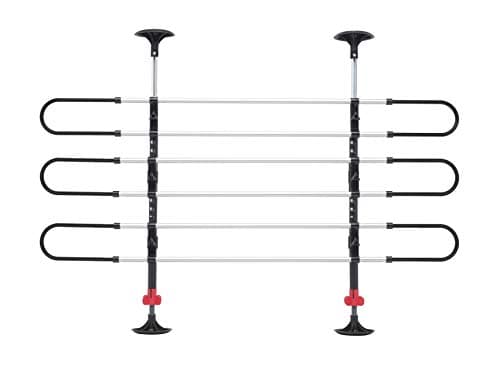 | WeatherTech Pet Barrier & Fence KitThe one materials sheet in this category with real numbers on it | 74/100 | $192.90 · Amazon |
| 3 | 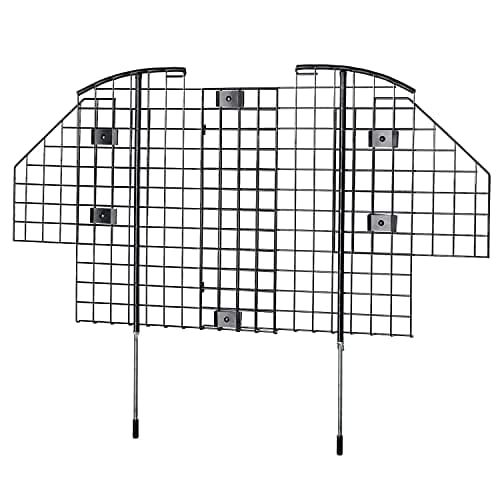 | MidWest Wire Mesh Car Barrier (Model 13)The most steel for the money | 62/100 | $89.32 · Amazon |
Tap any row to jump to the full review. Prices are pulled live from Amazon as of October 18, 2026; where we have no verified live price we show none rather than a stale number. #ad — how our links work.
The picks, ranked
1. Travall Guard (vehicle-specific)
Durability score 83/100Best for: One exact vehicle, rather than a rough opening
The best-made barrier in the category and the only one built for a single vehicle — just do not read its "crash tested" line as certification, because Travall names a lab for its crate and pointedly does not for this.
- Material
- Nylon powder-coated mild steel (Travall)
- Steel gauge
- Not published
- Fitment
- Vehicle-specific — one SKU per model and generation, 800+ listed (Travall)
- Installation
- No drilling or modification; ~10–15 min (Travall)
- Warranty
- Lifetime, manufacturing defects only (Travall)
- Made in
- Derby, United Kingdom (Travall)
- Load rating
- Not published
Pros
- The only barrier here cut for one exact vehicle rather than tensioned into a roughly-right opening — which is the whole reason a guard stays where you put it
- Powder-coated mild steel, and Travall states plainly that it is made in Derby, UK — an origin claim two of its rivals will not make
- Fits without drilling or permanent modification, so it comes back out when you sell the car
- Lifetime warranty against manufacturing defects
Cons
- Vehicle-specific, so the listing and price we link are the RAV4 (2018+) fitment. Yours is a different SKU at a different price — across four models we checked, prices ran from $267.99 to $294.99
- Travall calls its guards "crash tested" and pairs that with ISO 9001. ISO 9001 is a quality-management standard, not a safety test, and the two do not belong in the same sentence
- Travall names TÜV SÜD as the lab that certified its dog crate, and names no lab at all for its guards. It knows exactly what an independent certification looks like
- Its ECE R126 testing is on a type-approval basis — one guard tested, the rest assumed to match — which Travall discloses, to its credit, but which is not the same as testing the guard you are sent
- No steel gauge and no load rating published
How we assessed it: on published materials, hardware specs and construction — not long-term chew-tested. We say so because it is true, and because a claim we cannot back is worth nothing to you.
#ad Price as of October 18, 2026; Amazon prices change often, so check before you buy. How our links work.
2. WeatherTech Pet Barrier & Fence Kit
Durability score 74/100Best for: The one materials sheet in this category with real numbers on it
The most transparent materials sheet in the category, undercut by a lifetime warranty that excludes the one event you bought it for.
- Main upright
- 1" diameter, injection-molded resin (WeatherTech)
- Internal upright
- 3/4" anodized aluminum extrusion (WeatherTech)
- Cross bars
- 5/8" diameter aluminum (WeatherTech)
- Bar spacing
- 3-3/8" (WeatherTech)
- Adjustment
- 30–46" high, 39–66" wide (WeatherTech)
- Weight
- 6.3 lb (WeatherTech) / 6.61 lb (Amazon listing)
- Warranty
- Lifetime limited — original purchaser, original vehicle
- Made in
- USA (WeatherTech)
- Load rating
- Not published
Pros
- Itemizes its materials with actual diameters — a 3/4in anodized aluminum extrusion and 5/8in aluminum cross bars. Nobody else in this category will tell you what their tubing is or how thick it is
- "100% designed, engineered and manufactured in the USA" is an unambiguous claim, and WeatherTech is willing to put it in writing
- The tightest published bar spacing here at 3-3/8in, which is what actually stops a determined head going through
- Fourteen adjustment positions and a genuinely wide 39–66in range
Cons
- The lifetime warranty explicitly excludes vehicle accidents. Read that twice: the exact event you are buying a barrier for is the event the warranty carves out
- The warranty follows the original purchaser AND the original vehicle. Change cars and it is gone — on a universal-fit product designed to move between cars
- This ASIN is the barrier-plus-fence-kit bundle, so WeatherTech's "no tools or drilling" line does not apply to it: its own FAQ says a screwdriver and/or hex key is needed once a fence kit is added
- WeatherTech's own pages listed both the barrier and the fence kit as coming soon / unavailable when we checked, while Amazon had stock — so direct-from-manufacturer may not be an option
- No load rating, and no crash testing of any kind is claimed
How we assessed it: on published materials, hardware specs and construction — not long-term chew-tested. We say so because it is true, and because a claim we cannot back is worth nothing to you.
#ad Price as of October 18, 2026; Amazon prices change often, so check before you buy. How our links work.
3. MidWest Wire Mesh Car Barrier (Model 13)
Durability score 62/100Best for: The most steel for the money
The most metal for the money, from the only manufacturer here blunt enough to print that its warranty will not cover your dog.
- Material
- Steel, black E-coat finish (MidWest / Amazon listing)
- Mesh opening
- 2" (MidWest) — this is the mesh spacing, NOT a gauge
- Wire gauge
- Not published
- Deployed dimensions
- Not published by MidWest (Amazon's 27.88 × 23.5 in is the carton)
- Weight
- 17.05 lb (Amazon listing)
- Warranty
- 1 year, defects only — "does not cover damage by the dog" (MidWest FAQ)
- Load rating
- Not published
Pros
- Real steel wire mesh and, at 17 lb, comfortably the heaviest barrier here — you are getting metal rather than resin
- The 2in mesh opening is genuinely hard for a dog to push a head through, which is more than the wide-bar designs can say
- Mounts on clamps and threaded rods rather than bungee cords wrapped round a headrest
- Non-reflective E-coat, so it does not throw glare into your mirror
Cons
- MidWest says out loud that its warranty "does not cover damage by the dog" — on a product whose entire job is stopping a dog. Credit for the honesty; it is still a one-year warranty that excludes the only thing likely to break it
- No wire gauge published anywhere. The "2in heavy duty wire mesh" line is the mesh opening, not a gauge, and it is easy to misread as one
- MidWest publishes no deployed dimensions at all. The measurements on the Amazon listing are the shipping carton, which tells you nothing about whether it fits your car
- No load rating
How we assessed it: on published materials, hardware specs and construction — not long-term chew-tested. We say so because it is true, and because a claim we cannot back is worth nothing to you.
#ad Price as of October 18, 2026; Amazon prices change often, so check before you buy. How our links work.
The gap everybody misses
A cargo barrier stops the dog coming forward over the seat backs. It does not stop a determined dog going through the footwell gap between the folded seats, or around the side where the barrier meets a curved trim panel.
Test it with the dog out of the car: get down at dog height and look for daylight. Anywhere you can see through, a dog can eventually get through — and a dog stuck halfway through a gap while you are driving is a worse outcome than no barrier at all. Soft footwell barriers exist specifically to close that hole, and they are a supplement rather than a substitute.
What a barrier does in a crash, honestly
It is worth being blunt, because this is the assumption the category quietly trades on.
No dog car barrier we can find is crash-certified. The Center for Pet Safety’s certification program covers harnesses, carriers and crates — not barriers. And none of the barriers we have examined publishes a load rating, so there is no basis on which to estimate what one would hold.
What a barrier genuinely does, and it is worth having:
- Keeps a dog out of the driver’s space, which is a real safety benefit while driving.
- Keeps a dog in the cargo area at a fuel stop when a door opens.
- Keeps mud, hair and claws off the rear seats.
What it does not do is restrain a dog in a collision. For that you need a certified harness or a certified crate, correctly anchored — and the anchoring is part of the certification, not an accessory. See CPS crash testing explained, and dog car harness vs crate for which to choose.
Re-check it, because barriers loosen
A tension barrier is held by friction, and friction relaxes. Vibration, temperature swings and the trim settling all reduce it, so the barrier you fitted tight in April is looser in July.
- Push-test it monthly. It takes ten seconds.
- Re-tension after any long drive on rough roads.
- Re-fit completely after you move the seats.
- Check the contact points for damage to the headliner or trim — a barrier quietly grinding a hole in a trim panel is an expensive way to save a seat cover.
If your reason for the barrier was upholstery rather than containment, a seat cover or cargo liner does that job better and costs less — cargo liners and seat covers.
Frequently asked questions
How do you install a dog barrier in a car?
Measure the opening in three places first — width at the floor, width at the ceiling and height at the center — because apertures taper and the box's adjustment range assumes a rectangle. Then fold the seats into the configuration you actually drive in, assemble the frame finger-tight, square it in the opening, and only then tighten around it. Spread the load at every contact point, push-test it hard with both hands from the cargo side, and finally check from the driver's seat that it has not blocked the mirror or your over-shoulder view.
Do dog car barriers need to be drilled in?
No. Vehicle-specific guards mount to existing anchor points already in the body — usually seatbelt or luggage-anchor threads — with no drilling or modification; Travall states about 10-15 minutes for its guards. Universal barriers fit by tension between floor and ceiling, or hang from the rear headrest posts, or both. If a vehicle-specific guard exists for your car, buy that one: the load goes into the car's structure rather than into friction.
Will a car barrier protect my dog in a crash?
No, and this is the assumption the category quietly trades on. No dog car barrier we can find is crash-certified — the Center for Pet Safety's program covers harnesses, carriers and crates, not barriers — and none of them publishes a load rating, so there is no basis for estimating what one would hold. A barrier is containment: it keeps the dog out of the driver's space, keeps it in at a fuel stop, and keeps the rear seats clean.
Can you fit a dog barrier to a car with no headrests?
Yes, but not a headrest-mounted one. Some cars have fixed integrated rear headrests with no posts at all, and that is precisely the gap floor-to-ceiling tension barriers fill — PetSafe's pressure-mount design requires no headrests. It is worth knowing that headrest posts are engineered for vertical load rather than horizontal impact, so a headrest mount should be treated as containment regardless.
Why does my dog car barrier keep coming loose?
Because a tension barrier is held by friction and friction relaxes — vibration, temperature swings and trim settling all reduce it, so a barrier fitted tight in spring is looser by midsummer. Push-test it monthly with both hands from the cargo side, re-tension after long drives on rough roads, and re-fit completely whenever you move the seats. Also check the contact points: a barrier grinding into a headliner or trim panel is an expensive way to save a seat cover.
Do dog car barriers publish a load rating?
None of them. WeatherTech publishes the most detailed materials sheet in the category — a 1 in injection-molded resin main upright over a 3/4 in anodized aluminum internal upright, 5/8 in aluminum cross bars at 3-3/8 in spacing, 6.3 lb — and still does not state a load rating. Travall, MidWest, PetSafe, ZooKeeper and Kurgo do not either. MidWest's 2 in figure is a mesh opening, not a gauge.
Sources
Every spec on this page traces to one of these. Where a manufacturer does not publish a figure, we say “not published” rather than estimating it.
- Travall — Guard fitment and installation (vehicle-specific SKUs; no drilling; ~10–15 minutes)
- WeatherTech — Pet Barrier specification sheet (1 in resin upright, 3/4 in anodized aluminum internal upright, 5/8 in aluminum cross bars, 3-3/8 in bar spacing)
- Center for Pet Safety — certified products list (the only independent crash certification in this category)
- AVMA — Pet safety in vehicles