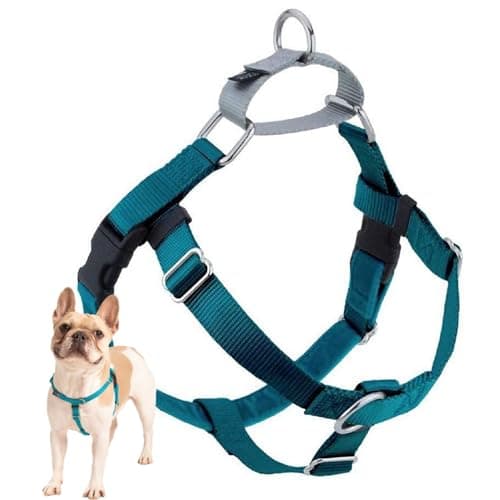
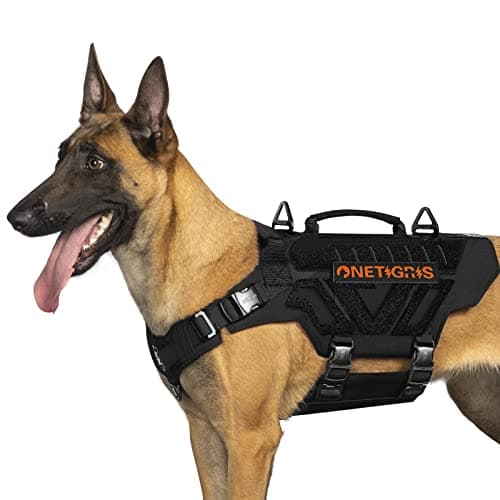
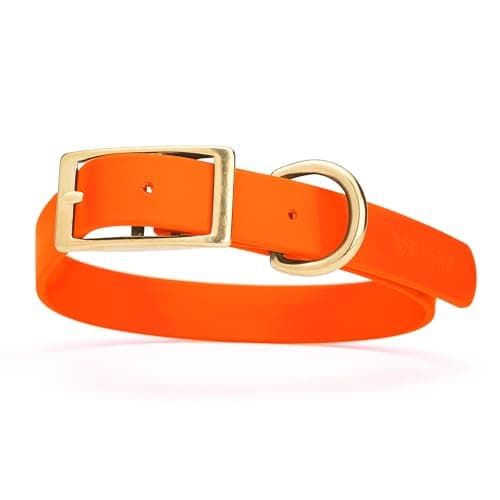
Dog Harness vs Collar
The received wisdom is that collars damage necks and harnesses are safer. The veterinary literature is markedly less certain than the internet is, in both directions.
This comparison is usually settled before it starts. Collars crush tracheas; harnesses are kind; the argument is over. We went and read the veterinary literature, and it is a good deal more interesting than that.
The short comparison
| Flat collar | Harness | |
|---|---|---|
| Documented risk | Embedded collars; raised intraocular pressure when pulled against; severe trauma in case reports | Altered gait and restricted thoracic excursion, in all types studied |
| Widely claimed but unevidenced | Thyroid, tracheal, jugular and carotid damage from routine leash pulling | That “non-restrictive” designs avoid the gait effect |
| Effect on pulling | Baseline | Back clip: measurably worse. Front clip: as good as a prong collar |
| Escape resistance | Poor — the easiest thing to back out of | Good, with a properly fitted three-strap design |
| Carries ID | Yes — and this is the reason to own one regardless | No |
| Failure mode | Dog is loose immediately | Usually still attached by a second strap |
What is actually documented about collars
The 2026 review of dog-worn equipment in Frontiers in Veterinary Science separates the known from the alleged, and the separation is not what most owners expect. In the author’s words:
“Claims of collar-related injury due to leash-pulling, such as damage to the thyroid gland, trachea, jugular veins, or carotid arteries, are not supported in the literature.”
Severe trauma — strangulation, hanging — is documented, but through case reports of catastrophic events rather than as a consequence of ordinary walking. The review notes that a normal canine trachea withstands considerable pressure without closing, while a trachea with pre-existing collapse does not. That last clause is the real clinical point, and it is the one that gets lost when the finding is compressed into “collars are fine.”
What is well documented is the embedded collar: a collar left on a growing or heavily coated dog, slowly overgrown, causing chronic pressure damage. That is a management failure rather than a design failure, and it is prevented by the two-finger check.
The eye-pressure finding, stated precisely
Pauli and colleagues (2006, JAAHA) measured intraocular pressure in 51 eyes of 26 dogs while force was applied through a collar or a harness. Intraocular pressure rose significantly from baseline when pressure was applied via the collar, and did not when it was applied via the harness.
The clinical conclusion drawn was specific: dogs with thin or weak corneas, with glaucoma, or with any condition where a rise in intraocular pressure could be harmful should wear a harness rather than a collar, particularly during activity. That is a real, cited reason to choose a harness — and it is a reason about a defined group of dogs, not a general indictment.
The harness side of the ledger
Harnesses are not free of findings either, and the same 2026 review is the source for the awkward one: multiple studies show that harnesses restrict thoracic excursion and alter shoulder extension during movement, regardless of whether the design is marketed as restrictive or non-restrictive. Individual dogs respond differently, and the review is explicit that the field suffers from “a paucity of evidence regarding best designs and best practices.”
Then there is pulling, where the evidence is unusually clean. Shih et al. (2021) measured leash tension in 52 dogs and found maximum tension of 16.87 N on a back-connection harness against 6.97 N on a collar, with dogs pulling for 67% of the time on the harness versus 35% on the collar. A back-clip harness does not merely fail to help; it measurably makes pulling worse. We take that apart in do harnesses help with pulling.
What we would actually do
Own both. Walk on the harness, keep the collar on for ID. That is not a fence-sit, it is what the evidence supports.
The collar earns its place because it carries the tag, and a tag is the thing that gets a loose dog home. It is also the piece of equipment that is on the dog when the harness is not. Buy it well — welded ring, decent hardware, correct fit — and check the fit monthly.
The harness earns its place for walking because it removes neck loading entirely, which matters a great deal for the specific dogs Pauli identified and a little for everyone else, and because a fitted three-strap harness is far harder to escape from than a flat collar. Choose a front attachment if the dog pulls. Accept the gait finding as a real trade-off and fit the thing properly, which is where most of the harm in a harness comes from anyway.
Three cases where the answer is not both
- A brachycephalic dog, or any dog with a diagnosed collapsing trachea: harness for walking, and this one is not a preference. The review is explicit that a trachea with pre-existing collapse behaves differently under pressure from a normal one.
- A dog with glaucoma, thin corneas, or after eye surgery: harness, per Pauli. Ask your vet — we review gear, we do not practice medicine.
- A dog that has ever backed out of a collar: harness, or a limited-slip collar, and never a plain flat collar on a walk again. An escape is not a wear problem, it is a road.
Frequently asked questions
Is a harness better than a collar for a dog?
For walking, usually — but for narrower reasons than the internet suggests. The strongest cited case is Pauli et al. (2006), which found intraocular pressure rose significantly when force was applied through a collar but not through a harness, and concluded that dogs with glaucoma, thin corneas or similar conditions should use a harness. The broader claims of tracheal, thyroid, jugular or carotid damage from routine leash pulling are, per a 2026 Frontiers in Veterinary Science review, not supported in the literature.
Do collars damage a dog's trachea?
The 2026 Frontiers in Veterinary Science review of dog-worn equipment states that collar-related injury to the trachea from leash pulling is not supported in the literature, and notes that a normal canine trachea withstands significant pressure without closing. The important exception is a trachea with pre-existing collapse, which does not behave the same way. Severe trauma from strangulation or hanging is documented, but through case reports of catastrophic events rather than ordinary walking.
Do harnesses affect a dog's gait?
Yes. The 2026 Frontiers review reports that multiple studies found harnesses restrict thoracic excursion and alter shoulder extension during movement, and that this held for all types studied — including designs marketed as non-restrictive. Individual dogs vary. The review also flags a general shortage of evidence on which designs are actually better, which is worth knowing before paying a premium for an 'ergonomic' cut.
Should my dog wear a collar and a harness at the same time?
That is what we would do, and it is what the evidence supports. Walk on the harness so nothing loads the neck, and keep a well-fitted flat collar on for identification — the tag is what gets a loose dog home, and the collar is the item that is on the dog when the harness is off. Check the collar's fit monthly with the two-finger rule, because embedded collars on growing or long-coated dogs are one of the few genuinely documented collar injuries.
Which is safer if my dog escapes?
A properly fitted three-strap harness, comfortably. A flat collar is the easiest thing in the category for a dog to reverse out of, and when it comes off the dog is loose immediately. A harness that fails at one strap usually still has the dog attached by another. If your dog has ever backed out of a collar, treat that as disqualifying for walking use.
Sources
Every spec on this page traces to one of these. Where a manufacturer does not publish a figure, we say “not published” rather than estimating it.
- Ridgway (2026) — “Health implications of dog-worn equipment: a review of known and alleged physical risks”, Frontiers in Veterinary Science 13:1711781
- Pauli, Bentley, Diehl & Miller (2006) — “Effects of the application of neck pressure by a collar or harness on intraocular pressure in dogs”, J. Am. Anim. Hosp. Assoc. 42(3):207–11
- Shih, Phillips, Mills, Yang, Georgiou & Paterson (2021) — “Dog Pulling on the Leash: Effects of Restraint by a Neck Collar vs. a Chest Harness”, Frontiers in Veterinary Science 8:735680
- Johnson & Wynne (2024) — “Comparing efficacy in reducing pulling and welfare impacts of four types of leash walking equipment”, PeerJ 12:e18131