The Best Heavy-Duty Dog Doors
You are cutting a permanent hole in an insulated wall. The three things that matter are how well it seals, what the frame is made of, and whether it lets anything else in.
Buy the PetSafe Extreme Weather for a cold climate: three flaps instead of one, in an aluminum frame. The flap count is a genuine construction difference and it works on the same principle as double glazing.
Buy the Ideal Ruff-Weather if the door is going through a wall rather than a door — its telescoping frame is what makes that practical — and the Power Pet if the real problem is other animals coming in.
Start from what this actually is
A dog door is a permanent hole in your building envelope, with a flexible cover. Everything good and bad about the category follows from that sentence.
It is an insulation problem: a flap is a poor seal compared with the door it is set into. It is a security problem: it is an opening, and a large dog door is a large opening. And it is a wildlife problem: raccoons, cats and neighboring dogs use dog doors, which is not a hypothetical in most of the country.
Those three problems are what separate the products here, and only one of them addresses all three.
Flap count is the insulation specification
A single flap seals with a magnet against a plastic frame. In wind it lifts, and in cold it stiffens and seals worse.
Dual flaps (Ideal Ruff-Weather) trap a layer of air between them. Same principle as double glazing, and it is a real improvement rather than a marketing one.
Three flaps (PetSafe Extreme Weather) trap two air layers. PetSafe publishes an energy-efficiency claim for it; we found no independent certification behind that claim and report it as the manufacturer’s own.
The trade-off is force. Every flap a dog has to push through adds resistance, and some dogs simply refuse a three-flap door. If your dog is timid or small, this is a real consideration and worth training for before you commit to cutting the hole.
Frame material is the durability specification
A dog door takes a shoulder impact twice a day for a decade. Plastic frames crack at the corners; aluminum does not.
That is most of the price difference between the PetSafe and the Ideal, and for a large dog it is the difference that matters. For a small dog a plastic frame is perfectly adequate and the money is better spent elsewhere.
Watch the flap magnets too. They weaken over years, and a door whose flap no longer closes firmly is a door that blows open in wind — which is usually the first sign a door needs replacing rather than repairing.
Quick picks
The short answer, ranked and scored against our published durability rubric. Where a manufacturer does not publish a spec, we say so rather than estimating it.
| # | Photo | Product | Durability | Price |
|---|---|---|---|---|
| 1 | 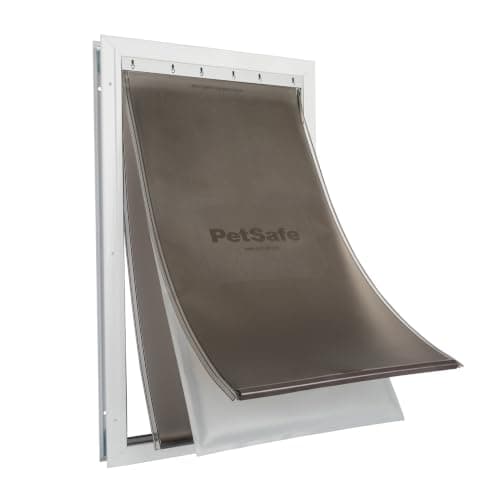 | PetSafe Extreme Weather Aluminum Pet DoorCold climates — three flaps instead of one | 73/100 | $164.99 · Amazon |
| 2 | 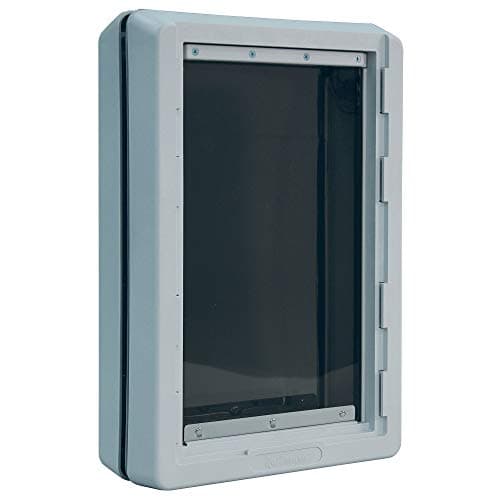 | Ideal Pet Products Ruff-Weather Pet DoorA double-flap door at a mid-range price | 61/100 | $114.99 · Amazon |
| 3 | 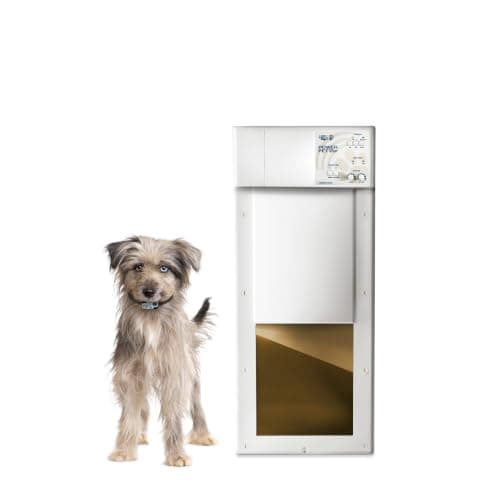 | High Tech Pet Power Pet Electronic DoorKeeping wildlife and neighbors' dogs out — a door that only opens for your dog | 70/100 | $419.00 · Amazon |
Tap any row to jump to the full review. Prices are pulled live from Amazon as of October 18, 2026; where we have no verified live price we show none rather than a stale number. #ad — how our links work.
The picks, ranked
1. PetSafe Extreme Weather Aluminum Pet Door
Durability score 73/100Best for: Cold climates — three flaps instead of one
The right dog door for a cold climate, and the flap count is the reason rather than the branding.
- Frame
- Aluminum
- Flap system
- Three flaps for insulation, per PetSafe
- Closing panel
- Included
- Energy rating
- PetSafe publishes an energy-efficiency claim; independent certification not stated
Pros
- Three flaps rather than one is a genuine construction difference, not a marketing one — it is the same logic as double glazing
- Aluminum frame rather than plastic, which is what survives a dog shouldering through it twice a day
- Includes a closing panel for when you want the door shut
Cons
- Three flaps take more force to push through, and some dogs refuse them
- The energy claim is PetSafe's own; we found no independent certification
- Installation in a door is straightforward, in a wall much less so
How we assessed it: on published materials, hardware specs and construction — not long-term chew-tested. We say so because it is true, and because a claim we cannot back is worth nothing to you.
#ad Price as of October 18, 2026; Amazon prices change often, so check before you buy. How our links work.
2. Ideal Pet Products Ruff-Weather Pet Door
Durability score 61/100Best for: A double-flap door at a mid-range price
The sensible mid-range door, and the best one here for going through a wall rather than a door.
- Frame
- Plastic with a telescoping tunnel for wall thickness
- Flap system
- Dual flaps
- Closing panel
- Included
- Wall installation
- Telescoping frame accommodates a range of wall thicknesses
Pros
- The telescoping frame makes wall installation genuinely practical, which most doors do not
- Dual flaps give real insulation over a single-flap door
- Well under half the price of the aluminum options
Cons
- Plastic frame, and that is where a big dog eventually breaks a pet door
- Flap magnets weaken over years, after which the door blows open in wind
- No independent energy certification
How we assessed it: on published materials, hardware specs and construction — not long-term chew-tested. We say so because it is true, and because a claim we cannot back is worth nothing to you.
#ad Price as of October 18, 2026; Amazon prices change often, so check before you buy. How our links work.
3. High Tech Pet Power Pet Electronic Door
Durability score 70/100Best for: Keeping wildlife and neighbors' dogs out — a door that only opens for your dog
The right answer if wildlife or neighboring dogs are the actual problem. Everything else here is a hole in your door with a flap on it.
- Operation
- Motorized panel that slides open on an ultrasonic collar signal
- Seal
- Solid panel with a weather seal rather than a flap
- Power
- Mains adapter, with battery backup options
- Collar
- Waterproof ultrasonic collar unit required
Pros
- A solid motorized panel seals far better than any flap, which makes it the best-insulating door here by construction rather than by claim
- Only opens for a dog wearing the collar unit, which genuinely excludes raccoons, cats and other dogs
- No flap for a determined dog to chew or a raccoon to push
Cons
- The most expensive by a very wide margin, and it needs power
- A power cut or a flat collar battery means a door that does not open
- Mechanically complex — there are motors and sensors where the others have a rubber flap
How we assessed it: on published materials, hardware specs and construction — not long-term chew-tested. We say so because it is true, and because a claim we cannot back is worth nothing to you.
#ad Price as of October 18, 2026; Amazon prices change often, so check before you buy. How our links work.
The electronic option, and when it is worth it
The Power Pet is a different machine. Instead of a flap, a motorized solid panel slides open when it detects an ultrasonic signal from a collar unit.
Two consequences follow, and both are significant:
- It seals properly. A solid panel with a weather seal is not a flap. This is structurally the best-insulating door here, by construction rather than by claim.
- It only opens for your dog. Raccoons, cats and neighboring dogs are excluded, which for a lot of households is the actual reason to buy one.
The costs are real: it is by far the most expensive, it needs mains power, and a power cut or a flat collar battery means a door that does not open. There are motors and sensors where the others have a rubber flap. Buy it if wildlife is the problem; do not buy it as a general-purpose upgrade.
Sizing, which is not the same as the dog’s height
- Measure the dog’s width at the widest point — usually the shoulders or, on a barrel-chested dog, the ribcage.
- Measure the shoulder height, floor to the top of the shoulder.
- Flap width should be at least two inches wider than the dog’s widest point.
- The rise — the height of the flap bottom above the floor — should be no higher than the dog’s lowest joint can step over comfortably. This is the measurement people get wrong, and it is the one that matters for an aging dog.
Note that a bigger flap is not automatically better: a larger opening is worse for insulation and worse for security, and an oversized flap is heavier for the dog to push.
The security question, answered honestly
A large dog door is a way into your house. Every product here includes a solid closing panel for exactly that reason, and using it is a habit worth forming for nights and holidays.
Placement helps more than hardware: a dog door in a fenced side return is a materially different proposition from one in a front door onto a street. And a door into a garage or a utility room, with an internal door beyond it, gives you a buffer that a direct external door does not.
Finally, a dog door only makes sense behind a secure boundary. If the garden is not dog-proof, the door is a hole through which your dog leaves — which brings you back to fencing and, if the fence is the problem, to a secure run instead.
Frequently asked questions
What is the best heavy-duty dog door?
The PetSafe Extreme Weather for a cold climate — three flaps instead of one, trapping two air layers on the same principle as double glazing, in an aluminum frame that survives a large dog shouldering through twice a day. The Ideal Ruff-Weather is the better choice for going through a wall, because its telescoping frame accommodates the wall thickness. PetSafe publishes an energy claim for the Extreme Weather; we found no independent certification behind it.
Do dual-flap dog doors actually insulate better?
Yes, and it is a construction difference rather than a marketing one — two flaps trap a layer of air between them, exactly as double glazing does, and three flaps trap two. The trade-off is force: every flap adds resistance the dog has to push through, and some dogs simply refuse a three-flap door. If your dog is small or timid, that is worth testing before you cut a permanent hole.
How do I size a dog door?
Measure the dog's width at its widest point — usually the shoulders, or the ribcage on a barrel-chested dog — and make the flap at least two inches wider than that. Then measure shoulder height. The measurement most people get wrong is the rise, the height of the flap bottom above the floor: it must be low enough for the dog to step over comfortably, which matters increasingly as the dog ages. Bigger is not better, since a larger opening is worse for insulation and security.
How do I stop raccoons coming through the dog door?
An electronic door is the only design here that genuinely solves it. The Power Pet uses a motorized solid panel that opens only on an ultrasonic signal from a collar unit, so there is no flap for another animal to push. It also seals far better than any flap. The costs are real: it is the most expensive by a wide margin, needs mains power, and a power cut or flat collar battery means a door that does not open.
Are dog doors a security risk?
A large one is a way into your house, which is why every door here ships with a solid closing panel — using it at night and on holidays is a habit worth forming. Placement helps more than hardware: a dog door in a fenced side return is very different from one in a front door onto the street, and a door into a garage or utility room with an internal door beyond it gives you a buffer. And a dog door only makes sense behind a genuinely dog-proof boundary.
Sources
Every spec on this page traces to one of these. Where a manufacturer does not publish a figure, we say “not published” rather than estimating it.