The Best Elevated Dog Feeders With Storage
The feeder half of these products is easy. The storage half is where they fail — and there is published federal guidance on how dry dog food should be kept that almost nothing in this category is designed around.
Buy the New Age Pet ecoFLEX Piedmont if you want a piece of furniture. It is the only station here that is not laminated particleboard — a composite of recycled polymer and wood fiber that New Age Pet calls impervious to moisture and odor — and it carries a 10-year limited warranty.
Buy the Gamma2 Vittles Vault alongside a feeder you already own if what you actually want is for the food to stay fresh. It is the only product here whose maker claims a genuine airtight, pest-proof seal, and the line runs from 10 lb to 60 lb so you can buy to the bag you actually carry home.
Buy the IRIS USA 15 in feeder if you buy big bags. It is the only feeder here that both seals and swallows a full large sack — up to 47 lb — with two removable 64 oz stainless bowls set into the lid.
The published guidance this whole category ignores
Before the products, the rule set. The FDA publishes storage instructions for dry pet food, and they are specific enough to shop by:
- Keep the food in its original bag. The FDA’s first instruction is to store pet food in the original container or bag, because that is what carries the UPC code, the lot number, the manufacturer and the “best by” date.
- If you want a container, put the whole bag inside it. Not pour — put. The guidance says plainly: “If you want to store dry pet food in another storage container, put the entire bag into the container rather than pour the kibble directly into it.”
- If you do pour, save the code. The FDA tells you to keep the UPC, lot number, product name, manufacturer and best-by date, and suggests taping that information to the outside of the container — and changing it when you open a new bag.
- Wash and dry the container between bags to get residual fat and crumbs off the surfaces. Wash and dry bowls after each use; wash water bowls daily.
- Store it below 80 F, cool and dry. The FDA is explicit that excess heat or moisture may cause the nutrients to break down. That is a straightforward argument against the garage in July.
The lot code point is not bureaucratic. It is the thing that tells you whether your bag is in a recall, and the FDA says less than half of the pet food complaints it receives include one. If you decant into a bin and bin the bag, you have thrown that away.
Read the category through that lens and it reorganizes itself. A feeding station with a drawer is not a food-storage solution and does not need to be one — it needs to be a clean, dry, wipeable box that a bag fits into. A container that seals is doing something different and genuinely useful. And a raw particleboard cabinet that absorbs fat and cannot be washed out is failing the only instruction that matters.
What we scored
- Does it seal, or does it just hold a bag? Both are legitimate — but only one of them is what the marketing implies. A threaded, gasketed lid is a real closure. A sliding wooden lid is a lid. We say which is which in every spec table on this page, and we do not treat “storage” and “airtight” as the same word.
- Capacity against the bag you actually buy. This is where most of these products quietly fail. A station that holds 15–20 lb is a mid-size bag; if you feed a big dog out of 40 lb sacks you are still storing most of it somewhere else, which defeats the point of buying furniture to hide it.
- Material, judged by what fat and moisture do to it. Kibble is oil-coated. Raw MDF and particleboard drink that oil at every cut edge and swell at the first spill; composite and food-grade plastic do not. Bowls are the same argument in miniature — stainless does not scratch into a surface that holds bacteria the way plastic does, which is why our stainless bowl roundup exists.
- Can you actually wash it out between bags? The FDA instruction is easy to say and hard to do with a 47 lb bin or a fixed cabinet. Round, smooth-walled containers empty and dry properly. Square boxes with internal corners and screwed-on panels do not.
One thing this page does not settle: height
Every product here raises the bowls, and raising the bowls is not automatically good. The 2000 JAVMA study by Glickman and colleagues found raised feeding associated with increased risk of gastric dilatation-volvulus in large and giant breed dogs — the opposite of how elevated feeders are usually sold. We are reporting that, not adjudicating it, and if you own a deep-chested dog it is a conversation with your vet rather than a shopping decision. The full treatment, including what later work has and has not shown, is on the elevated feeder roundup and in should you use a raised dog bowl. Settle the height question there; this page is about where the food lives.
Quick picks
The short answer, ranked and scored against our published durability rubric. Where a manufacturer does not publish a spec, we say so rather than estimating it.
| # | Photo | Product | Durability | Price |
|---|---|---|---|---|
| 1 | 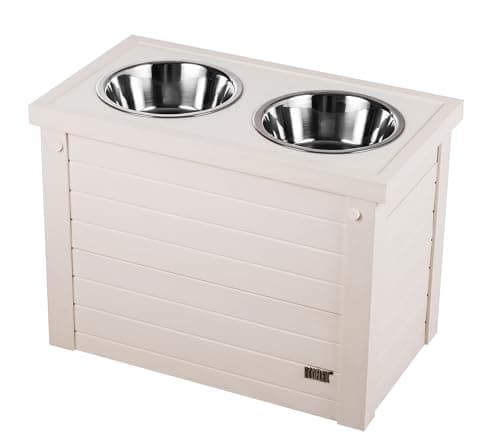 | New Age Pet ecoFLEX Piedmont Raised Diner with Food StorageThe furniture-style station that is not made of particleboard | 75/100 | $72.42 · Amazon |
| 2 | 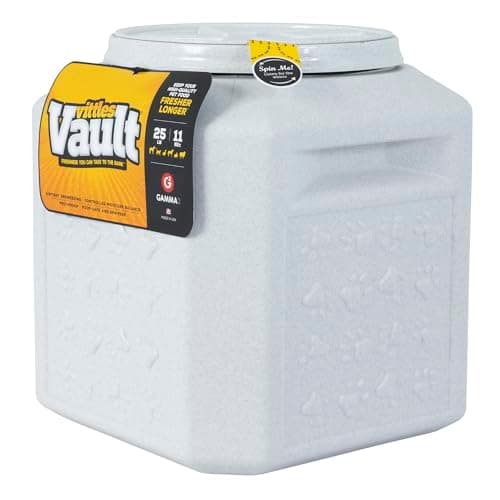 | Gamma2 Vittles Vault Pet Food Storage Container (25 lb)The storage half done properly - pair it with any feeder you already own | 72/100 | Check price |
| 3 | 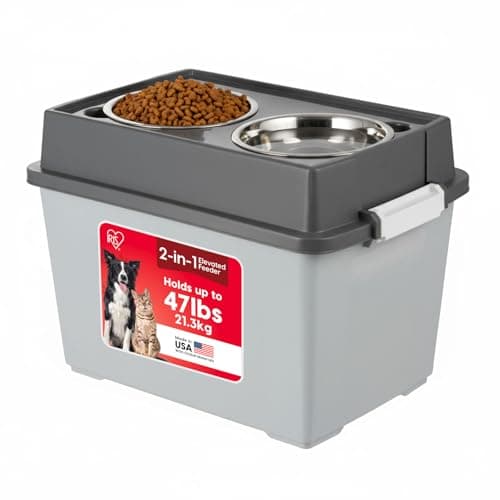 | IRIS USA Elevated Dog Bowls, 15 in with Airtight StorageThe most food capacity of anything here, in a feeder that seals | 70/100 | $39.98 · Amazon |
| 4 | 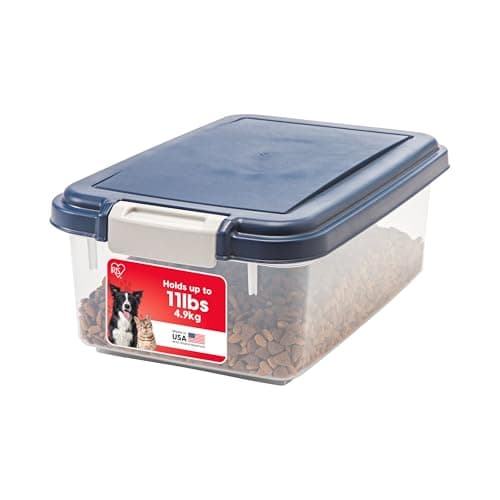 | IRIS USA Dog Food Storage Container (11 lb)Small dogs, small bags, and treats kept somewhere the dog cannot reach | 59/100 | $17.99 · Amazon |
Tap any row to jump to the full review. Prices are pulled live from Amazon as of October 18, 2026; where we have no verified live price we show none rather than a stale number. #ad — how our links work.
The picks, ranked
1. New Age Pet ecoFLEX Piedmont Raised Diner with Food Storage
Durability score 75/100Best for: The furniture-style station that is not made of particleboard
The only furniture-style feeding station here we would put money on, because the material and the warranty are real - just do not mistake its bin for an airtight container.
- Material
- ecoFLEX - New Age Pet's composite of recycled polymers and reclaimed wood fiber
- Moisture
- New Age Pet describes ecoFLEX as 'impervious to moisture and odor'
- Bowls
- Two stainless steel, 32 oz each
- Storage capacity
- 15-20 lb of food, held in a resealable storage bag inside the compartment
- Is the compartment airtight?
- No. It is a lidded bin - the seal is the bag inside it, which is what the FDA recommends anyway
- Warranty
- 10-year limited, on ecoFLEX parts, with proof of purchase
- Load rating
- Not published
Pros
- ecoFLEX is the reason to buy it: a recycled-polymer and wood-fiber composite that the maker calls impervious to moisture and odor, in a category where almost everything else is laminated particleboard
- A 10-year limited warranty - by a distance the longest term anything in this category carries
- Two 32 oz stainless bowls rather than plastic, so the food surface is the one material that does not scratch into a bacteria trap
- The compartment is sized and shaped for a bag rather than for loose kibble, which is exactly how the FDA says to store dry food
- Wipes out properly between bags - there is no raw MDF edge to soak up fat
Cons
- The storage is not airtight. If you pour kibble straight in, you are relying on a plastic bag and a loose lid, and you have thrown away the lot code with the bag
- 15-20 lb is a mid-size bag. If you buy 40 lb sacks for a big dog, this holds half of one and you still need somewhere for the rest
- Fixed height, and the height question is a veterinary one for deep-chested breeds rather than a furniture one
- No published weight rating for the top surface
- The most expensive of the two actual feeders here
How we assessed it: on published materials, hardware specs and construction — not long-term chew-tested. We say so because it is true, and because a claim we cannot back is worth nothing to you.
#ad Price as of October 18, 2026; Amazon prices change often, so check before you buy. How our links work.
2. Gamma2 Vittles Vault Pet Food Storage Container (25 lb)
Durability score 72/100Best for: The storage half done properly - pair it with any feeder you already own
The honest answer to the storage half: a genuinely sealed container in the size of your actual bag, bought alongside a feeder rather than instead of one.
- This size
- Fits up to 25 lb; the listing states 12 in L x 13.75 in H and 'Made in the USA'
- Seal
- Gamma Seal threaded lid; Petmate describes the line as having 'airtight, pest-proof seals'
- Material
- BPA-free, food-grade plastic (Petmate)
- Size range
- The line runs from 10 lb to 60 lb, so you can buy to your bag rather than to a shelf
- Stackable
- Yes on the stackable models
- Warranty
- Not published
Pros
- It is the only thing on this page whose maker claims an actual airtight, pest-proof seal rather than a lid that sits on a box
- A threaded lid tightens against a gasket, which is a fundamentally better closure than a snap latch that loosens as the plastic ages
- The range spans 10-60 lb, so you can match the container to the bag you actually buy instead of decanting into something too small
- Round, smooth-walled and completely emptyable - which is what makes the FDA's 'wash and dry between bags' instruction realistic rather than theoretical
- This size is stated as Made in the USA on the listing
Cons
- It is not a feeder. You still need somewhere to put the bowls, and it will not look like furniture in a kitchen
- Gamma2 publishes no warranty term that we can find
- The gasket is a wear part - it is sold as a spare for a reason, and a flattened gasket quietly stops being airtight
- The threaded lid is slower to open than a flip lid, which matters twice a day for years
- If you decant, the bag goes in the bin and the lot code goes with it unless you tape it to the side
How we assessed it: on published materials, hardware specs and construction — not long-term chew-tested. We say so because it is true, and because a claim we cannot back is worth nothing to you.
#ad We only show a price when we have a live one from Amazon. We don’t have one for this product right now, so we’re not going to guess. How our links work.
Search Amazon for the Gamma2 Vittles Vault Pet Food Storage Container (25 lb)
3. IRIS USA Elevated Dog Bowls, 15 in with Airtight Storage
Durability score 70/100Best for: The most food capacity of anything here, in a feeder that seals
The most practical single object here if you buy big bags: it is the only feeder on this page whose storage actually seals, and it holds twice what the furniture does.
- Storage capacity
- Up to 47 lb - the only one here that swallows a full large bag
- Seal
- IRIS states an airtight container with buckle-reinforced lid
- Bowls
- Two removable stainless steel, 64 oz each, set into the lid
- Height
- 15 in to the bowl
- Material
- Plastic body with stainless bowls
- Origin
- Made in USA per the listing
- Warranty
- Not published
Pros
- 47 lb of capacity in a sealed container - it is the only product here that takes a full large bag and closes properly on it
- Two 64 oz removable stainless bowls, which are both bigger and better material than the plastic dishes most 2-in-1 feeders ship with
- One object instead of two: the feeder is the container, so nothing else takes up floor space
- Made in USA per the listing, in a category that is almost entirely imported
- 15 in is a genuinely tall feeder for a large dog - read the height section before you take that as a benefit
Cons
- The bowls sit in the lid, so every meal opens the food store - the seal is only as good as your habit of closing it properly
- Plastic body. It will not soak up fat the way raw MDF does, but it scratches, and scratched plastic is harder to get properly clean
- No published warranty at all
- A 47 lb bin is heavy and awkward to lift out and wash, which is exactly the maintenance the FDA asks for between bags
- It looks like a plastic bin, because it is one
How we assessed it: on published materials, hardware specs and construction — not long-term chew-tested. We say so because it is true, and because a claim we cannot back is worth nothing to you.
#ad Price as of October 18, 2026; Amazon prices change often, so check before you buy. How our links work.
4. IRIS USA Dog Food Storage Container (11 lb)
Durability score 59/100Best for: Small dogs, small bags, and treats kept somewhere the dog cannot reach
The small-bag answer and a good treat bin - bought with clear eyes about the latch, which is the part that will eventually give.
- This size
- 12 qt, holds up to 11 lb of dry food (IRIS notes actual capacity varies by kibble)
- Seal
- Foam seal with snap-lock latches; IRIS describes it as airtight
- Material
- BPA-free translucent plastic
- Origin
- Made in USA per the listing
- Format
- Low profile for a shelf or cabinet; stacks
- Warranty
- Not published
Pros
- The cheapest genuinely sealed option here, and the right size for a small dog's bag rather than a scoop of a big one
- A translucent body means you can see the level without opening it, which is a small thing you appreciate daily
- Low profile: it fits in a cabinet, which is the coolest and driest place most homes have and where the FDA wants dry food kept
- Made in USA per the listing
- Doubles honestly as a treat bin, which is the other thing dogs break into
Cons
- A foam seal with snap latches is a weaker closure than a threaded, gasketed lid - foam compresses and takes a set over time
- 11 lb is genuinely small. For a medium or large dog this is a treat bin, not a food store
- Plastic latches are the failure point, and there is no published warranty behind them
- Square internal corners hold crumbs and fat where a round container does not
- It is storage only, with no feeding function at all
How we assessed it: on published materials, hardware specs and construction — not long-term chew-tested. We say so because it is true, and because a claim we cannot back is worth nothing to you.
#ad Price as of October 18, 2026; Amazon prices change often, so check before you buy. How our links work.
The combination most households should actually buy
The uncomfortable finding of this page is that the integrated products are usually the compromise. A feeding station has to be furniture, storage and a stand at once, and the part that gets compromised is nearly always the seal or the capacity.
For most people the better buy is two objects: a feeder chosen on height and bowl material, plus a container chosen on seal and bag size. It is usually cheaper than the furniture, each half does its own job properly, and the container can live somewhere cool and dark rather than next to a radiator because that is where the stand looks right. Start from the elevated feeder roundup for the stand and take the Vittles Vault for the food.
Buy the integrated station instead when the constraint is space or tidiness rather than freshness — a small kitchen, an apartment, a household where the bag on the floor is the actual problem being solved. That is a real reason, and the Piedmont is the one we would buy for it.
Where the bag actually goes
The practical version of the FDA guidance, in the order you do it:
- Buy the container to the bag, not the shelf. A 25 lb container and a 30 lb bag is a daily annoyance and a bag of kibble left open on the floor.
- Put the bag in whole. Roll the top down and clip it. You keep the fat barrier the bag is built to be, you keep the lot code, and the container becomes the second line of defense rather than the only one.
- If you must decant, photograph the bag first — or tape the panel with the UPC, lot number and best-by date to the container, and swap it every time you open a new bag. The FDA suggests exactly this.
- Empty and wash between bags, not between years. Old fat at the bottom of a bin goes rancid and taints the new food you pour on top of it. This is the single most skipped step in dog ownership and it costs nothing.
- Keep it below 80 F. Inside the house, out of sun, away from the dryer and the radiator. A sealed container in a hot garage is still a hot container.
Pests, humidity and the garage
Three practical points, stated at the level we can actually support.
A sealed lid is a pest barrier; a bag is not. Petmate markets the Vittles Vault line specifically on airtight, pest-proof seals, and that is the honest reason to own one if you store food in a garage, a basement or a barn. It is also the reason we would not store a bag inside an unsealed wooden cabinet in those places.
Humidity is the quiet one. The FDA’s instruction pairs heat and moisture for a reason: damp kibble is where mold gets its start, and mold in stored grain is a genuinely serious hazard rather than a cosmetic one. If your storage spot is damp, the sealed container stops being optional.
What we will not tell you is how long kibble stays good after opening. The makers give different answers, the best-by date on the bag assumes it is unopened, and we have no test data of our own. What we can tell you is what the bag and the container are each for, and that buying a month’s food at a time is a better answer than buying three months and a bigger bin.
What we would not buy
- A raw MDF or particleboard feeding station. This is most of what the search returns. Kibble is oil-coated and a food cupboard is a wet environment; laminated chipboard swells at the edges and takes on the smell within a year. If the listing does not say what the panels are made of, assume this is what they are made of.
- Anything you cannot get a hand and a cloth into. If the bin is fixed, deep and square, you will not wash it between bags and the fat will build up.
- A station whose bowls are plastic and not removable. Bowls are washed daily by FDA guidance; anything that makes that harder is a design mistake. Removable stainless is the bar, and it is met by everything ranked here.
- “Airtight” used for a lid that just sits on a box. A hinged wooden lid with no gasket is not a seal, whatever the listing calls it. This distinction is in every spec table on this page for a reason.
- A container too small for your bag. It sounds trivial and it is the most common regret in this category. Measure the bag, then buy.
If what you are actually solving is a dog that raids the bin rather than food that goes stale, that is a latch problem and a location problem — the same logic as crate furniture: the pretty version and the dog-proof version are rarely the same product, and the FDA’s own advice for a persistent dog is to store the food somewhere it cannot get to at all.
Frequently asked questions
Do you need an airtight container for dog food?
It depends where you store it, and it is not the FDA's first instruction. The FDA's guidance is to keep pet food in its original bag - which carries the UPC, lot number and best-by date - and, if you want a container, to put the whole bag inside it rather than pour the kibble in. A genuinely airtight container earns its keep when the storage spot is damp, hot or exposed to pests, such as a garage, basement or barn: Petmate markets the Vittles Vault line on airtight, pest-proof seals, and that is the case where the seal does real work. In a cool, dry kitchen cupboard, bag-inside-a-clean-bin is already doing most of the job.
Should you keep dog food in the bag or pour it into a container?
Keep the bag. The FDA is explicit: 'If you want to store dry pet food in another storage container, put the entire bag into the container rather than pour the kibble directly into it.' Two reasons. The bag is built as a fat and moisture barrier, and it carries the lot number that identifies your specific batch if there is a recall - the FDA notes that fewer than half of the pet food complaints it receives include one. If you do decant, save the UPC, lot number, product name, manufacturer and best-by date, and tape that panel to the container.
What size food storage container do I need for a 40 lb bag?
Buy the container to the bag, not to the space. The Gamma2 Vittles Vault line runs from 10 lb up to 60 lb, so a 40 lb bag wants the 40 lb model or larger - and larger is the safer error, because a bag that goes in whole needs more room than loose kibble does. Among the feeding stations here, the IRIS USA 15 in unit holds up to 47 lb, which is the only one on this page that takes a full large sack. The New Age Pet Piedmont holds 15-20 lb, which is a mid-size bag.
Are wooden dog feeding stations with storage any good?
Most of them are laminated particleboard, and particleboard is the wrong material for a container that holds oil-coated food in a room where things get spilled: the cut edges absorb fat and moisture and swell. The exception on this page is the New Age Pet Piedmont, which is made of ecoFLEX - the maker's composite of recycled polymers and reclaimed wood fiber, which it describes as impervious to moisture and odor - and which carries a 10-year limited warranty. If a listing will not tell you what the panels are made of, treat that silence as the answer.
How often should you clean a dog food container?
Between bags, every time. The FDA's instruction is to wash and dry the storage container between finishing one bag of kibble and filling it with another, specifically to get residual fat and crumbs off the surfaces - old fat goes rancid and taints the food poured on top of it. Bowls are a shorter cycle: wash and dry food bowls after each use, and wash water bowls daily. This is worth checking before you buy, because a deep, square, fixed bin is a container you will not actually wash.
Where should dog food be stored?
Somewhere cool, dry and below 80 F, per the FDA - excess heat or moisture may cause the nutrients to break down, which rules out most garages in summer and anywhere next to a radiator, a dryer or a sunny window. Inside the house, in a cupboard or a sealed container, is the straightforward answer. If your dog is persistent about getting into the food, the FDA's own advice is to store it somewhere the dog cannot access rather than relying on a latch.
Sources
Every spec on this page traces to one of these. Where a manufacturer does not publish a figure, we say “not published” rather than estimating it.
- FDA — Proper Storage of Pet Food & Treats (original bag, whole-bag-in-container, wash between bags, store below 80 F, wash bowls after each use)
- FDA — Save Your Pet Food Lot Number (why the code on the bag is what identifies a recalled batch)
- New Age Pet — Piedmont Pet Diner: ecoFLEX composition, 'impervious to moisture and odor', two 32 oz stainless bowls, 15–20 lb storage, 10-year limited warranty
- Petmate / Gamma2 — Vittles Vault line: 'airtight, pest-proof seals', BPA-free food-grade plastic, sizes from 10 lb to 60 lb
- IRIS USA — Elevated Dog Bowls 15 in with airtight storage: up to 47 lb capacity, two removable 64 oz stainless bowls, Made in USA
- IRIS USA — Dog Food Storage Container, up to 11 lb: 12 qt, foam seal with snap-lock latches, BPA-free, Made in USA
- Glickman et al. (2000) — “Non-dietary risk factors for gastric dilatation-volvulus in large and giant breed dogs”, JAVMA 217(10):1492–9 (the study that found raised feeders associated with INCREASED risk)