Leather vs Nylon Dog Collar
The honest answer depends entirely on which leather. Full-grain is the longest-lived collar material there is. Bonded leather is shredded offcuts in glue, and it fails faster than webbing.
The comparison people want is leather versus nylon. The comparison that actually decides the outcome is full-grain leather versus everything else sold as leather, because the gap inside the leather category is far wider than the gap between good leather and good nylon.
The four things sold as leather
The grading language is standard and it is not marketing — it describes where in the hide the material came from, which determines how the fibers run.
- Full grain — the outermost layer of the hide with the grain surface intact. The fiber structure is densest here, which is why it is the strongest and why it develops a patina instead of wearing through. This is the buy-it-for-life material.
- Top grain — full grain with the surface sanded and refinished to remove blemishes. Slightly weaker, more uniform-looking, still genuinely good.
- Corrected grain / genuine leather — a lower split, heavily sanded and embossed with a fake grain pattern. “Genuine leather” is a grade, and it is a low one. It is real leather and it is not good leather.
- Bonded leather — leather dust and shredded offcuts mixed with polyurethane and rolled onto a backing. It is to leather what particle board is to timber. It cracks, delaminates and fails, and it fails faster than $8 nylon webbing.
Watch how a product page words it. A maker with full-grain leather says “full grain,” because it costs more and they want the credit. A page that says only “genuine leather” or, worse, just “leather,” is usually declining to specify — and in this category declining to specify almost always means the answer is further down the list.
The comparison, once you have the good leather
| Full-grain leather | Nylon webbing | |
|---|---|---|
| Service life, dry use | Years; often outlives the dog | Years, but fades and softens progressively |
| Wet and muddy use | Poor unless maintained — dries hard, cracks, rots stitching | Good; dries fast, no maintenance |
| Swimming and salt | Bad. Repeated soaking destroys it | Tolerable; holds odor badly |
| Odor | Resists it | Absorbs it permanently |
| UV degradation | Minor — dries out rather than weakens | Real; fades and loses tensile strength |
| Failure mode | Gradual — the leather cracks visibly before it parts | Gradual at the strap, sudden at the hardware |
| Maintenance | Required: condition it, and never dry it near heat | None, beyond rinsing salt out |
The rolled-leather case, which is genuinely different
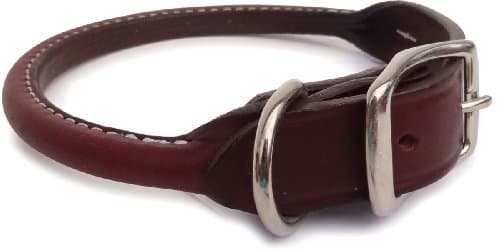
A rolled leather collar is a cylinder of leather rather than a flat strap, and it is the one design that solves a problem neither flat leather nor nylon can. On a long-coated dog, a flat collar parts and mats the coat along its edges; a round section slides through the coat instead of cutting into it.
If you have a setter, a collie, a spaniel or anything else with feathering at the neck, this is not a style preference — it is the reason the design exists. We cover the specific ones worth owning in our durable collar roundup.
The third option that beats both for wet dogs
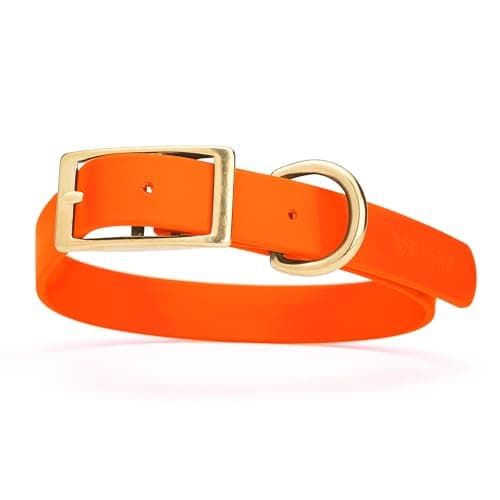
We would be doing you a disservice to run this as a two-way comparison and not mention biothane, because for a dog that swims it beats both materials outright.
Biothane is a polyester webbing core sealed inside a TPU or PVC coating. There is nothing exposed to absorb water, hold odor or rot. BioThane publishes a 1,000 lb break strength for its standard 1 in Beta 520 strap — a real, published figure, which by itself puts it ahead of most of this category on evidence. It wipes clean, it does not stiffen, and it does not smell.
What it is not is handsome in the way a good leather collar is handsome, and it is slick in the hand on a long line. The full treatment is in biothane versus leather.
Whichever strap you buy, the hardware decides it
This is the point we end up making on nearly every page in this hub, because it keeps being the finding. The strap is almost never what fails.
BioThane’s own numbers make the case: the strap breaks at 1,000 lb; the buckle rated to hold it is rated at 200 lb. The same asymmetry exists in leather and in nylon, and it is worse in cheap versions of both, because a maker cutting cost cuts the buckle first — it is the part nobody photographs.
So: a welded D-ring rather than a split ring. Stainless or solid brass rather than plated zinc, especially if the dog gets wet. A cast buckle rather than a stamped one. Those three choices matter more than leather-versus-nylon does, and they cost a few dollars.
The straight answer
Buy full-grain leather if the dog is mostly dry, if you will condition it once or twice a year, and if you want a collar that looks better in five years than it does today. It is the longest-lived collar material there is, on the condition that you look after it.
Buy nylon if the dog is wet, muddy, or in and out of water, if the collar will be ignored rather than maintained, or if you want the lowest-hassle option. Buy it with metal hardware and it will outlast several leather collars that were never conditioned.
Do not buy bonded or unspecified “genuine” leather at all. It is the one clear loser in this comparison — worse than good leather by a distance and worse than cheap nylon too, while costing more than the nylon.
One thing this comparison deliberately does not do is make a safety claim about leather. Nobody in the category publishes a tannage, so that claim cannot be sourced in either direction. What can be checked — whether a buckle-and-tongue closure can be released in a hurry, what the hardware is made of, and why repeated soakings are the thing that really ends a leather collar — is on are leather dog collars safe.
Frequently asked questions
Is a leather or nylon dog collar better?
Full-grain leather lasts longer than nylon on a dog that stays mostly dry and gets its collar conditioned once or twice a year. Nylon wins for a dog that swims, works in mud or gets its collar ignored, because it dries fast and needs no maintenance. The decisive variable is not the material but the grade: bonded and unspecified 'genuine' leather are outlasted by cheap nylon webbing.
What is the difference between full grain and genuine leather?
They are grades, and 'genuine leather' is a low one. Full grain is the outermost layer of the hide with the grain intact, where the fiber structure is densest — it is the strongest leather and it patinas rather than wearing through. 'Genuine leather' typically means a lower split, heavily sanded and embossed with an artificial grain pattern. A maker with full grain says 'full grain' on the page, because it costs more and they want the credit for it.
Is bonded leather any good for a dog collar?
No. Bonded leather is leather dust and shredded offcuts mixed with polyurethane and rolled onto a backing — particle board rather than timber. It cracks and delaminates, and it fails faster than inexpensive nylon webbing while usually costing more. It is the one material in this comparison we would tell you to avoid outright.
Can a leather dog collar get wet?
Occasionally, yes; repeatedly, no. Water strips the oils out of leather, and drying — especially near heat — leaves it hard and cracked, with the stitching rotting before the leather does. A dog that swims regularly should not be in leather. If a leather collar does get soaked, dry it slowly at room temperature and condition it once it is dry, never in front of a radiator.
What is a rolled leather collar for?
Long coats. A flat collar parts and mats the coat along both its edges; a round cross-section slides through the coat instead of cutting into it. On a setter, collie, spaniel or any breed with neck feathering, that is a functional reason to choose rolled leather rather than a styling one.
What about biothane instead of leather or nylon?
For a dog that swims, biothane beats both. It is a polyester webbing core sealed inside a TPU or PVC coating, so there is nothing exposed to absorb water, hold odor or rot, and BioThane publishes a 1,000 lb break strength for its standard 1 in Beta 520 strap. The trade-offs are that it lacks the character of good leather and is slick in the hand on a long line.
Sources
Every spec on this page traces to one of these. Where a manufacturer does not publish a figure, we say “not published” rather than estimating it.
- Leather grades — full grain, top grain, corrected grain and splits, explained
- BioThane — Beta 520 PET material spec (1,000 lb strap break strength; 200 lb buckle pull strength)
- Denier explained — ASTM D1907 skein method (grams per 9,000 meters)
- Cordura — Classic fabric yarn sizes (330D / 500D / 700D / 1000D)
- BioThane — what the material actually is (polyester core, TPU/PVC coating)