How to Make a Chew-Proof Dog Bed
You can meaningfully improve a bed at home. What you cannot do is make an indestructible one, and past a certain point the DIY costs more than the bed you were avoiding.
Start with the honest frame. No bed is chew-proof. K9 Ballistics — a company whose entire business is chew-resistant beds — says in its own FAQ that no bed is 100% indestructible. Big Barker says a determined dog could chew through its bed. If the makers will not claim it, neither will we, and neither should any DIY guide.
What you can do at home is remove the things a dog starts on, and buy yourself months. Here is what actually works, in the order we would do it.
Six steps, in order of effect
Remove every seam, zip and tag the dog can reach. This is the single highest-value step and it costs nothing. Dogs almost never start in the middle of a panel — they start at an edge, a corner, a zip pull or a piping seam, because that is where there is something to get a tooth behind. Cut off tags flush. Tuck or tape zip pulls. If there is exposed piping, that is your bed’s weak point.
Put the bed inside a heavy canvas cover with no exposed edges. A duvet cover made from 10–12 oz cotton duck, sewn closed rather than zipped, with the seams turned inside. Canvas will not stop a determined dog, but it removes the edges and it is cheap to replace. Carhartt sells a bed using a 12 oz duck shell for exactly this reason — abrasion resistance and no soft edge.
Get the bed off the floor or fit it tight to the crate. A bed with a free edge in the middle of a room is a target. A bed cut to the exact crate footprint has no lifted corner to pull. Elevation removes the diggable surface entirely, which is a different failure mode covered in beds for diggers.
Switch to solid foam and lose the shredded fill. Shredded fill is a bag of individually swallowable pieces. A single block of foam fails as one object you can see, rather than as a hundred you find in the garden. This is a safety step more than a durability one.
Upgrade the fabric — with your eyes open on cost. Ballistic nylon is the real material: K9 Ballistics publishes 1200 denier for its Armored line and describes it as densely woven, similar to flak-jacket fabric. You can buy ballistic nylon and Cordura by the yard. Price it first. By the time you have bought enough fabric, thread rated for it and a machine that will actually sew it, you are usually within reach of a finished bed that comes with a warranty.
Sew with the right thread and turn every seam inward. If you are sewing: bonded nylon or polyester thread, a heavy needle, and every seam allowance turned to the inside so no raw edge is presented to a tooth. A bartack at each corner is worth more than a decorative topstitch anywhere.
The one step that does not work
Bitter sprays. They are the most-recommended fix on the internet for this problem and in our view the least useful. They wear off, they need reapplying constantly, plenty of dogs simply do not care, and some dogs treat a novel smell as a reason to investigate the bed more thoroughly rather than less.
More importantly, a spray addresses none of the actual causes. A dog destroying its bed is usually bored, under-exercised, teething or anxious, and none of those is a flavor problem.
When to stop and buy the bed
Three signals that the DIY is the wrong move:
- You have rebuilt it twice. Two repairs is the market telling you the approach is wrong.
- Your fabric bill is approaching the price of a warranted bed. Ballistic nylon by the yard is not cheap, and your seams carry no warranty at all.
- The dog is eating the material. Not shredding it — ingesting it. Stop immediately, remove all soft bedding, and talk to a vet. Foreign-body obstruction is a surgical emergency and no fabric upgrade addresses it.
The three products below are what we would buy at that point, and why the warranty is the thing to compare.
Quick picks
The short answer, ranked and scored against our published durability rubric. Where a manufacturer does not publish a spec, we say so rather than estimating it.
| # | Photo | Product | Durability | Price |
|---|---|---|---|---|
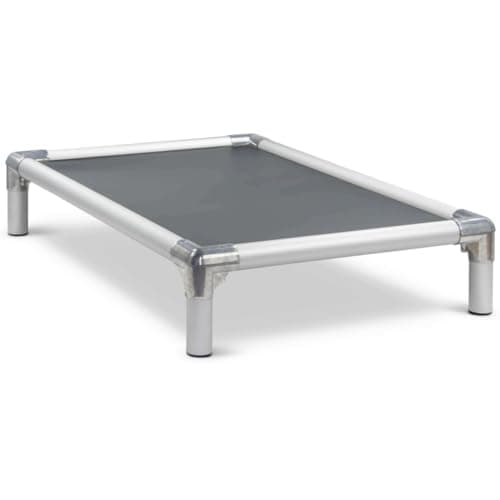
| 1 | 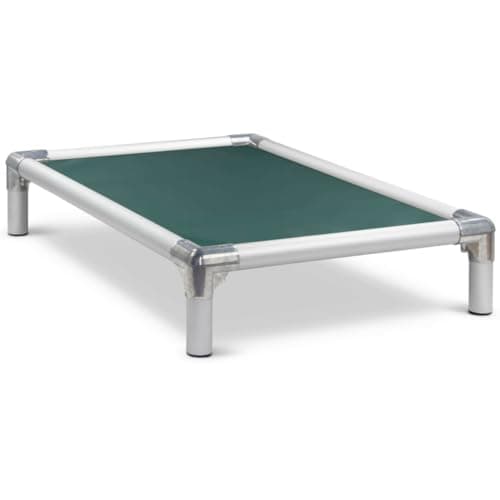 | Kuranda Chewproof Aluminum Elevated BedThe most confident chew warranty in the bed category | 91/100 | $144.95 · Amazon |
| 2 | 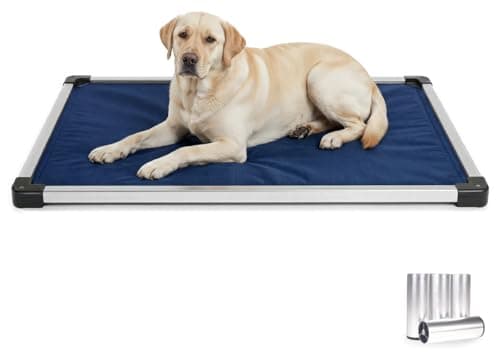 | K9 Ballistics Chew Proof Armored BedA soft bed for a chewer, with a real replacement promise | 77/100 | $165.00 · Amazon |
| 3 | 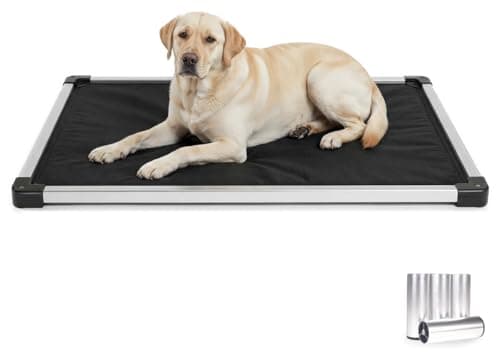 | K9 Ballistics Tough Crate PadThe only crate pad here with a genuine chew-replacement promise | 82/100 | $165.00 · Amazon |
Tap any row to jump to the full review. Prices are pulled live from Amazon as of October 18, 2026; where we have no verified live price we show none rather than a stale number. #ad — how our links work.
The picks, ranked
1. Kuranda Chewproof Aluminum Elevated Bed
Durability score 91/100Best for: The most confident chew warranty in the bed category
The most defensible chew-proof bed on the market, because Kuranda is the only maker willing to warrant its bed against the dog for a full year.
- Frame
- Aircraft-grade aluminum; stainless steel fasteners
- Weight rating
- Up to 250 lb (aluminum frame)
- Fabrics
- 40 oz heavy-duty vinyl, ballistic nylon, Cordura, or outdoor mesh
- Sizes
- 25x18 through 50x36 in
- Chew warranty
- 1 year — and it explicitly covers damage from digging and scratching
- Fabric denier
- Not published — Kuranda says only 'high-denier nylon'
Pros
- A one-year chew warranty is the longest and most confident in the entire bed category — four to twelve times longer than the rest
- Uniquely, the warranty explicitly covers damage from digging and scratching, not just manufacturing defects
- There is no foam and no stuffing to disembowel — the failure mode is a torn fabric panel, which is replaceable
- Off the ground: no absorbed urine, no mold, and it stays cool
- Aluminum frame rated to 250 lb, with stainless fasteners that will not rust
Cons
- Outdoor mesh, bed pads and accessories are NOT covered by the chew warranty — read which fabric you are buying
- Cosmetic damage is excluded, and marketplace purchases must be claimed through the retailer, not Kuranda
- Kuranda will not publish an actual denier number for its fabrics
- Hard surface — an elevated cot is not a soft bed, and an older dog with joint pain may not thank you
How we assessed it: on published materials, hardware specs and construction — not long-term chew-tested. We say so because it is true, and because a claim we cannot back is worth nothing to you.
#ad Price as of October 18, 2026; Amazon prices change often, so check before you buy. How our links work.
2. K9 Ballistics Chew Proof Armored Bed
Durability score 77/100Best for: A soft bed for a chewer, with a real replacement promise
The best soft bed for a chewer, and the only one whose maker publishes a fabric denier — but the clock runs out after 120 days.
- Fabric
- 1200 denier ballistic — 'densely woven, similar to that used in flak jackets'
- Chew warranty
- 120 days, one-time replacement
- Armored line coverage
- Full bed replacement (not cover-only)
- Foam density
- Not published
Pros
- 1200 denier ballistic fabric is a real, published number — most bed makers will not give you one
- The Armored line gets a full bed replacement under the 120-day warranty, not just a cover
- A soft, padded bed a chewer can actually use, unlike a cot
Cons
- 120 days is one-time only, and it is four times shorter than Kuranda's
- K9 Ballistics does not publish foam density anywhere
- Their 10-year and 1-year warranties both explicitly exclude chewing — only the 120-day one covers it
- K9 Ballistics themselves say plainly: no bed is 100% indestructible
How we assessed it: on published materials, hardware specs and construction — not long-term chew-tested. We say so because it is true, and because a claim we cannot back is worth nothing to you.
#ad Price as of October 18, 2026; Amazon prices change often, so check before you buy. How our links work.
3. K9 Ballistics Tough Crate Pad
Durability score 82/100Best for: The only crate pad here with a genuine chew-replacement promise
The crate pad to buy if the dog chews, and the only one whose maker will do something about it when the dog wins.
- Fabric
- Ballistic weave; K9 Ballistics publishes 1200 denier on its Armored line
- Format
- Flat pad sized to standard crate footprints
- Chew coverage
- K9 Ballistics chew replacement, per its published warranty terms
- Fill density
- Not published
- Washability
- Removable cover
Pros
- The only crate pad in this roundup backed by a chew-replacement promise rather than a defects-only warranty
- Ballistic weave is a real fabric category rather than a marketing adjective — K9 Ballistics publishes 1200 denier across its chew-resistant line
- Flat profile fits a crate without bunching, which is what defeats a folded bed
- Removable, washable cover — the thing that actually determines whether a crate pad survives a year
Cons
- Fill density is not published, so orthopedic support cannot be verified
- By a wide margin the most expensive pad here
- Chew coverage is a replacement promise, not an indestructibility claim — a determined dog will still open it
How we assessed it: on published materials, hardware specs and construction — not long-term chew-tested. We say so because it is true, and because a claim we cannot back is worth nothing to you.
#ad Price as of October 18, 2026; Amazon prices change often, so check before you buy. How our links work.
Why the warranty is the real spec here
This is the central finding of our whole beds hub, and it applies directly to the build-or-buy decision: a chew warranty is the only durability claim in this category that costs the manufacturer money if it is wrong.
- Kuranda — a one-year chew warranty that explicitly covers damage from digging and scratching. It is the most confident warranty in the category, and the reason is structural: there is no soft surface to destroy. Aircraft-grade aluminum frame, stainless fasteners, taut fabric, rated to 250 lb.
- K9 Ballistics Armored — 120 days, one-time replacement, and on the Armored line it is a full bed replacement rather than cover-only. Read the line name carefully: the Ripstop line’s chew warranty covers the cover only.
- Everyone else — either no chew warranty, or one written so that a partially destroyed bed does not qualify. We went through every one of them in which dog bed warranties actually cover chewing.
If the bed lives in a crate
Crate bedding is a distinct problem, because a dog in a crate is bored, confined, and has one object to work on. Two approaches, and they are opposites:
- Armor the pad. A ballistic-fabric crate pad with a chew replacement promise behind it.
- Remove the soft object entirely. An elevated aluminum bed sized to the crate footprint gets the dog off the wire pan with nothing soft to destroy. It is the stronger answer for a genuine crate-chewer.
Both are ranked in the best dog crate pads.
Fix the cause, not just the bed
A dog that destroys bedding is telling you something, and the fabric is the last part of the answer:
- Under-exercised or under-stimulated. The most common cause by a distance. A stuffable toy frozen with kibble converts destructive chewing into problem-solving — see our chew toy roundup.
- Teething. Under about seven months, this passes. Do not buy a $300 bed for a puppy.
- Separation-related distress. Destruction confined to your absences, often near exits, is a behavioral problem and gear does not fix it. See crates and separation anxiety.
- Heat. A dog digging and bunching a bed in summer may be trying to get to a cooler surface. An elevated cot solves that one outright.
Frequently asked questions
Can you actually make a chew-proof dog bed at home?
You can make a meaningfully more chew-resistant one; you cannot make a chew-proof one. K9 Ballistics, whose entire business is chew-resistant beds, states in its own FAQ that no bed is 100% indestructible, and Big Barker says a determined dog could chew through its bed. The highest-value home step costs nothing: remove every seam, zip pull, tag and piece of exposed piping, because dogs start at edges rather than in the middle of a panel.
What fabric is best for a chew-proof dog bed?
Ballistic nylon is the real material — K9 Ballistics publishes 1200 denier for its Armored line and describes it as densely woven, similar to flak-jacket fabric. You can buy ballistic nylon and Cordura by the yard, but price it first: by the time you have bought enough fabric, bonded thread rated for it and a machine that will sew it, you are usually within reach of a finished bed that comes with a chew warranty your own seams will never have.
Do anti-chew bitter sprays work on dog beds?
In our view, no. They wear off and need constant reapplication, many dogs simply do not care, and some treat a novel smell as a reason to investigate the bed more rather than less. More importantly, a spray addresses none of the actual causes — boredom, under-exercise, teething or anxiety are not flavor problems.
When should I stop repairing a dog bed and buy a better one?
Three signals. You have rebuilt it twice — two repairs means the approach is wrong. Your fabric bill is approaching the price of a bed that comes with a chew warranty, which your own seams will never have. Or the dog is ingesting the material rather than shredding it, in which case stop immediately, remove all soft bedding and speak to a vet: foreign-body obstruction is a surgical emergency and no fabric upgrade addresses it.
What is the most chew-resistant dog bed you can buy?
An elevated aluminum-framed cot, because there is no soft surface to destroy. Kuranda backs its aluminum bed with a one-year chew warranty that explicitly covers digging and scratching, which is the most confident warranty we found in the category, on a frame rated to 250 lb with stainless fasteners. For a soft bed, K9 Ballistics' Armored line gives 120 days with a full bed replacement — note that its Ripstop line covers the cover only.
Should I use shredded foam or solid foam in a homemade dog bed?
Solid foam, and it is a safety decision more than a durability one. Shredded fill is effectively a bag of individually swallowable pieces, so when the cover fails you get a hundred small objects distributed around the house and garden. A single block fails as one visible object you can remove.
Sources
Every spec on this page traces to one of these. Where a manufacturer does not publish a figure, we say “not published” rather than estimating it.