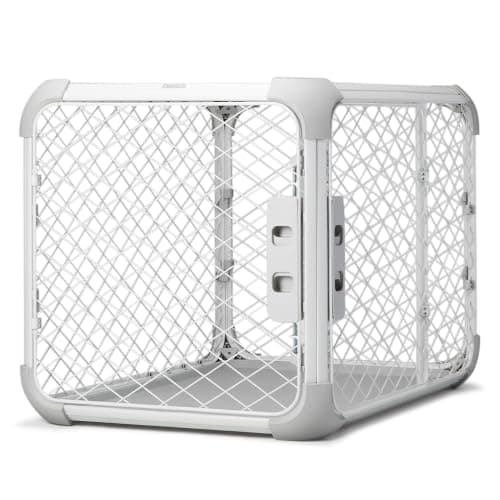
The Best Dog Crates for Truck Beds
No independent crash certification covers a dog crate in an open truck bed. What decides it there is what the crate is strapped to, whether the rain drains out, and how hot the box gets parked in the sun.
Buy the Lucky Duck Lucky Kennel in Large for the dog most people put in a truck bed: a retriever, a pointer, anything from about 70 to 110 lb. It is the only crate the Center for Pet Safety has certified with a 110 lb test dog. It has tie-down points built in, not a carry handle you are expected to strap through. And its floor is pitched to run water away from the dog into drain channels, which in an open bed is not a nicety. Lucky Duck now sells it on Amazon itself.
Buy the Gunner G1 if your dog fits the sizes CPS certified (Small, Medium or Intermediate) and heat is your main worry. Gunner is the only maker here that sells its kennel as double-walled. Amazon stocks the Small; the two larger certified sizes are sold direct.
And whatever you buy, buy straps with a published rating. Gunner’s strap kit is ranked last only because it is not a crate. In a truck bed, the straps are the part doing the work.
No crash certification covers a truck bed
Everything else on this page follows from this. The Center for Pet Safety is the only independent body that crash-certifies dog crates, and its crate test is run with the crate anchored in a simulated vehicle cargo area. Its 2015 crate study describes the setup as securing the crate “to the connections in the simulated cargo area per manufacturer instructions.” Nothing we read on the CPS site addresses an open truck bed.
So “5-star crash tested” on a truck-bed kennel is narrower than it sounds. It means the shell, the door, the latch and the connection points stayed together and kept the test dog inside through a standardized crash, with the kennel anchored in a cargo area. That is real evidence about how the crate is built, and it is the best evidence available. It is not a certificate for your truck bed, and neither certified maker here claims it is. How the program works in detail is in CPS crash testing explained.
The American Veterinary Medical Association puts it more bluntly. Its literature review on dogs in truck beds says an enclosure there gives “only limited protection in the event of an accident.” Its current policy still names a properly secured enclosure as the only acceptable way to carry a dog in an open bed at all:
“Transport of pets, loose or tethered, in open cargo areas of motor vehicles is not safe and puts the animal’s health and welfare at risk. Properly secured, size-appropriate enclosures designed for use in open cargo areas need to be used when transporting pets in this manner.”
That sentence rules out two things people do every weekend: the loose dog and the dog on a tether. It also names the three things this page ranks on. The enclosure must be secured, size-appropriate and designed for an open bed.
How often it goes wrong, honestly, nobody knows. The same AVMA review cites a 1997 survey in which 141 Massachusetts veterinarians reported treating 592 dogs in a single year for injuries from riding in truck beds. It footnotes the source as an untitled Massachusetts SPCA document obtained by personal communication. That figure is nearly thirty years old and it is the only one we found, so treat it with the same caution we do.
What an open bed does that a cargo area does not
- The anchors are different. A cargo-area crate is strapped to anchors inside a closed body. A truck-bed crate is strapped to whatever tie-down points your bed happens to have. CPS’s warning about cargo areas applies here with more force: “Cargo area anchors are not always weight-rated for the forces generated in an accident.” Gunner gives its own customers the same advice: “We always recommend checking with your local dealership to confirm that those anchor points are crash rated.” Start with your owner’s manual.
- Weather gets in. Rain, road spray and dust all reach the crate. The AVMA’s review lists “road dust, debris, and heated metal surfaces” among the hazards of an uncovered bed. In that setting, a kennel that drains and one that does not are different products.
- Heat has nowhere to go. A kennel parked in an open bed sits in full sun on a metal floor, and none of these makers publish a temperature rating. We come back to this below, because it is the biggest gap in the whole category.
- Covering the bed creates a new problem. The AVMA review warns that “Enclosures on a truck bed may accumulate toxic carbon monoxide,” citing a JAMA study of carbon monoxide poisoning in children riding in the back of pickup trucks. A crate under a closed cap or a hard tonneau cover is a crate inside a second box with no ventilation.
How we ranked them
Our usual rubric of materials, hardware, construction, failure mode and warranty still applies. In a truck bed, five questions decide it:
- Does it have dedicated tie-down points? Lucky Duck builds powder-coated tie-downs into the kennel. Gunner says its kennel has “stainless-steel pins that are integrated into the rotomold.” Dakota’s G3 has no dedicated anchor points; its Amazon listing for the G3 says the carry handle “doubles as a convenient tie-down point.” That difference matters more in a bed than anywhere else.
- Have the shell and its connections passed an independent test? Only the CPS list counts. Two kennels here are on it and two products are not. Each card says which.
- Does the latch lock? A truck bed is often parked and unattended. Every kennel here has a locking or keyed paddle latch, and the dog box uses stainless T-handles.
- Does it drain and ventilate? Drain channels or a drain hole, and enough vents to move air while the truck is parked.
- What does the warranty exclude? In this category the exclusions tell you more than the length does. See below.
The law: six states, and one word they share
No federal rule applies. In its 2019 summary the Animal Legal & Historical Center at Michigan State University counted six states whose laws expressly address dogs in the back of a pickup. We read each statute itself rather than the summary.
- California, Vehicle Code § 23117: the load space must be enclosed, or have side and tail racks at least 46 inches high. Otherwise the animal must be cross-tethered or protected by a secured container or cage. Ranch and farm dogs traveling in rural areas are exempt.
- Connecticut, § 14-272b: no dog in “the open rearward compartment” of a pickup on a public highway “unless the dog is secured in a cage or other container or otherwise protected or secured” against being thrown, falling or jumping.
- Maine, 29-A § 2087: the dog must be “protected in a manner that prevents the dog from falling or jumping or being thrown from the vehicle.” It exempts a farmer’s working dog, and a hunting dog moved between hunting sites by a licensed hunter.
- Massachusetts, c. 90 § 22H: much the same options as California, including “a secured container or cage,” with a fine “of not less than $50.”
- New Hampshire, RSA 644:8-f: the same options again. It exempts farm dogs during farming and a hunting dog “at hunting sites or between hunting sites” during the legal season.
- Rhode Island, § 31-22-28, covers any open-air motor vehicle. The animal must be in an enclosed area, held by someone other than the driver, or restrained by a harness that is not a neck restraint.
The word that recurs is secured. Every one of these statutes that mentions a crate says a secured one, and we read that in the plain way: strapped down. A crate that can slide to the tailgate is not keeping anything in the truck. Note, too, where the Maine and New Hampshire hunting exemptions actually apply: at hunting sites or between them. Read literally, neither covers the drive from your house to the first site. The summary we started from dates to 2019, and a city or county can add rules of its own, so check where you actually drive. The wider picture for cars as well as trucks is in dog car restraint laws by state.
The clause both certified makers share
This surprised us more than anything else. Both kennels on this page that hold a CPS certification leave crash damage out of their warranties.
- Gunner: the warranty does not apply if the kennel or its components have been “damaged in an accident.”
- Lucky Duck: the lifetime warranty excludes “Dropping or impact damage.”
We do not think either company is hiding anything. A kennel that has taken a crash has done its job, and no maker can warrant a product against the event it was built to survive. But it changes how you should budget. Treat a certified kennel as spent after a collision. You cannot see inside a rotomolded wall to know what it absorbed, and neither maker will replace it for you.
Both also exclude chewing, and so does Dakota, which specifies chewing on “all edges, vent holes and door seams.” Dakota’s FAQ adds an exclusion that could have been written for this page: damage from falls due to “carelessness or lack of tie downs.”
Quick picks
The short answer, ranked and scored against our published durability rubric. Where a manufacturer does not publish a spec, we say so rather than estimating it.
| # | Photo | Product | Durability | Price |
|---|---|---|---|---|
| 1 | 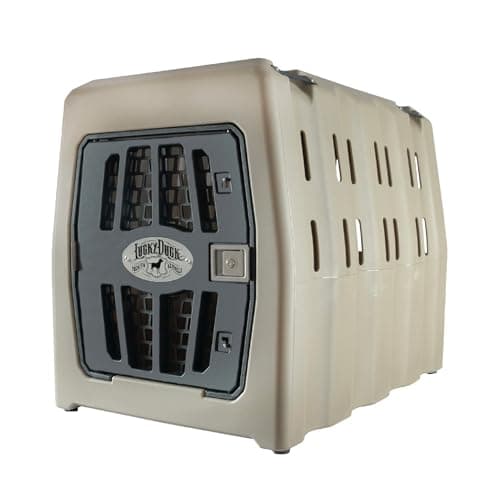 | Lucky Duck Lucky KennelThe only CPS-certified crate for a dog up to 110 lb | 86/100 | $699.99 · Amazon |
| 2 | 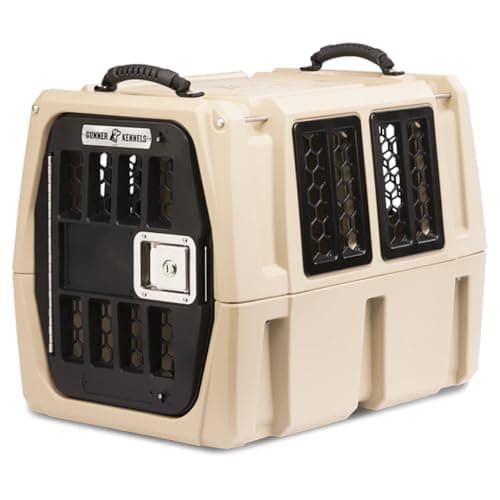 | Gunner G1 KennelA CPS-certified crate — in the sizes that are actually certified | 86/100 | $550.00 · Amazon |
| 3 | 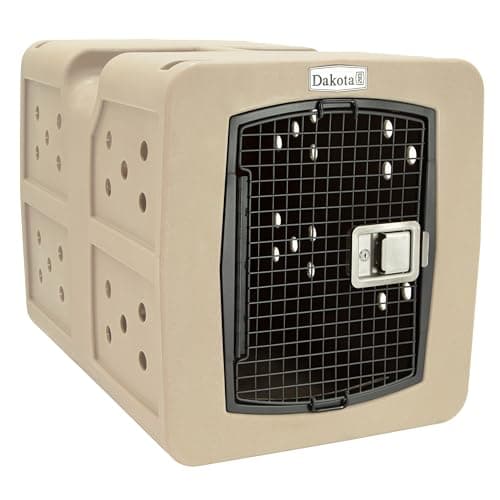 | Dakota 283 G3 Framed Door Kennel (Large)A tough rotomolded truck kennel with a real lock, if you accept no crash rating | 70/100 | $629.99 · Amazon |
| 4 | 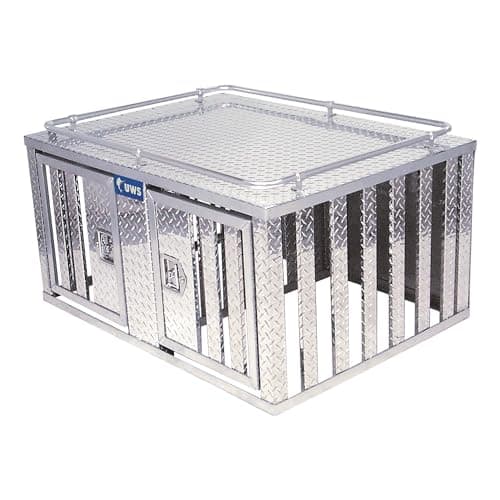 | UWS DB-4848 Double-Door Aluminum Dog BoxTwo working dogs, a box mounted to the truck, and warm country | 62/100 | $1,095.03 · Amazon |
| 5 | 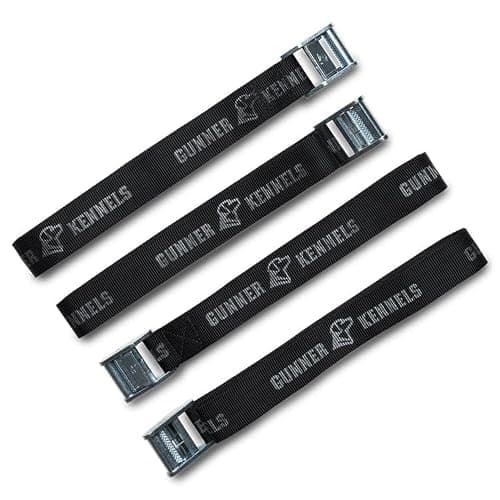 | Gunner Tie-Down Strap Kit (4 x 8 ft)Strapping any crate into a truck bed properly — the purchase that matters more than the crate | 78/100 | $90.00 · Amazon |
Tap any row to jump to the full review. Prices are pulled live from Amazon as of October 18, 2026; where we have no verified live price we show none rather than a stale number. #ad — how our links work.
The picks, ranked
1. Lucky Duck Lucky Kennel
Durability score 86/100Best for: The only CPS-certified crate for a dog up to 110 lb
If your dog is over 90 lb and you want a certified crate, this is currently the only one that exists.
- CPS certification
- 5-star: Medium (50 lb test dog), Intermediate (75 lb), Large (110 lb)
- The Large
- Currently the ONLY CPS-certified crate tested at 110 lb — certified with Lucky Duck's own ratchet strap kit
- Construction
- One-piece rotomolded, stainless hardware, powder-coated tie-downs
- Latch
- Locking paddle latch, one-handed operation
- Large dimensions
- 38 x 24 x 29 in external; 45 lb; for dogs 70–110 lb
- On Amazon
- Listed as 'Lucky Dog Kennel' — brand Lucky Duck, sold by Lucky Duck Decoys
- Warranty
- Lifetime against manufacturing defects, original purchaser only — excludes 'pet-related chewing or scratching' and 'Dropping or impact damage'
Pros
- The Large is the only CPS-certified crate on the entire list tested with a 110 lb dog. For a giant breed there is currently no certified alternative
- Certified across three sizes — Medium, Intermediate and Large
- One-piece rotomolded shell with stainless hardware and integrated tie-down points
Cons
- The warranty excludes 'Dropping or impact damage' — the kennel is certified for a crash and not covered after one
- The lifetime warranty excludes chewing and scratching, like almost every crate in this category
- The certified configuration includes Lucky Duck's own ratchet straps, which are sold direct rather than on Amazon
- Expensive
How we assessed it: on published materials, hardware specs and construction — not long-term chew-tested. We say so because it is true, and because a claim we cannot back is worth nothing to you.
#ad Price as of October 18, 2026; Amazon prices change often, so check before you buy. How our links work.
2. Gunner G1 Kennel
Durability score 86/100Best for: A CPS-certified crate — in the sizes that are actually certified
One of the few genuinely CPS-certified crates — but only in Small, Medium and Intermediate. Buy the size that was tested, not the size that fits.
- CPS certification
- 5-star: Small (30 lb test dog), Medium (45 lb), Intermediate (75 lb)
- NOT certified
- Large and XL — CPS has not certified them at any weight
- Protocol
- CPS-002-016.01, tested with strength-rated anchor straps
- Construction
- Double-walled rotomolded shell, welded aluminum frame
- Door
- Paddle latch with key lock; backup safety latches top and bottom
- Warranty
- Lifetime against defects — but 'does not extend to cover destruction done to the product by the pet'
Pros
- Genuinely CPS 5-star certified in Small, Medium and Intermediate — one of only a handful of crates that is
- The certification covers the crate WITH its strength-rated anchor straps, which is how it must actually be installed
- Backup safety latches top and bottom, plus a lockable paddle latch
Cons
- There is NO CPS-certified Gunner G1 Large or XL. If you have a 110 lb dog, a G1 Large is an uncertified crate — this is the single most misunderstood fact in the category
- The lifetime warranty explicitly excludes destruction by your dog
- Gunner sells a separate steel 'Chew Kit' for high-drive dogs, which is a tacit admission the base kennel is chewable
- Very expensive and very heavy
How we assessed it: on published materials, hardware specs and construction — not long-term chew-tested. We say so because it is true, and because a claim we cannot back is worth nothing to you.
#ad Price as of October 18, 2026; Amazon prices change often, so check before you buy. How our links work.
3. Dakota 283 G3 Framed Door Kennel (Large)
Durability score 70/100Best for: A tough rotomolded truck kennel with a real lock, if you accept no crash rating
A well-built rotomolded kennel with a real lock, for the owner who wants field toughness and accepts that nobody has crash-tested it. Strap it down properly or the warranty will not help you.
- Construction
- Single-piece rotomolded polyethylene, 'Molded and assembled in the USA' (Dakota 283)
- Large dimensions
- 35.2 x 24.5 x 26.5 in exterior; 33 x 22.8 x 26.2 in interior; 46 lb
- Door
- Keyed paddle latching door. Door-frame and latch metal: not stated on Dakota's product page
- Ventilation
- 40 holes on the Large, 20 per side in the upper section; drain hole
- Tie-down
- No dedicated anchor points. Dakota's Amazon listing says the built-in handle 'doubles as a convenient tie-down point'
- Crash certification
- None — not on the CPS certified list, and Dakota 283 publishes no crash test
- Warranty
- Limited lifetime on kennels bought after May 1, 2025; original purchaser only; excludes chewing on 'all edges, vent holes and door seams'
Pros
- One-piece rotomolded shell — no bolt-together seam around the middle to split
- A keyed paddle latch, on the model Dakota sells as its high-security kennel
- A drain hole and 40 vent holes on the Large, which is what a shell in an open bed needs
Cons
- Not crash certified, and Dakota 283 publishes no crash test of any kind
- No dedicated tie-down points: the straps run through the carry handle, which makes the handle the connection — and nobody has tested it as one
- Dakota's warranty excludes damage from falls due to 'lack of tie downs', as well as chewing on any edge, vent or door seam
- Dakota's product page does not say what the door frame or latch is made of
How we assessed it: on published materials, hardware specs and construction — not long-term chew-tested. We say so because it is true, and because a claim we cannot back is worth nothing to you.
#ad Price as of October 18, 2026; Amazon prices change often, so check before you buy. How our links work.
4. UWS DB-4848 Double-Door Aluminum Dog Box
Durability score 62/100Best for: Two working dogs, a box mounted to the truck, and warm country
The right answer for two dogs that ride in the truck every week, mounted properly. It is a kennel with a lid, not a safety device, and nothing on this page pretends otherwise.
- Material
- 0.058 in one-piece aluminum (UWS)
- Size
- 48 x 48 x 24 in; 32 cubic feet as two compartments with a divider; 73.6 lb (UWS)
- Doors
- Two, 17-1/4 x 21 in openings, stainless steel T-handles
- Ventilation
- Vented on three sides; sold as a 'warm weather' box (Amazon listing)
- Floor
- UWS: 'Open bottom and wide-spaced rungs for consistent airflow and easy cleaning'
- Mounting
- Mounting hardware not included (UWS)
- Crash certification
- None — no crash test published
- Warranty
- Limited lifetime (one-year finish, one-year parts)
- Made in
- 'Designed, fabricated, and welded in Florida' (UWS)
Pros
- Two separate compartments in one footprint — two dogs, two spaces, never one shared box
- A published wall thickness, which is more than any rotomolded kennel here will tell you
- Aluminum does not rust, and the top rail takes cargo tie-downs, so the box doubles as a load platform
Cons
- No crash test of any kind, and the AVMA's own literature review says truck-bed enclosures provide 'only limited protection in the event of an accident'
- Sold as a warm-weather box, and UWS's product page describes no way to close the vents — plan for wind and cold on a winter highway
- Aluminum in direct sun is a heat problem, and this box has no insulation claim at all
- Mounting hardware is not included, and on Amazon it is sold by a third-party truck-parts seller rather than UWS
- The structure is lifetime; the finish and the parts get one year
How we assessed it: on published materials, hardware specs and construction — not long-term chew-tested. We say so because it is true, and because a claim we cannot back is worth nothing to you.
#ad Price as of October 18, 2026; Amazon prices change often, so check before you buy. How our links work.
5. Gunner Tie-Down Strap Kit (4 x 8 ft)
Durability score 78/100Best for: Strapping any crate into a truck bed properly — the purchase that matters more than the crate
Buy these, or straps with published ratings like them, whatever crate you choose. A bungee is not a tie-down.
- Webbing
- Manufacturer-rated 5,100 lb break strength nylon (Gunner)
- Cam buckle
- Manufacturer-rated 2,900 lb load capacity, dual spring (Gunner)
- Kit
- Four 8 ft straps, 1-1/2 in wide. A Combination kit (two 8 ft + two 14 ft) is sold for long beds and corner placement
- Weather
- Synthetic material Gunner says can be left out 24/7; 380 F melting point
- CPS
- The certified configuration is 'Gunner G1 Kennel with Strength Rated Anchor Straps'
- Warranty
- No written term published for the straps — Gunner's 'GUNNER Guarantee' is a customer-service promise
Pros
- Published ratings for both the webbing and the buckle, so you can see which part governs — the buckle, at 2,900 lb
- Four straps, one per corner, and a longer kit for beds where the anchors are far from the crate
- Rated to live outside, which is where truck-bed straps spend their lives
Cons
- The straps are only as strong as the truck's anchor points, and Gunner itself tells buyers to check with a dealer that those 'are crash rated'
- A cam buckle is tensioned by hand — there is no ratchet to take up slack, so recheck it after the first few miles
- Strapping another brand's crate with these does not make that crate certified; the certification belongs to the Gunner kennel with its straps
- Expensive for four straps — you are paying for the published rating and the certification pedigree
How we assessed it: on published materials, hardware specs and construction — not long-term chew-tested. We say so because it is true, and because a claim we cannot back is worth nothing to you.
#ad Price as of October 18, 2026; Amazon prices change often, so check before you buy. How our links work.
The straps: read the lowest number
Both certified kennels were certified with their straps. CPS lists the tested products as “Gunner G1 Kennel with Strength Rated Anchor Straps” and “Lucky Kennel with Lucky Ratchet Strap Kit.” A certified crate held down with a pair of hardware-store bungees is not what passed. CPS’s own instruction is plain: “Crates should always be secured with strength-rated anchor straps.”
A strap is a chain of parts, and it is only as strong as the weakest one. The two makers publish different parts of the chain in different terms, so read the lowest number rather than the biggest:
- Gunner rates its nylon webbing at 5,100 lb break strength and its cam buckle at 2,900 lb load capacity. The buckle is the limit.
- Lucky Duck rates its webbing at 3,500 lb break strength, its ratchet at 4,500 lb load capacity and its S-hooks at 3,500 lb. The webbing and the hooks are the limit.
Break strength and load capacity are different measurements, so we will not tell you one kit beats the other on those figures. What both makers do is publish a figure for every part, and that is the test to apply to any strap you buy. If a listing gives you one big number and does not say which part it belongs to, you do not know how strong the strap is.
There are two practical differences. Lucky Duck’s kit ratchets, so it takes up slack mechanically. Gunner’s uses a cam buckle, tensioned by hand, and Gunner says the material can be left out “24/7,” which is the claim that matters for straps that live on a truck. Lucky Duck’s kit is sold direct and Gunner’s is on Amazon, which is why Gunner’s is the strap kit we rank.
One caveat. Gunner’s straps on a Lucky Kennel, or Lucky’s straps on a Gunner, are not a certified configuration. That is strength-rated straps on a certified crate. It is far better than bungees, and it is still not what was tested.
How to strap a crate into a truck bed
- Find the anchors, and find out what they are rated for. Check the owner’s manual first and the dealer second, as both CPS and Gunner advise. If the bed has only light cargo cleats, a certified crate is being held down by hardware nobody has rated.
- Put the crate forward, against the front wall of the bed. In a hard stop the crate moves toward the cab. If it is already against the bulkhead, it has no room to build speed. It also rides behind the cab, out of the worst of the wind. This is our reasoning, not a tested result.
- Use four straps, one per corner, each to its own anchor and pulling against the others so the crate cannot move in any direction. Gunner sells a longer combination kit for long beds or a crate set in a corner.
- Tension it, drive, then tension it again. Webbing settles. Check it after the first few miles and at every fuel stop on a long run.
- Face the door where you can reach it without climbing into the bed, usually toward the tailgate or the side.
- Put nothing on the dog inside the crate. Take the leash off before the door closes. A lead inside a closed crate is something to snag on.
- Never use bungees. They are elastic by design, and elastic is the opposite of what a tie-down is for.
Heat: the spec nobody publishes
No kennel or dog box on this page carries a temperature rating, and we have not found one anywhere in the category. The AVMA’s warning about parked cars applies just as much to a parked truck bed: “Cars can overheat quickly to deadly temperatures, even when the weather isn’t severe.”
The only comparative heat data we found from any maker is Gunner’s. Gunner says it worked with a third-party lab to simulate a hot summer day, with radiant heating over 16 hours and air temperatures of 80 to 115 °F. It reports that the G1 stayed “an average of 8% cooler than a leading single-wall rotomolded kennel” and 12% cooler than a leading aluminum kennel. It also says the aluminum kennel’s ceiling heated up about 50 degrees more than the Gunner’s in 100-plus-degree weather.
Read that as a direction, not a measurement. The company whose kennel won commissioned it, the lab and the competing kennels are not named, and 8% cooler in Fahrenheit is a small number of degrees on a hot day. The direction still matches what you would expect: a double wall insulates, a single wall less so, and bare aluminum in the sun is the worst of the three. The practical lesson is the one the AVMA review already gives. Enclosures need “ventilation, and protection from the elements.” On a hot day, the answer is shade or the cab, not a better box.
Sizing: smaller than a house crate, on purpose
The AVMA review has the best sizing rule we have read for a truck. The crate needs enough room “to stand up and lie down, but not enough that the dog may be thrown from one side of the crate/kennel to the other.” Lucky Duck says the same from the other direction: its listed measurements are “designed for safe travel use, for home use we recommend going up a size.” A travel kennel should be snug. How to measure the dog is in what size crate does my dog need.
Then measure the truck. The Lucky Kennel Large is about 38 in long and 29 in tall outside. The Dakota G3 Large is 35.2 in long and 26.5 in tall. The UWS box takes a 48 by 48 in patch of the bed. Check length against the bed with the tailgate closed, and height against any rack or cover you run. If the dog has to get up into a lifted bed, see dog ramps.
Two dogs: two kennels or one box
If two dogs ride together, the rule from crates for two dogs holds: two spaces, never one shared one. In a truck, that means one of two setups. The first is two kennels strapped side by side; Gunner sells a connection strap kit for joining its kennels. The second is a divided box like the UWS, and this is the one situation where a dog box earns its place over a pair of kennels. It is mounted, it is always there, and it holds two dogs in about the space two large kennels would fill anyway. What it does not have is any crash test, and the card says so.
What we did not rank, and why
- Ruff Land kennels. Not on Amazon: the only results under the name were third-party strap and hook kits sold as compatible with them, not the kennel itself. Ruff Land is not on the CPS certified list.
- Cabela’s GunDog kennel. CPS certified in Intermediate and Large, and a legitimate option. An Amazon search returned nothing for it, so buy it from Cabela’s.
- Owens dog boxes. Owens aluminum boxes are listed on Amazon, but when we checked, the listings showed one or two units left, or none. We would rather not rank a box you may not be able to buy.
- Impact crates. Aluminum, very well made, and not on the CPS list. Impact’s dog-damage guarantee covers only its High Anxiety line; the details are in are Impact dog crates crash tested.
- Wire crates. CPS’s conclusion from its 2015 study is that wire crates “should be considered as distraction prevention tools and will not provide significant protection in the case of an accident.” In a truck bed they also leave the dog exposed to wind, rain and road debris.
- Two-piece plastic airline crates. These are built for a cargo hold and held together by fasteners around a seam. They are not designed for an open bed. What they are actually for is covered in airline dog crate requirements.
- Truck-bed tethers. California, Massachusetts and New Hampshire allow a cross-tethered dog. The AVMA’s policy is that tethered transport in an open bed is not safe, and its review lists the risks as “tangling, choking, or dragging behind the vehicle.” CPS does not recommend extension tethers or zipline-style products inside a vehicle either. We do not rank any tether.
When the right answer is the back seat
If you drive a crew cab and have one dog, the honest answer may be that the dog does not belong in the bed at all. The AVMA review notes that inside the cab a dog “is subject to the same risks as a human passenger,” and that a safety harness “may minimize injuries to both in the event of an accident.” A certified harness on the rear bench keeps the dog inside the cab, out of the weather and in the air conditioning. Our crash-tested harness roundup lists what CPS has actually certified, and harness versus crate sets out the trade-off.
The bed is the right place for the dog that is wet, muddy, one of several, or working, which is the dog this page was written for. Put that dog in a secured, size-appropriate enclosure designed for an open bed. That is the AVMA’s standard, and the only one we would apply.
If the dog is riding in the cab instead, the cover question has a truck-specific answer: a crew-cab bench is shallow, often split, and usually sits over storage, which rules out most of the hammocks sold for cars. The covers that suit a pickup are on the best dog seat covers for trucks.
Frequently asked questions
Is it legal to put a dog crate in the back of a pickup truck?
In most states no law addresses it. Six states expressly do, by the Animal Legal & Historical Center's 2019 count: California, Connecticut, Maine, Massachusetts, New Hampshire and Rhode Island. Every one of those that mentions a crate requires it to be secured. California, Massachusetts and New Hampshire say a 'secured container or cage', and Connecticut says 'secured in a cage or other container'. Maine and New Hampshire exempt hunting dogs moved at or between hunting sites by licensed hunters, and several states exempt working farm dogs. Strapped down is the only reading we would rely on.
Are any dog crates crash tested for truck beds?
Not by any independent certifier. The Center for Pet Safety, the only independent crash certifier for dog crates, tests crates anchored in a simulated vehicle cargo area, and nothing on its site addresses open truck beds. A 5-star certification is real evidence that the shell, door, latch and connection points hold together, and it is the best evidence available, but it is not a truck-bed certification. The AVMA's literature review says truck-bed enclosures provide 'only limited protection in the event of an accident.'
How do you tie down a dog crate in a truck bed?
Use four strength-rated straps, one per corner, each to its own bed anchor and pulling against the others. Put the crate forward against the front wall of the bed, tension the straps, and check them again after the first few miles. Find out what your bed anchors are rated for from the owner's manual or a dealer, as both CPS and Gunner advise. Never use bungee cords. And if you want the certified configuration, use the maker's own straps, because CPS certified each kennel with them.
Is a dog box better than a kennel for a truck?
For two or more dogs that ride every week, a mounted, divided aluminum dog box is the practical answer. It is always there and it gives each dog its own compartment. It has no crash test of any kind, though, and aluminum in direct sun runs hot. For one dog, a CPS-certified kennel strapped to rated anchors is the better-evidenced choice, and it comes out of the truck when you need the bed back.
Can a dog ride in a crate in a truck bed in hot weather?
Only with care, and never parked in full sun. The AVMA's standard for a truck-bed enclosure is 'ventilation, and protection from the elements.' No kennel publishes a temperature rating, and the AVMA warns that vehicles 'can overheat quickly to deadly temperatures, even when the weather isn't severe.' Gunner's own commissioned test found its double-wall kennel ran cooler than a single-wall and an aluminum kennel, but on a hot day the answer is shade or the cab, not a better box.
Does a dog crate warranty cover crash damage?
Not from either certified maker on this page. Gunner's warranty does not apply if the kennel has been 'damaged in an accident', and Lucky Duck's lifetime warranty excludes 'Dropping or impact damage.' Budget to replace a certified kennel after any collision. You cannot see inside a rotomolded wall to know what it absorbed.
Can I use a truck-bed tether instead of a crate?
Legally, in some states. California, Massachusetts and New Hampshire accept a cross-tethered dog. The AVMA's policy, however, is that transporting a pet 'loose or tethered' in an open cargo area 'is not safe', and its review lists the risks as tangling, choking, or dragging behind the vehicle. We do not recommend a tether and do not rank one.
Sources
Every spec on this page traces to one of these. Where a manufacturer does not publish a figure, we say “not published” rather than estimating it.
- AVMA policy — Safe non-commercial transport of pets in motor vehicles (“Transport of pets, loose or tethered, in open cargo areas of motor vehicles is not safe”)
- AVMA Animal Welfare Division — Literature Review on the Welfare Implications of Dogs Traveling in Truck Beds (July 24, 2007): tether risks, carbon monoxide in enclosures, crate sizing, the 1997 Massachusetts survey
- AVMA — Warm weather pet safety (“Cars can overheat quickly to deadly temperatures, even when the weather isn’t severe”)
- Center for Pet Safety — certified products (checked 2026-09-22: crates are Cabela's GunDog Intermediate and Large, Gunner G1 Small, Medium and Intermediate, Lucky Duck Lucky Kennel Medium, Intermediate and Large)
- Center for Pet Safety — Lucky Kennel Large: 5 Star, 110 lb test dog, July 2022, protocol CPS-002-016.01, tested as “Lucky Kennel with Lucky Ratchet Strap Kit”
- Center for Pet Safety — Gunner G1 Small: 5 Star, 30 lb test dog, June 2017, protocol CPS-002-016.01, tested as “Gunner G1 Kennel with Strength Rated Anchor Straps”
- Center for Pet Safety — cargo area connection advisory (anchors “not always weight-rated”; crates secured with strength-rated anchor straps; extension tethers and zipline-style products not recommended)
- Center for Pet Safety — 2015 Crate Study (crates secured “to the connections in the simulated cargo area”; wire crates “will not provide significant protection”)
- Animal Legal & Historical Center — FAQ: Dogs Transported in Pickup Truck Beds (Rebecca F. Wisch, 2019): CA, CT, ME, MA, NH and RI
- CA Vehicle Code § 23117 — transportation of animals; enclosure or restraint requirements
- CT Gen. Stat. § 14-272b — transport of dogs in pick-up trucks
- ME 29-A M.R.S. § 2087 — transporting dogs in open vehicle regulated (farm and hunting-site exemptions)
- MA Gen. Laws c. 90 § 22H — safe transportation of animals (fine of not less than $50)
- NH RSA 644:8-f — transporting dogs in pickup trucks (farm and hunting-site exemptions)
- RI Gen. Laws § 31-22-28 — transporting animals in open-air vehicles
- Gunner — Tie-Down Strap Kit (four 8 ft straps, or two 8 ft and two 14 ft as a combination kit; 1-1/2 in wide; “We always recommend checking with your local dealership to confirm that those anchor points are crash rated”)
- Gunner — Why do kennel tie-down straps matter? (5,100 lb webbing, 2,900 lb cam buckle; stainless-steel pins integrated into the rotomold)
- Gunner — commissioned heat test (G1 “an average of 8% cooler” than a leading single-wall rotomolded kennel and 12% cooler than a leading aluminum kennel; lab and competitors unnamed)
- Gunner — warranty (does not apply if the kennel or its components have been “damaged in an accident”)
- Lucky Duck — Lucky Kennel (sizes and weight ranges, integrated powder-coated tie-downs, pitched floor with drain channels, made in the USA)
- Lucky Duck — Lucky Ratchet Strap Kit (3,500 lb webbing, 4,500 lb ratchet, 3,500 lb S-hooks)
- Lucky Duck — warranty (excludes “Dropping or impact damage” and pet-related chewing or scratching; original purchaser only)
- Dakota 283 — G3 Large Framed Kennel (dimensions, 46 lb, 40 vent holes, keyed paddle latching door)
- Dakota 283 — terms and warranty (limited lifetime on kennels bought after May 1, 2025; excludes chewing on “all edges, vent holes and door seams”)
- Dakota 283 — FAQ (warranty excludes damage from falls due to “carelessness or lack of tie downs”)
- UWS — DB-4848 dog box (0.058 in aluminum, 32 cubic feet, 73.6 lb, limited lifetime warranty with one-year finish and parts)