The Best Dog Backpacks
A pack is the one piece of dog gear where the numbers genuinely matter — volume, empty weight and load limit. Exactly one brand publishes all three.
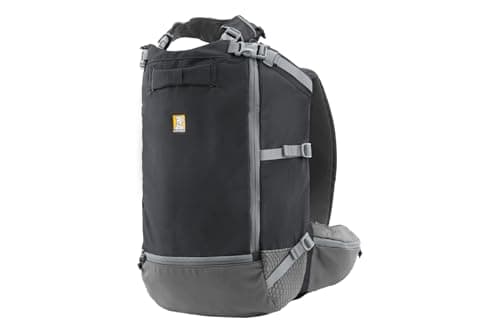
Buy the Ruffwear Approach Pack. It publishes pack volume in liters, empty weight in pounds, and a stated load limit — for every size in the run — and no other pack in this category publishes any of the three.
Buy the Palisades instead only if the removable saddlebags change how you would use it. Buy the OneTigris Mammoth if you want MOLLE modularity at a third of the price and accept that you are buying a shape rather than a specification.
The load rule, which one brand states and everyone else omits
Ruffwear publishes it directly: “It’s recommended that your dog carry no more than 25% of their body weight, including pack weight and its contents.”
Read the second half of that sentence, because it is the part that gets ignored. The 25% includes the pack. A 60 lb dog has a 15 lb budget; a Palisades in Large weighs 1 lb 11 oz empty, so the payload is a little over 13 lb. Two liters of water is 4.4 lb. The arithmetic gets tight much faster than owners expect, and a pack that says nothing about its own weight makes the arithmetic impossible.
We are reporting Ruffwear’s guidance as Ruffwear’s guidance rather than as a veterinary standard. We found no consensus veterinary figure, and a lower limit is sensible for a young dog, an old dog, a brachycephalic dog, or any dog new to carrying.
Volume, and why it is published in a strange unit
Ruffwear publishes both packs in liters by size: 5 L (XS), 10 L (S), 13 L (M) and 21 L (L/XL). Nobody else publishes a volume at all, which makes a like-for-like comparison impossible outside Ruffwear’s own line.
Twenty-one liters sounds enormous for a dog. In practice it is bulk rather than mass — a dog pack fills with sleeping bag, jacket and food long before it hits the weight limit, and the constraint that actually bites is almost always the 25% rule rather than the volume.
Fit matters more on a pack than on anything else
A loaded pack that rolls is a pack that chafes and a pack that unbalances the dog on a traverse. That is why adjustment count is the spec worth paying for here: the Approach has five points of adjustment and the Palisades has six.
It is also why the 150D shell on both Ruffwear packs is worth flagging as a real trade-off. That is half the denier of the 300D used on the Front Range harness. Ruffwear is buying lightness, and on a pack that will be dragged along rock while the dog squeezes past a boulder, lightness has a cost. We scored materials accordingly.
Quick picks
The short answer, ranked and scored against our published durability rubric. Where a manufacturer does not publish a spec, we say so rather than estimating it.
| # | Photo | Product | Durability | Price |
|---|---|---|---|---|
| 1 | 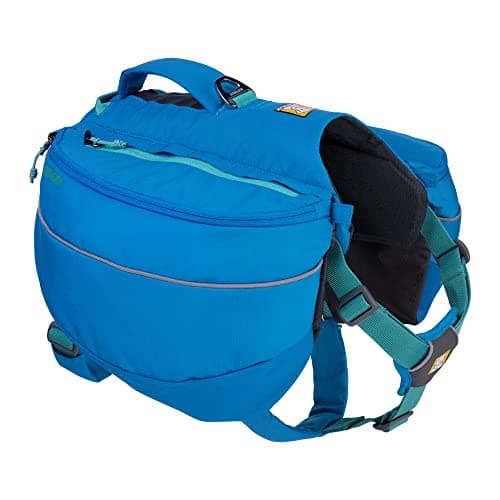 | Ruffwear Approach PackThe pack that publishes its volume, its weight and a load limit | 78/100 | $59.99 · Amazon |
| 2 | 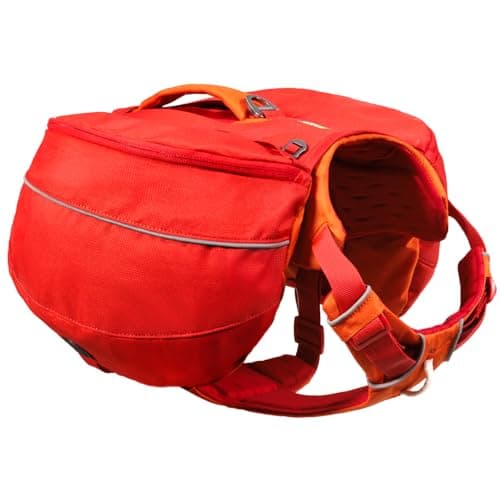 | Ruffwear Palisades PackMulti-day trips — the saddlebags come off and leave a harness behind | 78/100 | $149.99 · Amazon |
| 3 | 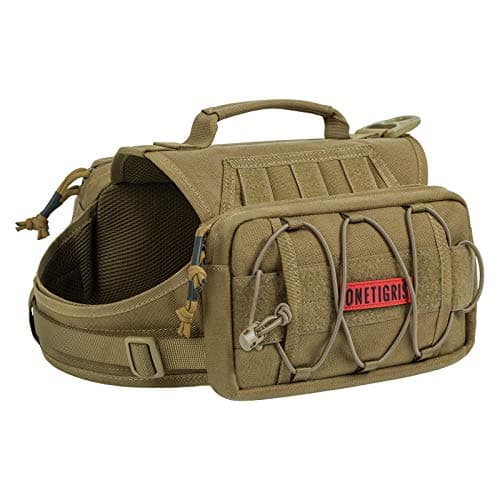 | OneTigris Mammoth Dog PackMOLLE load carriage at a third of the price | 57/100 | $37.99 · Amazon |
| 4 | 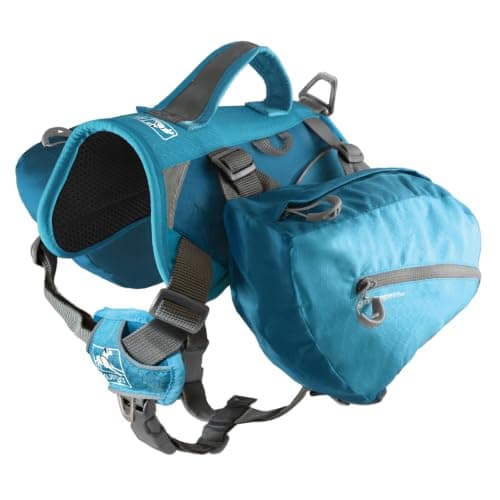 | Kurgo Baxter Dog BackpackThe cheapest pack here with a lifetime defect warranty | 58/100 | $29.39 · Amazon |
| 5 | 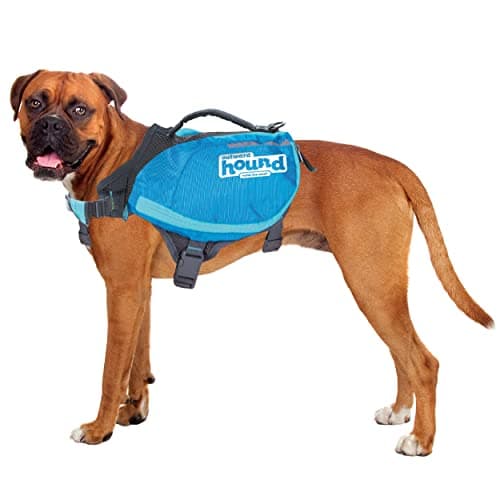 | Outward Hound DayPakTrying the idea before committing to it | 42/100 | Check price |
Tap any row to jump to the full review. Prices are pulled live from Amazon as of October 18, 2026; where we have no verified live price we show none rather than a stale number. #ad — how our links work.
The picks, ranked
1. Ruffwear Approach Pack
Durability score 78/100Best for: The pack that publishes its volume, its weight and a load limit
The best-documented dog pack on the market, and the only one that tells you in the same breath how much it holds, what it weighs and how much your dog should carry.
- Shell
- 150D polyester ripstop with DWR and PU coating
- Harness
- Laminated, molded bonded polyester mesh and perforated PE foam
- Adjustment
- Five points
- Volume
- 5 L (XS) / 10 L (S) / 13 L (M) / 21 L (L–XL)
- Weight
- 0.73 lb (XS) to 1.3 lb (L–XL)
- Buckles
- ITW Nexus Airloc side-release
- Leash ring
- Anodized 6061-T6 aluminum V-ring
- Load guidance
- No more than 25% of body weight, including the pack
- Sizes
- XS (17–22 in) to L/XL (32–42 in) girth
Pros
- Publishes volume in liters AND weight AND a load limit for every size — no other pack in this roundup publishes all three
- Ruffwear states the load rule plainly: no more than 25% of body weight including the pack itself
- Named hardware throughout — ITW Nexus buckles, an anodized 6061-T6 aluminum V-ring, YKK zippers
- Five points of adjustment, which is what a loaded pack needs to stop it rolling
Cons
- 150D shell is light for a pack that will be dragged along rock — the Front Range harness uses 300D
- The saddlebags do not detach, so it is a pack or nothing
- Chewing excluded from the warranty, as everywhere in Ruffwear's line
How we assessed it: on published materials, hardware specs and construction — not long-term chew-tested. We say so because it is true, and because a claim we cannot back is worth nothing to you.
#ad Price as of October 18, 2026; Amazon prices change often, so check before you buy. How our links work.
2. Ruffwear Palisades Pack
Durability score 78/100Best for: Multi-day trips — the saddlebags come off and leave a harness behind
The right pack if the saddlebags coming off changes how you use it. If they never come off, buy the Approach and keep the difference.
- Shell
- 150D polyester ripstop (bluesign approved; 40% recycled)
- Saddlebags
- Removable — the harness can be worn on its own
- Adjustment
- Six points
- Volume
- 5 L (XS) / 10 L (S) / 13 L (M) / 21 L (L–XL)
- Weight
- 15 oz (XS) to 1 lb 11 oz (L–XL)
- Buckles
- ITW Nexus Airloc side-release
- Leash ring
- Anodized 6061-T6 aluminum V-ring
- Load guidance
- No more than 25% of body weight, including pack and contents
Pros
- Removable saddlebags mean one purchase does the loaded hike and the unloaded camp walk
- Six points of adjustment — the most of any pack here, and it matters most when the bags are loaded unevenly
- Same published discipline as the Approach: volume, weight and load limit for every size
Cons
- Heaviest pack here empty, and roughly two and a half times the price of the Approach
- Same 150D shell as the cheaper pack — you are paying for the system, not for heavier fabric
- Overkill for anything shorter than an overnight
How we assessed it: on published materials, hardware specs and construction — not long-term chew-tested. We say so because it is true, and because a claim we cannot back is worth nothing to you.
#ad Price as of October 18, 2026; Amazon prices change often, so check before you buy. How our links work.
3. OneTigris Mammoth Dog Pack
Durability score 57/100Best for: MOLLE load carriage at a third of the price
The modular option, and good value — but you are buying a shape rather than a specification.
- Shell
- Nylon; denier not published for this model
- Load carriage
- MOLLE/PALS webbing panels
- Volume
- Not published
- Weight
- Not published
- Load guidance
- Not published
Pros
- Genuine MOLLE panels, so pouches can be added and moved rather than living in a fixed compartment
- A third of the price of the Ruffwear packs
- The obvious pairing for anyone already running OneTigris tactical gear
Cons
- No published volume, weight or denier for this model, so you cannot compare it on any axis that matters
- No published load guidance at all — Ruffwear's 25%-of-body-weight rule has no equivalent here
- MOLLE adds bulk and stitching to a panel that sits directly on a dog's back
How we assessed it: on published materials, hardware specs and construction — not long-term chew-tested. We say so because it is true, and because a claim we cannot back is worth nothing to you.
#ad Price as of October 18, 2026; Amazon prices change often, so check before you buy. How our links work.
4. Kurgo Baxter Dog Backpack
Durability score 58/100Best for: The cheapest pack here with a lifetime defect warranty
A fine first pack for a dog carrying its own water on day walks. Not a pack for a loaded multi-day trip.
- Shell
- Not published in detail
- Saddlebags
- Fixed, two side pockets
- Volume
- Not published
- Warranty
- Kurgo lifetime warranty on manufacturing defects
- Load guidance
- Not published
Pros
- Lifetime defect warranty, and the lowest price of any pack here
- Simple two-pocket layout that is hard to load badly
Cons
- No published volume, fabric or load guidance
- Wear and tear sits outside the free warranty — and a pack is a wear item
- Lightly built compared with the Ruffwear packs at roughly a fifth of the price
How we assessed it: on published materials, hardware specs and construction — not long-term chew-tested. We say so because it is true, and because a claim we cannot back is worth nothing to you.
#ad Price as of October 18, 2026; Amazon prices change often, so check before you buy. How our links work.
5. Outward Hound DayPak
Durability score 42/100Best for: Trying the idea before committing to it
The try-before-you-commit pack. Useful for exactly that and not much beyond it.
- Shell
- Not published in detail
- Pockets
- Four expandable pockets
- Volume
- Not published
- Load guidance
- Not published
- Warranty
- Not published
Pros
- Four pockets rather than two makes it easier to balance a light load side to side
- The lowest cost way to find out whether your dog will accept carrying anything at all
Cons
- Nothing published about materials, volume or load
- No warranty terms published
- Light construction — this is a water-bottle-and-poop-bags pack, not a hauling pack
How we assessed it: on published materials, hardware specs and construction — not long-term chew-tested. We say so because it is true, and because a claim we cannot back is worth nothing to you.
#ad We only show a price when we have a live one from Amazon. We don’t have one for this product right now, so we’re not going to guess. How our links work.
Conditioning a dog to carry
Do not put a loaded pack on a dog for the first time at a trailhead. The progression that works:
- Empty pack, indoors, short sessions, food.
- Empty pack on a normal walk, a few times.
- Light and evenly balanced — start well under the limit, not at it.
- Build over weeks, not over one weekend.
And balance the sides deliberately. A pack loaded 3 lb one side and 1 lb the other will rotate, and the dog will compensate by walking crooked for the whole day.
Which dogs should not carry a pack
- Growing dogs. Ask your vet about your breed’s growth-plate closure before loading a young dog. We review gear; we do not practice medicine.
- Brachycephalic dogs. A pack adds work and adds heat to an animal whose cooling is already compromised.
- Dogs with diagnosed joint or spinal disease. Again, a veterinary question, not a gear one.
- Any dog in genuine heat. A pack traps heat against the back. The AVMA’s advice to work dogs in the cooler hours applies with more force to a loaded dog, and a cooling vest is not a substitute for that advice.
The hardware, which is the quiet reason to buy Ruffwear
Both Ruffwear packs use ITW Nexus Airloc buckles, an anodized 6061-T6 aluminum V-ring for the leash and YKK reverse coil zippers. Every one of those is a named part from a named supplier.
Nobody else in this roundup names a single component. On a harness that is a preference; on a loaded pack, where a failed buckle mid-traverse means a dog wearing a saddlebag around its elbows on a slope, it is worth the money.
Chewing, as everywhere in this category, is excluded from Ruffwear’s warranty — see when to replace a harness for what that means in practice.
If you meant the other kind of dog backpack
“Dog backpack” is two products. This page is the pack the dog wears, carrying its own load. If what you are looking for is the pack you wear with the dog inside it - for a small dog that cannot do the distance, a senior recovering from surgery, or a puppy not yet cleared for long walks - that is a different category with different limits, and we ranked it separately in the dog carrier backpacks.
The load limit is the one number in this category anybody publishes, and it is worth reading literally: Ruffwear’s 25% of body weight includes the pack itself, so a 1.3 lb pack on a 40 lb dog leaves about 8.7 lb of contents rather than 10. Which dogs should not be carrying weight at all — and why fit, not weight, is what usually causes a problem — is on are dog backpacks bad for dogs.
Frequently asked questions
How much weight can a dog carry in a backpack?
Ruffwear's published guidance is that a dog should carry no more than 25% of its body weight, including the weight of the pack itself and its contents. That inclusion is the part usually dropped: a 60 lb dog has a 15 lb budget, and a large Palisades weighs 1 lb 11 oz empty, leaving about 13 lb of payload. We report that as the manufacturer's guidance rather than a veterinary standard, and a lower figure is sensible for young, old or brachycephalic dogs.
What is the best dog backpack for hiking?
The Ruffwear Approach Pack, because it is the only pack in the category that publishes volume in liters, empty weight, and a load limit for every size — 5 L to 21 L depending on size, 0.73 to 1.3 lb empty. It also names its hardware: ITW Nexus Airloc buckles, an anodized 6061-T6 aluminum V-ring and YKK zippers. No competing pack publishes any of that.
Should I buy a dog pack with removable saddlebags?
Only if you will actually remove them. The Ruffwear Palisades has removable saddlebags so the harness can be worn alone, and six adjustment points rather than five — genuinely useful if you hike loaded and then want a plain harness at camp. It costs roughly two and a half times the Approach and uses the same 150D shell, so if the bags never come off you are paying for a system you are not using.
How do I get a dog used to wearing a pack?
In stages, over weeks. Empty pack indoors in short sessions with food; then the empty pack on ordinary walks; then a light, evenly balanced load well under the limit; then build gradually. Balance matters as much as weight — a pack loaded three pounds on one side and one on the other will rotate and the dog will walk crooked all day to compensate.
Which dogs should not wear a backpack?
Growing dogs, until you have asked your vet about growth-plate closure for your breed. Brachycephalic dogs, because a pack adds both workload and trapped heat to an animal whose cooling is already compromised. Dogs with diagnosed joint or spinal disease. And any dog in real heat — a pack sits against the back and traps heat, and the AVMA's advice to work in the cooler hours applies with more force to a loaded dog.
Sources
Every spec on this page traces to one of these. Where a manufacturer does not publish a figure, we say “not published” rather than estimating it.
- Ruffwear — Approach Pack specs (150D shell; 5–21 L by size; 25%-of-body-weight load guidance)
- Ruffwear — Palisades Pack specs (removable saddlebags; six adjustment points; published weights)
- Kurgo — lifetime warranty terms (defects covered; wear and tear routed to paid replacement)
- AVMA — Warm weather pet safety (signs of heat stress; avoid hot surfaces; never leave a pet in a car)
- Ruffwear — warranty terms (chewing excluded; no duration stated)