The Most Durable Dog Bed Material
Across every bed we have assessed, exactly one maker publishes a fabric weight. So this is a guide to reading an unlabelled category - and to the fact that most beds do not fail at the fabric.
The verdict
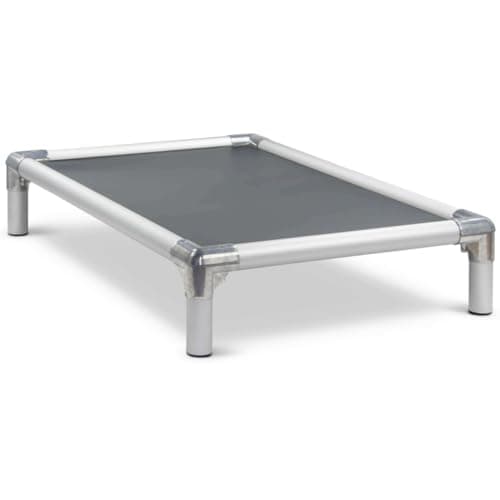
The most durable surface is the one that is not fabric at all: a taut vinyl or coated-mesh panel over an aluminum frame, as on the Kuranda chewproof bed— 40 oz heavy-duty vinyl on an aircraft-grade aluminum frame with stainless fasteners, rated to 250 lb, and the only bed in the category whose maker will warrant it against the dog for a full year including damage from digging and scratching. If you need a softbed, the most durable fabric with a number attached to it is K9 Ballistics’ 1200 denier ballistic, which the maker describes as densely woven, similar to that used in flak jackets — and it is the only denier figure published by anyone here, Kuranda included. The honest headline: the material question matters less than three other things, because beds overwhelmingly fail at a seam, a zip or a fold rather than in the middle of a panel, and no maker in this category publishes a foam density at all.
The specification gap, stated plainly
Before any material comparison is worth reading, you need to know how little is published. Across the beds we have assessed:
- One maker publishes a fabric denier.K9 Ballistics states 1200D ballistic on its Armored line. Kuranda — the premium chew-proof name in the category — will say only “high-denier nylon” and declines to give a number.
- Nobody publishes a foam density.Not K9 Ballistics, not Bully Beds. Which means “orthopedic” is, on every bed in this category, a claim you cannot check.
- Almost nobody publishes a weight rating.Kuranda states 250 lb for its aluminum frame. Veehoo, which sells a visually similar aluminum cot, publishes no weight rating at all. Carhartt publishes no load rating or fill density.
So the practical skill is not comparing numbers. It is knowing what each materialtype actually resists, and recognizing that a maker willing to print a figure is telling you something about itself.
Five materials, and what each one actually resists
| Material | Resists | Loses to | Published spec? |
|---|---|---|---|
| Vinyl on an aluminum frame (Kuranda) | Teeth, claws, urine, water. There is no fill to reach | Nothing in normal use; it is a hard surface, not a cushion | 40 oz vinyl; 250 lb frame rating |
| 1200D ballistic nylon (K9 Ballistics Armored) | Abrasion and tearing; the densest weave here | Sustained, focused chewing — the maker says so itself | 1200 denier — the only figure in the category |
| Tough ripstop (K9 Ballistics Ripstop) | Tear propagation — the grid stops a rip spreading | Puncture; it is a lighter construction than ballistic | No denier published for this line |
| 12 oz cotton duck (Carhartt) | Abrasion, scuffing, general field wear; sheds water | Teeth. It is canvas, and Carhartt does not pretend otherwise | 12 oz weight; water-repellent finish |
| Textilene coated mesh (Veehoo cot) | Water, airflow, no diggable surface at all | The corner seam, which is exactly where a digger’s claws land first | No weight rating published |
Two readings worth drawing out. First, denier is a weight, not a hardness: 1200D ballistic resists abrasion and tearing extremely well and still loses to a dog that settles down to work on one spot with its molars — which is why K9 Ballistics states outright that no bed is 100% indestructible. Second, ripstop and ballistic solve different problems. Ripstop’s reinforcing grid is designed to stop a tear spreading once started; ballistic weave is designed to resist the damage starting. For a dog that opens a seam and pulls, ripstop limits the damage. For a dog that abrades a bed down over months, ballistic lasts longer.
Most beds do not fail at the fabric
This is the part that reorders the whole shopping decision. In the failure pattern we see described across this category again and again, the fabric panel is rarely the first thing to go. The sequence is:
- A fold or a bunch forms— usually because the bed is slightly too big for the space it is in, or the fill has migrated.
- The fold raises a seam or a zip pull into something the dog can get a tooth behind.
- The dog opens the seam, which takes far less work than penetrating the panel.
- The fill comes out, and now you have a stuffing-ingestion problem rather than a bed problem.
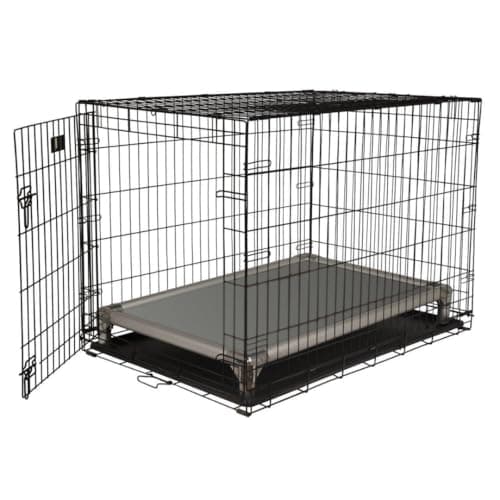
Which means three construction details beat any fabric choice: a bed sized so it lies flat with no fold, baffledrather than loose fill (Carhartt’s baffling is the reason its fill does not migrate to the edges and bunch), and seams and zips turned under or hidden rather than exposed. If the bed is going in a crate, the sizing point is critical and it has its own page: will a dog bed fit in a crate.
The warranty is the real materials spec
When a category refuses to publish numbers, the warranty is where makers tell you what they actually believe about their own fabric — and the spread is enormous:
- Kuranda: one year, and it explicitly covers damage from digging and scratching. The most confident chew cover in the bed category. Read which fabric you are buying, though: outdoor mesh, bed pads and accessories are not covered, cosmetic damage is excluded, and a marketplace purchase must be claimed through the retailer rather than Kuranda.
- K9 Ballistics: 120 days, one time. On the Armored line that replaces the whole bed. On the Tough Ripstop line it replaces the cover only— this is the carve-out that catches people. Their 10-year and 1-year warranties both exclude chewing entirely; only the 120-day one covers it.
- Bully Beds: 200 days — the longest on paper.And written so that the bed must be “completely unusable with the cover and foam destroyed and in pieces.” A chewed-but-still-usable bed, which is the normal outcome, does not qualify.
- Carhartt and Veehoo: nothing.Veehoo’s product is literally named “chew proof” and carries no chew warranty behind the name.
We read every one of these in full on which dog bed warranties actually cover chewing, which is the page to read before you spend four figures on a bed.
What to look for, in order
- Remove the diggable surface if you can live with a hard bed. A taut panel on a frame has no fill to reach and no seam at floor level. It is the only structural answer in the category.
- If it must be soft, buy the published denier.1200D ballistic is the only number anyone prints. Treat every unlabelled “heavy duty” fabric as unknown.
- Buy for flat, not for plush. A bed that folds raises a seam, and the seam is what fails.
- Insist on baffled fill and a removable washable cover. Washability decides whether a bed lasts a year more often than fabric weight does.
- Read the chew warranty as the spec sheet. Length, what it replaces (bed or cover), and what has to be true for a claim to succeed.
- Ignore “orthopedic” as a material claim. No maker here publishes a foam density, so it cannot be verified from any spec sheet.
Quick picks
The short answer, ranked and scored against our published durability rubric. Where a manufacturer does not publish a spec, we say so rather than estimating it.
| # | Photo | Product | Durability | Price |
|---|---|---|---|---|
| 1 | 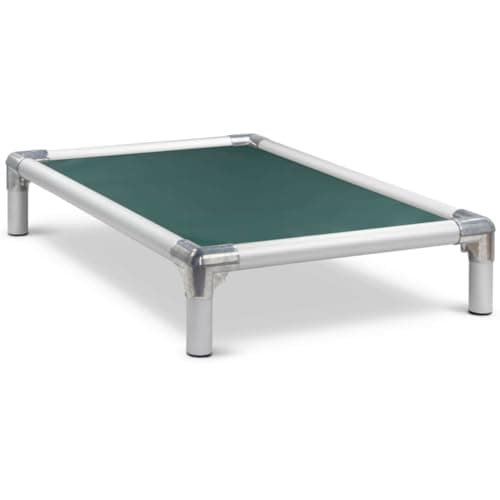 | Kuranda Chewproof Aluminum Elevated BedThe most confident chew warranty in the bed category | 91/100 | $144.95 · Amazon |
| 2 | 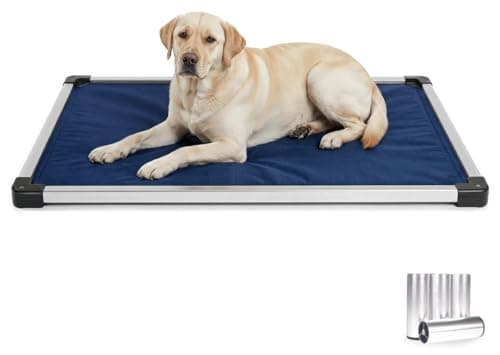 | K9 Ballistics Chew Proof Armored BedA soft bed for a chewer, with a real replacement promise | 77/100 | $165.00 · Amazon |
| 3 | 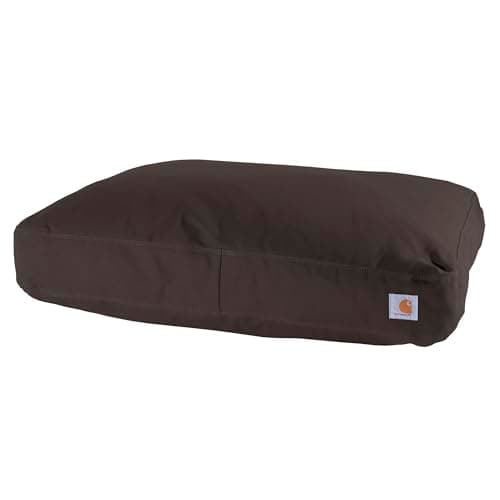 | Carhartt Durable Canvas Firm Duck BedField-canvas looks with a firm fill that will not bunch | 54/100 | $129.99 · Amazon |
| 4 |  | Veehoo Chew Proof Elevated Aluminum CotA lower-cost aluminum cot when Kuranda is out of budget | 57/100 | $70.99 · Amazon |
Tap any row to jump to the full review. Prices are pulled live from Amazon as of October 18, 2026; where we have no verified live price we show none rather than a stale number. #ad — how our links work.
The picks, ranked
1. Kuranda Chewproof Aluminum Elevated Bed
Durability score 91/100Best for: The most confident chew warranty in the bed category
The most defensible chew-proof bed on the market, because Kuranda is the only maker willing to warrant its bed against the dog for a full year.
- Frame
- Aircraft-grade aluminum; stainless steel fasteners
- Weight rating
- Up to 250 lb (aluminum frame)
- Fabrics
- 40 oz heavy-duty vinyl, ballistic nylon, Cordura, or outdoor mesh
- Sizes
- 25x18 through 50x36 in
- Chew warranty
- 1 year — and it explicitly covers damage from digging and scratching
- Fabric denier
- Not published — Kuranda says only 'high-denier nylon'
Pros
- A one-year chew warranty is the longest and most confident in the entire bed category — four to twelve times longer than the rest
- Uniquely, the warranty explicitly covers damage from digging and scratching, not just manufacturing defects
- There is no foam and no stuffing to disembowel — the failure mode is a torn fabric panel, which is replaceable
- Off the ground: no absorbed urine, no mold, and it stays cool
- Aluminum frame rated to 250 lb, with stainless fasteners that will not rust
Cons
- Outdoor mesh, bed pads and accessories are NOT covered by the chew warranty — read which fabric you are buying
- Cosmetic damage is excluded, and marketplace purchases must be claimed through the retailer, not Kuranda
- Kuranda will not publish an actual denier number for its fabrics
- Hard surface — an elevated cot is not a soft bed, and an older dog with joint pain may not thank you
How we assessed it: on published materials, hardware specs and construction — not long-term chew-tested. We say so because it is true, and because a claim we cannot back is worth nothing to you.
#ad Price as of October 18, 2026; Amazon prices change often, so check before you buy. How our links work.
2. K9 Ballistics Chew Proof Armored Bed
Durability score 77/100Best for: A soft bed for a chewer, with a real replacement promise
The best soft bed for a chewer, and the only one whose maker publishes a fabric denier — but the clock runs out after 120 days.
- Fabric
- 1200 denier ballistic — 'densely woven, similar to that used in flak jackets'
- Chew warranty
- 120 days, one-time replacement
- Armored line coverage
- Full bed replacement (not cover-only)
- Foam density
- Not published
Pros
- 1200 denier ballistic fabric is a real, published number — most bed makers will not give you one
- The Armored line gets a full bed replacement under the 120-day warranty, not just a cover
- A soft, padded bed a chewer can actually use, unlike a cot
Cons
- 120 days is one-time only, and it is four times shorter than Kuranda's
- K9 Ballistics does not publish foam density anywhere
- Their 10-year and 1-year warranties both explicitly exclude chewing — only the 120-day one covers it
- K9 Ballistics themselves say plainly: no bed is 100% indestructible
How we assessed it: on published materials, hardware specs and construction — not long-term chew-tested. We say so because it is true, and because a claim we cannot back is worth nothing to you.
#ad Price as of October 18, 2026; Amazon prices change often, so check before you buy. How our links work.
3. Carhartt Durable Canvas Firm Duck Bed
Durability score 54/100Best for: Field-canvas looks with a firm fill that will not bunch
The best-looking honest option here: a firm, abrasion-resistant canvas bed that resists bunching — but it is a canvas bed, not an armored one, and Carhartt does not pretend otherwise.
- Shell
- 12 oz cotton duck canvas with a water-repellent finish (Amazon listing)
- Fill
- Baffled polyester fiber — the baffle keeps it from migrating to the edges (Amazon listing)
- Cover
- Removable, washable shell
- Chew / dig warranty
- None published
- Load rating
- Not published
Pros
- 12 oz cotton duck is a genuinely abrasion-resistant canvas — it shrugs off pawing far better than a thin poly-suede or plush cover
- The baffled fill holds its shape, so a dog that digs and circles cannot bunch it into a lump the way it can a loose pillow
- Water-repellent shell wipes clean and handles the muddy paws that come with a digger
- A restrained, field-outfitter look instead of the usual novelty pattern
Cons
- Cotton duck is tough against abrasion but it is not ballistic nylon and it is not chew-proof — a dog that escalates from digging to biting will get through it
- No chew or dig warranty of any kind, unlike Kuranda or the K9 Ballistics beds
- Carhartt publishes no load rating or fill density
- It is a flat cushion — a determined burrower may still prefer a bolster to dig against
How we assessed it: on published materials, hardware specs and construction — not long-term chew-tested. We say so because it is true, and because a claim we cannot back is worth nothing to you.
#ad Price as of October 18, 2026; Amazon prices change often, so check before you buy. How our links work.
4. Veehoo Chew Proof Elevated Aluminum Cot
Durability score 57/100Best for: A lower-cost aluminum cot when Kuranda is out of budget
A credible budget cot that removes the diggable surface — but with no published weight rating and no warranty, it is the value pick, not the lifetime one.
- Frame
- Silver aluminum (Amazon listing)
- Surface
- Textilene (PVC-coated polyester) mesh, taut over the frame
- Feet
- Non-slip feet — it will not slide when a dog paws at it (Amazon listing)
- Size
- 42 x 31 in (this listing)
- Weight rating
- Not published
- Chew / dig warranty
- None — 'chew proof' is a product name here, not a warranty
Pros
- An aluminum-framed cot for well under the price of a Kuranda — the same 'nothing to dig into' idea at a lower entry point
- Taut mesh over an elevated frame gives a digger no loose surface to burrow into and nothing to disembowel
- Non-slip feet keep it from being shoved across the floor by a pawing dog
- Aluminum will not rust, and the mesh hoses clean
Cons
- Veehoo publishes no weight rating, so you are trusting the frame without a number — Kuranda states 250 lb
- 'Chew proof' is the product's name, not a warranty; there is no chew or dig guarantee behind it
- Textilene mesh is a real weak point at the corner seam — the exact spot a digger's claws find first
- Lighter-gauge hardware than a Kuranda; this is the value cot, not the buy-it-for-life one
How we assessed it: on published materials, hardware specs and construction — not long-term chew-tested. We say so because it is true, and because a claim we cannot back is worth nothing to you.
#ad Price as of October 18, 2026; Amazon prices change often, so check before you buy. How our links work.
The bottom line
If durability is the only criterion, stop shopping for fabric and buy a frame: vinyl or coated mesh stretched over aluminum, with a warranty that covers digging. If the dog needs a soft bed, buy the one fabric in the category with a published weight behind it, size it so it lies flat, and understand that you are buying 120 days of chew cover rather than a guarantee. And treat every bed as a consumable around a determined chewer — the makers do, which is why the warranties are written the way they are. For the ranked fields, see the chew-proof beds, the indestructible beds and the large-dog cut; and for the honest version of the category’s central promise, is there an indestructible dog bed.
Frequently asked questions
What is the most durable dog bed material?
For outright durability, a non-fabric surface: 40 oz heavy-duty vinyl or coated mesh stretched taut over an aluminum frame, as Kuranda builds it. There is no fill to reach, no floor-level seam, and Kuranda rates its aluminum frame to 250 lb and warrants the bed against digging and scratching for a year. Among soft fabrics, the most durable with an actual number attached is K9 Ballistics' 1200 denier ballistic, which the maker describes as densely woven, similar to flak-jacket material - and it is the only denier figure published by anyone in the category.
Is ballistic nylon or ripstop better for a dog bed?
They solve different failures. Ballistic weave resists damage starting - abrasion and tearing - and K9 Ballistics publishes 1200D for its Armored line. Ripstop uses a reinforcing grid to stop a tear spreading once it has started, and is a lighter construction. So for a dog that wears a bed down over months, ballistic lasts longer; for a dog that opens a seam and pulls, ripstop limits the damage. One warranty detail decides it for many buyers: on the Tough Ripstop line K9 Ballistics' 120-day chew warranty replaces the cover only, while on the Armored line it replaces the whole bed.
Does a higher denier mean a more chew-proof dog bed?
No. Denier is a measure of yarn weight, which correlates with abrasion and tear resistance, not with resistance to teeth. A 1200D ballistic panel will outlast a 300D one against scuffing and dragging and still lose to a dog that settles down to work one spot with its molars - K9 Ballistics says outright that no bed is 100% indestructible. Denier is useful mainly as a sign that the maker is willing to publish anything at all: Kuranda, the premium name in the category, will only say 'high-denier nylon'.
Why do dog beds always fail at the seam?
Because a seam is the only part of a bed a dog can get a tooth behind. The usual sequence is that the bed folds or bunches - often because it is slightly too large for the space - the fold raises a seam or a zip pull, the dog opens the seam, and the fill comes out. Penetrating the middle of a panel is much harder work than opening an edge. That is why sizing a bed to lie completely flat, baffled rather than loose fill, and hidden or turned-under seams matter more than fabric weight does.
Is cotton duck canvas durable enough for a dog bed?
For abrasion and general field wear, yes - Carhartt's 12 oz cotton duck with a water-repellent finish is a genuinely tough shell, and its baffled polyester fill is the reason it resists bunching into the edges. For teeth, no. Cotton duck is not ballistic nylon and it is not chew-proof: a dog that escalates from digging to biting will get through it, and Carhartt publishes no chew or dig warranty of any kind. It is the right bed for a dog that is hard on gear but does not eat it.
Do any dog bed makers publish foam density?
None that we have assessed. Not K9 Ballistics, not Bully Beds, not the chew-resistant lines generally. That matters because foam density is the specification that determines whether an orthopedic bed keeps supporting a dog's joints or flattens within a year. The practical consequence is that 'orthopedic' cannot be verified from a spec sheet anywhere in this category, so judge it on the warranty against flattening instead - and note that no-flatten warranties are frequently separate from, and inapplicable to, the chew-resistant beds.
Sources
Every spec on this page traces to one of these. Where a manufacturer does not publish a figure, we say “not published” rather than estimating it.
- Kuranda — warranty terms: the 1-year chew warranty that explicitly covers damage from digging and scratching, and the exclusions (outdoor mesh, pads, accessories, cosmetic damage)
- K9 Ballistics — warranty terms: the 120-day one-time chew replacement, the Armored line's whole-bed rather than cover-only replacement, and the 10-year/1-year warranties that both exclude chewing
- Bully Beds — warranty terms: the 200-day chew warranty and the requirement that the bed be 'completely unusable with the cover and foam destroyed and in pieces'