How to Measure a Dog for a Harness
Weight is the number owners reach for and the number that gets them the wrong harness. The measurement that actually decides fit is girth — and it takes about fifteen seconds to take properly.
Here is the whole guide in one line: measure the girth of the chest at its deepest point, just behind the front legs, with the tape snug against the coat rather than pulled tight — and buy to that number, not to your dog’s weight.
Everything below is the detail: why weight is the wrong input, where exactly the tape goes, what to do when the number lands between two sizes, and how to tell whether the harness you already own actually fits.
Why weight is the wrong number
Look at how the serious brands size their gear and you will notice something. Ruffwear sizes the Front Range on girth, across a stated 13–42 in range, and gives you a chest measurement for every size in the run. Weight appears nowhere in the decision.
That is not fussiness. Two 60 lb dogs can differ by six inches of chest. A deep-chested pointer and a barrel-chested bulldog can weigh the same to the pound and need harnesses two sizes apart. Weight is a proxy for volume; a harness has to fit a shape. Charts that are built on weight alone exist because weight is the number an owner already knows, not because it predicts anything.
Some cheaper brands publish weight-only charts. Treat that as a signal about the brand rather than as guidance about your dog.
The three measurements, in order of importance
1. Girth — the one that decides the size
Stand the dog up squarely. Run a soft tape measure around the ribcage at its deepest point, immediately behind the front legs and the armpit, and bring it back to where it started. Keep the tape level — a tape that sags at the belly reads long.
Snug means the tape is in contact with the coat all the way round, with no slack you can pull out, but not compressing anything. If the dog is heavily coated, part the coat and measure against the body; a double-coated shepherd can otherwise read an inch and a half over.
2. Neck — for collars, and for a few harness designs
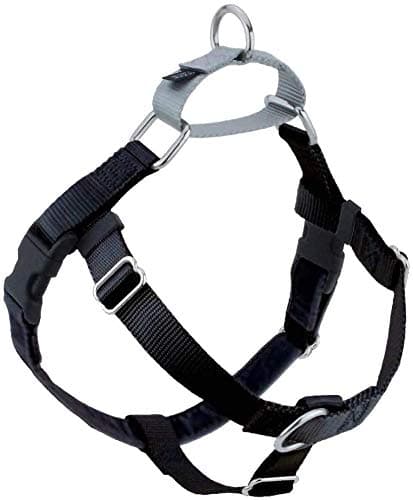
Measure around the base of the neck where a collar naturally sits — low, where the neck meets the shoulders, not up under the jaw. Harnesses with a fixed (non-adjustable) over-the-head opening are sized on this as well as on girth, which is exactly why step-in and Y-front designs are easier to fit on an awkwardly proportioned dog.
3. Topline — only if you are buying a coat, a pack or a cooling vest
Base of the neck to the base of the tail. Harnesses do not need it. Anything that has to cover the dog’s back does.
What to do when the number falls between two sizes
This is where most fitting mistakes happen, and there is no single right answer — but there is a right way to reason about it.
- Check where you are in the overlap. Size runs overlap deliberately. If you measure 27 in and the M is 26–32 in while the S is 22–27 in, you are at the very top of the S and the very bottom of the M. Take the size where you land in the middle of the range, because the middle is where the adjusters have travel in both directions.
- Size up for a growing dog, a heavy coat, or layers. A dog that will wear the harness over a winter coat needs the room now.
- Size down for an escape risk. A harness that a dog reverses out of is not a harness. If your dog has ever backed out of anything, the smaller of two sizes — properly adjusted — is the safer buy. We cover the designs built specifically for this in our durable harness roundup.
The two-finger check, and what it is actually testing
The standard advice is that you should be able to slide two fingers flat between the strap and the dog. That is a good rule, and it is worth understanding what it is testing: two fingers is roughly the clearance at which a strap can still move against the coat without either chafing or leaving a gap a dog can lever a leg through.
Check it at every strap, not just the chest. The most commonly missed one is the girth strap behind the elbow, which is the strap that decides whether the dog can back out of the harness — and the one that quietly loosens first, because it is the one under load on every walk.
Then do the moving check. A harness that fits standing still can still be wrong in motion. Walk the dog ten paces and watch the front legs: the girth strap should sit behind the elbow through the whole stride and not saw across it. This matters more than it sounds. The 2026 Frontiers review of dog-worn equipment found that every harness type studied altered gait — restricting thoracic excursion and changing shoulder extension — regardless of whether the design was marketed as “non-restrictive.” A badly fitted one does more of it.
Checking a harness you already own
Four checks, in the order they are worth doing:
- The backwards test. Hold the leash and take two steps towards the dog so it steps backwards. Anything that lets the dog pull its shoulders through is a fail, and it is a fail regardless of what the size chart says.
- The rotation test. Grip the chest panel and twist. A well-fitted harness moves a little and returns. One that rotates a quarter turn and stays there will chafe under the far armpit.
- The coat check. Take the harness off after a long walk and look at the coat underneath. Flattened fur is normal. Broken hair, a bald line, or pink skin means the strap is loaded in one place and needs re-adjusting or replacing.
- The webbing check. Pull each strap through its adjuster. If it slips under hand pressure, the adjuster is worn and the harness will loosen on a walk. That is a replacement, not an adjustment — see when to replace a harness.
One breed group needs a second measurement alongside girth. Harnesses for dachshunds explains why a long back changes where the belly strap lands, and why no walking-harness maker publishes a maximum back length.
Sizing a collar is a different job
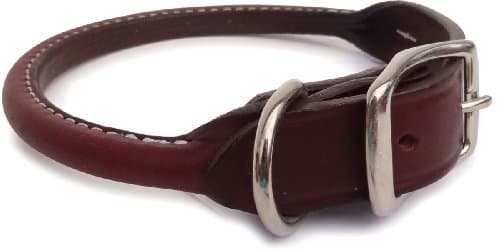
A collar is sized on neck circumference plus enough room for the two-finger rule, and the classic error runs the other way from harnesses: owners buy a collar too loose because a snug collar feels unkind.
A loose flat collar is the single easiest thing for a dog to back out of, and it is also the failure mode behind the one genuinely well-documented collar injury in the veterinary literature: the embedded collar, where a collar left on a growing or long-coated dog is slowly overgrown and causes chronic pressure damage. The 2026 Frontiers review lists that among the risks that are evidenced, as against the many that are merely repeated.
Two fingers, checked monthly on a growing dog, is the whole of the answer. If your dog already backs out of a flat collar, a limited-slip design is the correct tool and we cover the materials trade-off in the collar materials guide.
The thing size charts do not tell you
Nobody in this category publishes a fit tolerance. A harness will tell you it fits a 26–32 in girth. It will not tell you how much of that range the adjusters actually cover comfortably, or which strap runs out of travel first, or whether the chest panel is cut for a deep chest or a broad one.
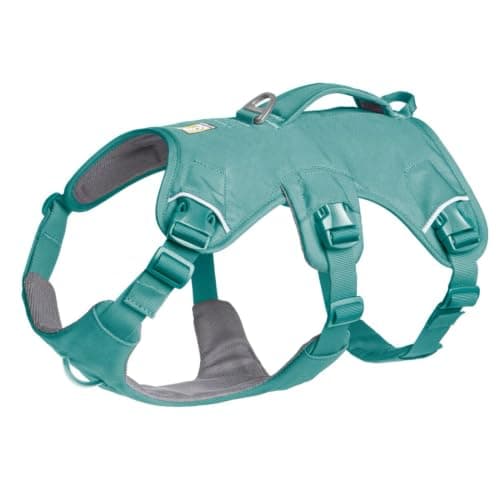
That is a real gap and we are not going to pretend it is not. It is also why the number of adjustment points is one of the specs worth paying for: the Ruffwear Web Master’s five points of adjustment are not a marketing bullet, they are the reason it fits dogs whose proportions do not match anyone’s chart. When you are choosing between two harnesses at the same girth rating, more independent adjusters is the better buy nearly every time.
When the measurement lands past the end of the chart
On very large dogs this stops being a fit question and becomes an availability one. Most of the premium brands top out at around a 42 in girth — Ruffwear does not sell a size above it in any line — so a broad mastiff or Dane can measure straight off the bottom of every chart at once. If your tape reads past 42 in, the best harnesses for large dogs sets out each maker’s published ceiling and what is still available above it.
Frequently asked questions
How do you measure a dog for a harness?
Measure the girth of the chest at its deepest point, immediately behind the front legs, with a soft tape held level and snug against the coat rather than pulled tight. That single number is what almost every serious brand sizes on — Ruffwear, for example, sizes the Front Range across a 13–42 in girth range. Measure the base of the neck as well if the harness goes over the head, and part a heavy coat so the tape reads the body rather than the fur.
Should I size a dog harness by weight?
No. Two dogs of identical weight can differ by six inches of chest girth — a deep-chested pointer and a barrel-chested bulldog are the standard example. Weight is a proxy an owner already knows, not a predictor of fit. Brands that publish weight-only charts are telling you something about the brand rather than about your dog.
What if my dog is between two harness sizes?
Look at where you sit in each size's range rather than at which is nearer. Pick the size where your measurement lands mid-range, because that is where the adjusters have travel in both directions. Size up for a growing dog or one that will wear a coat underneath; size down if your dog has ever backed out of a harness, because an escape-prone dog needs the smaller shell properly adjusted.
How tight should a dog harness be?
You should be able to slide two fingers flat between every strap and the dog — not just the chest strap. The girth strap behind the elbow is the one most often left loose and the one that decides whether a dog can reverse out. Re-check it in motion: the strap should stay behind the elbow through the whole stride rather than sawing across it.
Does a harness affect how a dog moves?
Yes, and this is better established than most owners realize. The 2026 Frontiers in Veterinary Science review of dog-worn equipment reports that multiple studies found harnesses restrict thoracic excursion and alter shoulder extension during movement — and that this held regardless of whether a design was marketed as restrictive or non-restrictive. Individual dogs respond differently. It is an argument for fitting carefully, not for abandoning harnesses.
Sources
Every spec on this page traces to one of these. Where a manufacturer does not publish a figure, we say “not published” rather than estimating it.
- Ruffwear — Front Range Harness specs and girth-based sizing (300D shell, ITW Nexus buckles)
- Ridgway (2026) — “Health implications of dog-worn equipment: a review of known and alleged physical risks”, Frontiers in Veterinary Science 13:1711781
- Pauli, Bentley, Diehl & Miller (2006) — “Effects of the application of neck pressure by a collar or harness on intraocular pressure in dogs”, J. Am. Anim. Hosp. Assoc. 42(3):207–11
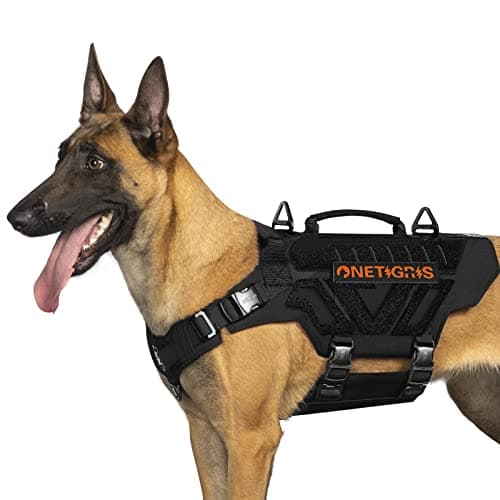
- OneTigris — X-Armor Tactical Harness (1000D nylon; published buckle and D-ring load ratings)