No-Pull vs Regular Dog Harness
The two are not different quality tiers of the same object. One puts the leash behind the dog's center of mass and one puts it in front, and that single change is the entire comparison.
The short answer. A “regular” harness clips at the back, behind the dog’s center of mass, and mechanically it is a pulling yoke — that is what a sled dog wears. A “no-pull” harness clips at the chest, in front of the center of mass, so pulling turns the dog rather than moving it forward. Everything else — fabric, padding, brand, price — is secondary to that one geometric fact.
Side by side
| Regular (back-clip) | No-pull (front-clip) | |
|---|---|---|
| Leash position | Behind the shoulders | At the center of the chest |
| What happens when the dog pulls | The dog leans into it and gains leverage | The dog is turned back toward the handler |
| Measured leash tension | Highest of anything tested by Shih et al. (16.87 N max) | Comparable to a metal prong collar on pull force (Johnson & Wynne) |
| Best for | A dog that already walks on a loose leash; carting, sport, tracking | A dog that pulls, and the handler who has to walk it tomorrow |
| Main drawback | Makes pulling easier, not harder | Leash can swing under a front leg; more fit-sensitive |
| Trains anything? | No | No — it manages, it does not teach |
What the measurements actually show
This is one of the few areas of dog gear where somebody has bothered to measure, and the results are more surprising than the marketing.
Shih et al. (2021) instrumented leashes and measured tension across different equipment in 52 dogs. The headline result for this comparison: a back-connection harness produced a maximum leash tension of 16.87 N — against 6.97 N on a collar. The back-clip harness was not neutral and it was not gentler. It was the highest-tension option in the study, because a strap across the shoulders is exactly the geometry you would design if you wanted a dog to pull efficiently.
Johnson & Wynne (2024) compared four types of walking equipment for efficacy and welfare impact, and found a front-connection harness statistically indistinguishable from a metal prong collar on pull force. That is a striking finding in both directions: it is a strong result for the front-clip harness, and it is a difficult one for anyone who assumed a prong was doing something no harness could.
Why the front connection works
Nothing clever, just leverage. Attach a line behind a dog’s center of mass and every newton the dog produces goes into forward motion. Attach it in front and the same force produces a rotation: the dog’s own effort turns its chest toward you.
The dog is not punished, restricted or corrected. It simply stops being rewarded for pulling by moving forward, which is the mechanism worth understanding before you buy anything. We go through it in more depth in do harnesses help with pulling.
Neither one trains a dog
Worth stating plainly, because it is the most common misunderstanding in the category: a front-clip harness manages pulling. It does not teach a dog to walk on a loose leash. Take it off and put a flat collar on, and most dogs pull exactly as they did before.
That is not an argument against buying one. Management is genuinely valuable — it makes the walk possible today, it stops the dog rehearsing pulling on every outing, and it buys you the calm you need to actually train. It is an argument against expecting the harness to do the training for you.
Quick picks
The short answer, ranked and scored against our published durability rubric. Where a manufacturer does not publish a spec, we say so rather than estimating it.
| # | Photo | Product | Durability | Price |
|---|---|---|---|---|
| 1 | 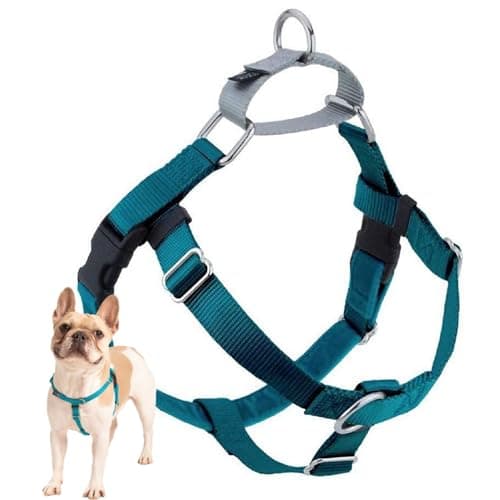 | 2 Hounds Design Freedom No-Pull HarnessA hard puller, if you buy the chew coverage with it | 82/100 | $34.98 · Amazon |
| 2 | 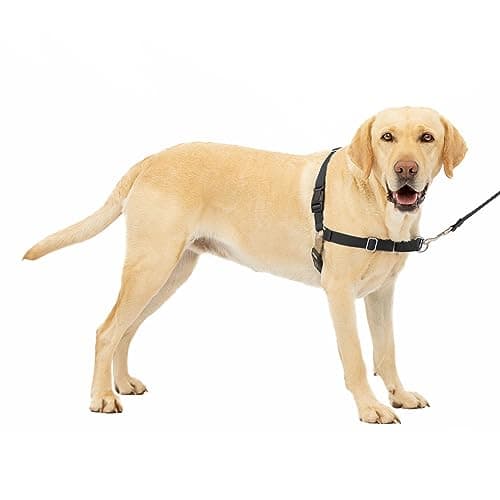 | PetSafe Easy Walk HarnessThe cheapest way to stop a dog pulling on a walk | 42/100 | $22.99 · Amazon |
| 3 | 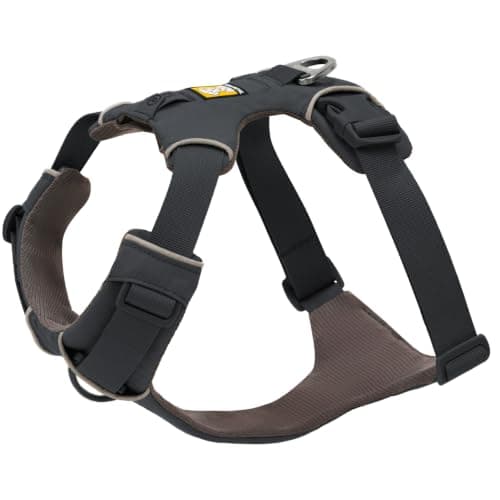 | Ruffwear Front Range HarnessThe everyday harness for a dog that does not pull hard | 77/100 | $59.99 · Amazon |
| 4 | 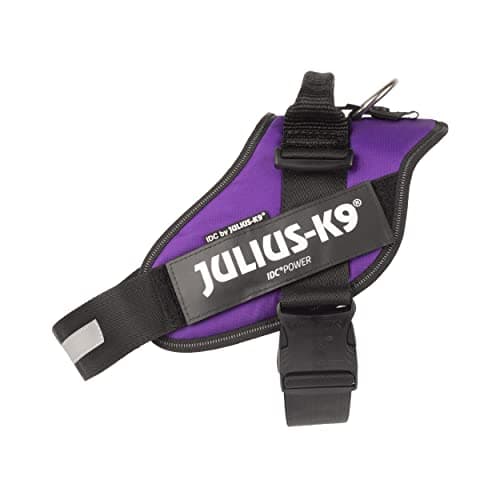 | Julius-K9 IDC PowerharnessQuick on, quick off, on a big working dog | 58/100 | $64.99 · Amazon |
Tap any row to jump to the full review. Prices are pulled live from Amazon as of October 18, 2026; where we have no verified live price we show none rather than a stale number. #ad — how our links work.
The picks, ranked
1. 2 Hounds Design Freedom No-Pull Harness
Durability score 82/100Best for: A hard puller, if you buy the chew coverage with it
The strongest published webbing in the category paired with stainless hardware — but budget for the paid chewing warranty if your dog is a chewer.
- Webbing
- 3,800 lb test strength (manufacturer's own claim)
- Lining
- Swiss velvet
- Hardware
- Stainless steel
- Control
- Martingale tightening loop on the back
- Sizes
- 5/8 in XS (14–20 in) to 1 in XXL (36–44 in)
- Made in
- North Carolina, globally sourced materials
Pros
- The 3,800 lb webbing figure is the highest published rating we found on any harness in this category
- Stainless steel hardware — rust-resistant and washable, unlike plated zinc
- The martingale loop tightens the chest strap rather than choking the neck
- Made in the USA, which is rare at this price
Cons
- The 3,800 lb figure is 2 Hounds' own claim, not third-party verified — treat it as a manufacturer's number
- Base warranty explicitly excludes chewed webbing and buckles; chew coverage is a separate paid add-on
- Velvet lining is comfortable but holds dirt and dries slowly
How we assessed it: on published materials, hardware specs and construction — not long-term chew-tested. We say so because it is true, and because a claim we cannot back is worth nothing to you.
#ad Price as of October 18, 2026; Amazon prices change often, so check before you buy. How our links work.
2. PetSafe Easy Walk Harness
Durability score 42/100Best for: The cheapest way to stop a dog pulling on a walk
It solves pulling cheaply, and that is all it does — do not mistake it for durable gear.
- Design
- Front-clip, martingale chest strap (Amazon listing)
- Materials
- Not published
- Hardware
- Not published
- Load rating
- Not published
Pros
- The front-clip design genuinely redirects a pulling dog, and it is the cheapest way to get that
- Very widely available
Cons
- PetSafe publishes no materials, hardware or load specification we could verify
- Plastic buckles throughout — this is not a harness built to survive a determined chewer
- The chest strap can rub in the armpit on a dog that pulls constantly
How we assessed it: on published materials, hardware specs and construction — not long-term chew-tested. We say so because it is true, and because a claim we cannot back is worth nothing to you.
#ad Price as of October 18, 2026; Amazon prices change often, so check before you buy. How our links work.
3. Ruffwear Front Range Harness
Durability score 77/100Best for: The everyday harness for a dog that does not pull hard
The best-specified everyday harness here, and the rare case where the cheaper Ruffwear has the heavier fabric.
- Shell
- 300D polyester ripstop (100% recycled), PU coating + non-fluorinated DWR
- Padding
- PE foam
- Webbing
- Polyester (30% recycled)
- Buckles
- ITW Nexus Airloc side-release
- Rear attachment
- Anodized 6061-T6 aluminum V-ring
- Front attachment
- Nylon webbing in a TPU tube
- Sizes
- XXS–L/XL, 13–42 in girth
- Load rating
- Not published
Pros
- 300D recycled ripstop is a genuinely heavier shell than the Web Master's 150D, for less money
- Named, specified hardware — ITW Nexus Airloc buckles, anodized aluminum V-ring
- Two leash points, four points of adjustment
- Polyester webbing resists abrasion better than polypropylene
Cons
- No published load rating — a real gap for a premium brand
- Ruffwear's warranty states no duration at all and explicitly excludes chewing damage
- Hand wash, mild detergent, air dry
How we assessed it: on published materials, hardware specs and construction — not long-term chew-tested. We say so because it is true, and because a claim we cannot back is worth nothing to you.
#ad Price as of October 18, 2026; Amazon prices change often, so check before you buy. How our links work.
4. Julius-K9 IDC Powerharness
Durability score 58/100Best for: Quick on, quick off, on a big working dog
Fast and comfortable, but one buckle is the whole harness — think hard about that before trusting it with a strong dog.
- Design
- Single-buckle chest closure, padded handle (Amazon listing)
- Materials
- Not published
- Load rating
- Not published
Pros
- One buckle and it is on — genuinely fast
- Broad chest plate spreads load across the sternum
Cons
- No published denier, hardware spec or load rating
- The single closure buckle is a single point of failure by design
How we assessed it: on published materials, hardware specs and construction — not long-term chew-tested. We say so because it is true, and because a claim we cannot back is worth nothing to you.
#ad Price as of October 18, 2026; Amazon prices change often, so check before you buy. How our links work.
The gait question, honestly
Front-clip harnesses attract a recurring criticism — that they restrict shoulder movement. The honest version of the evidence is broader than that.
Ridgway’s 2026 review in Frontiers in Veterinary Science examined the known and alleged physical risks of dog-worn equipment and reported that all harness types studied altered gait and restricted thoracic excursion to some degree — not just front-clip ones. The same review reported that claims of collar-related injury to the thyroid, trachea, jugular veins or carotid arteries from routine leash pulling are “not supported in the literature.”
So there is no free option. Both pieces of equipment have costs and the evidence does not support the confident positions taken on either side. What follows practically is: fit the harness properly, keep the chest strap below the point of shoulder, and take the harness off when the dog is not working.
The harnesses that are both
The tidy binary above is slightly out of date, because most good harnesses now carry both attachment points. The Ruffwear Front Range has a rear aluminum V-ring and a front connection in a TPU-sleeved webbing loop; the 2 Hounds Freedom pairs a front ring with a martingale loop on the back that tightens as the dog pulls.
If you are buying one harness, buy a dual-attachment one. Use the front ring while you are training and on high-distraction walks, and the back ring once the dog has genuinely learned to walk politely — or when you want the dog to pull, which is a legitimate thing to want on a hiking trail or a scent trail.
Fit matters more on a front-clip
A back-clip harness that is slightly loose is untidy. A front-clip harness that is slightly loose does not work:
- The chest strap rides up toward the throat, which is uncomfortable and moves the attachment point away from the leverage you bought it for.
- The strap rotates so the front ring ends up on the dog’s shoulder instead of its sternum, and the turning effect disappears.
- The leash swings under a front leg — the most common complaint about front-clip harnesses and almost always a symptom of a loose or badly positioned chest strap.
Measure properly before you buy — how to measure a dog for a harness covers the mistake that makes most girth measurements wrong — and re-check the adjusters monthly, because webbing creeps.
Which to buy
- Your dog pulls. Front-clip, or dual with a front ring. Start with the front ring.
- Your dog walks politely already. A back-clip is more comfortable, simpler to fit and less fit-sensitive. There is no reason to add a front connection you will not use.
- Your dog is meant to pull — carting, skijoring, tracking, or just a hiking harness you want the dog to lean into. Back-clip, and that is the correct tool rather than a compromise.
- Your dog backs out of harnesses. Neither category solves that on its own; you want a third strap or a martingale loop. See escape-proof harnesses.
Ranked picks for each are in the best no-pull harnesses and the most durable harnesses.
Frequently asked questions
What is the difference between a no-pull harness and a regular harness?
Where the leash attaches. A regular harness clips at the back, behind the dog's center of mass, so pulling moves the dog forward efficiently — mechanically it is the same geometry as a sled dog's harness. A no-pull harness clips at the chest, in front of the center of mass, so the dog's own pulling force turns it back toward the handler instead. Fabric, padding and price are secondary to that single geometric difference.
Does a back-clip harness make pulling worse?
The measurements say yes. Shih et al. (2021) instrumented leashes across equipment types in 52 dogs and recorded a maximum leash tension of 16.87 N on a back-connection harness against 6.97 N on a collar — the back-clip harness was the highest-tension option in the study. A strap across the shoulders is precisely the geometry you would choose if you wanted a dog to pull efficiently.
Do no-pull harnesses actually work?
For managing pulling, yes. Johnson & Wynne (2024) compared four types of walking equipment and found a front-connection harness statistically indistinguishable from a metal prong collar on pull force. But it manages rather than teaches: take the harness off and put a flat collar on, and most dogs pull exactly as before. The value is that it makes the walk possible today and stops the dog rehearsing pulling on every outing.
Do no-pull harnesses restrict a dog's shoulders?
The evidence is broader than that criticism suggests. Ridgway's 2026 review reported that all harness types studied altered gait and restricted thoracic excursion to some degree, not only front-clip designs — while separately reporting that claims of collar injury to the thyroid, trachea or major vessels from routine leash pulling are not supported in the literature. There is no free option; fit the harness properly, keep the chest strap below the point of shoulder, and take it off when the dog is not working.
Why does my dog's leash keep swinging under its front leg?
Almost always a loose or badly positioned chest strap. If the front strap rides up toward the throat or rotates so the ring sits on the shoulder rather than the sternum, the leash falls into the leg path and the turning effect disappears at the same time. Re-measure, tighten to two fingers of clearance, and check the adjusters monthly — webbing creeps through them over weeks.
Should I buy a harness with both front and back attachment points?
If you are only buying one, yes. Use the front ring while training and on high-distraction walks, and the back ring once the dog walks politely — or when you actually want the dog to pull, which is legitimate on a trail or in tracking work. Most good harnesses now carry both: the Ruffwear Front Range pairs a rear aluminum V-ring with a front connection, and the 2 Hounds Freedom pairs a front ring with a martingale loop that tightens on the back.
Sources
Every spec on this page traces to one of these. Where a manufacturer does not publish a figure, we say “not published” rather than estimating it.
- Shih et al. (2021) — “Comparison of Leash Tension When Walking Dogs Using Different Collars and Harnesses”, Frontiers in Veterinary Science 8:735680
- Johnson & Wynne (2024) — “Comparing efficacy in reducing pulling and welfare impacts of four types of leash walking equipment”, PeerJ 12:e18131
- Ridgway (2026) — “Health implications of dog-worn equipment: a review of known and alleged physical risks”, Frontiers in Veterinary Science 13:1711781
- 2 Hounds Design — Freedom No-Pull Harness specs (3,800 lb test webbing, stainless hardware, martingale back loop)
- Ruffwear — Front Range Harness specs (300D recycled polyester ripstop, ITW Nexus Airloc buckles, 6061-T6 aluminum V-ring)