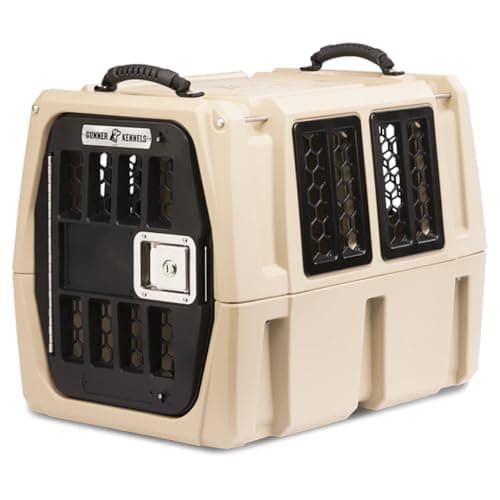
Dog Crate vs Playpen
They look like alternatives and they are not. One is a containment device with a latch; the other is a boundary suggestion with a footprint. Picking wrongly is how people end up owning both.
The verdict
Buy a crate if the requirement is that the dog stays where you put it— a pen has no roof, no load-bearing latch and no fixed anchorage, so any dog willing to climb, lean or walk it across a floor will leave. Buy a pen if the requirement is floor space inside a boundaryfor a dog that already respects the boundary — a settled puppy, a litter, a recovering dog that needs room to move but not to run. For a genuine escape artist, the answer is not a stronger pen, it is the Impact High Anxiety crate, whose lifetime Dog Damage Guarantee is the only warranty in the category that pays out when the dog wins — and note it applies to the High Anxiety line only, not to Impact’s Collapsible or Stationary models. Two things neither product does: neither is a car restraint, and neither treats the reason a dog is distressed. We do not assess exercise pens, so this page recommends none — the picks below are crates.
They are not alternatives, they are different devices
The comparison gets framed as a choice because both appear in the same aisle at the same price. Structurally they have almost nothing in common.
| Crate | Playpen / exercise pen | |
|---|---|---|
| What it is | A closed box with a latching door | An open-topped fence with no fixed anchorage |
| Contains a dog that wants out? | Yes, if the latch and the build are right | No. It is climbable, leanable and pushable |
| Floor space | Enough to stand, turn and lie down. Not to move around | Its whole advantage — several times a crate’s |
| Den effect | Enclosed on all sides; many dogs settle better | Open; no shelter unless you add it |
| Travel | Portable; some models are airline-shaped | Folds flat, but useless in a vehicle |
| Car restraint | Only if independently crash-certified | Never. Not a restraint in any configuration |
| Toileting room | Deliberately none — that is the house-training logic | Yes, and that is the point for a young puppy |
Read down the two columns and the decision resolves itself. A pen answers “where can the puppy be loose and supervised without eating the baseboards?” A crate answers “where does the dog go when nobody can watch it?” Most households with a young dog genuinely need both answers, which is why so many end up owning both — and why buying one as a substitute for the other is the expensive mistake.
The containment question, honestly
A pen’s failure modes are structural rather than material. It has no roof, so a dog that can get its front feet on the top rail can get over it. It is not anchored, so a dog that leans steadily moves it, and a dog that lies against one wall and pushes with its back legs walks the whole pen across a smooth floor. And its height is the only spec that matters, which is why pen marketing leads on height.
Crates fail differently: at the latch, and at the warranty. The pattern across the category is remarkable once you see it, and it is the single most useful thing we have found in this hub:
- ProSelect Empire— 20-gauge steel reinforced with half-inch steel tubes on a three-quarter-inch tube frame, dual door latches. Sold for “powerful dogs that are able to claw or chew their way out of other cages,” with a one-year warranty that explicitly excludes breakage or damage caused by the dog. That is the category’s central absurdity in one sentence.
- Diggs Evolv— the best-designed crate here, with a dual latching system Diggs states cannot be opened from inside the crate. Its warranty is one year and excludes damage caused by dogs who are not crate-trained or who chew the product. Worth knowing: Diggs is sometimes remembered as a crash-certified brand, and it is not — its only certificate was on the Passenger Carrier, certified at 18 lb in 2021 and since delisted.
- Impact High Anxiety— powder-coated aluminum, and a lifetime Dog Damage Guarantee: if your dog breaks it, Impact replaces it. In a category built on excluding exactly that, it is the whole argument. The scope limit is strict: High Anxiety crates only. Buy the Collapsible or the Stationary instead and the guarantee does not come with it.
If escape specifically is your problem, the ranked field is the escape-proof crates, and the modification route is how to make a crate escape-proof. A pen is not on either page for a reason.
Neither one goes in a car
Worth its own heading because people improvise here. A pen is not a vehicle restraint in any configuration. And a crate is only a restraint if it has been independently crash-certified — certification is issued per product and per dog weight, and the Center for Pet Safety is the only body that issues it. CPS’s own finding on wire crates is that they will not provide significant protection in an accident, so a wire crate in a cargo area is distraction prevention, not safety equipment. The certified list, what certification does and does not cover, and the harness alternative are all on the crash-tested crates roundup and how CPS testing actually works.
For a puppy, the usual sequence
The two products tend to be needed at different stages rather than in competition:
- Early weeks— a pen is genuinely useful: a safe, supervised area with room for a bed at one end and a toileting surface at the other, which a crate deliberately does not provide.
- House-training— the crate earns its place, because the logic of crate training is that the space is too small to toilet in and the dog learns to hold.
- Adolescence— the pen stops containing, usually abruptly, and the crate becomes the only reliable option for unsupervised time.
- Adult— most households keep the crate and retire the pen.
Sizing is the one thing people get wrong in both directions: too small is cruel and too large defeats house-training. What size crate does my dog need has the measuring method. And if the real problem is a dog that panics when confined rather than one that escapes for fun, neither product is the answer and the equipment decision is the wrong decision to be making — that is handled properly, with its citations, on crates and separation anxiety.
Choosing, in order
- Name the job. Containment when unsupervised, or space when supervised. One of those is a crate and the other is a pen.
- If it is containment, look at the latch first. Dual latching, and ideally one the maker states cannot be worked from inside.
- Then read the warranty for the dog-damage clause. Almost every crate excludes damage caused by the dog. One line does not.
- Check the published gauge — and notice who refuses. ProSelect states 20-gauge steel with half-inch tubes. Impact and Diggs will not publish their aluminum gauge or steel gauge at all.
- Do not buy either for the car. That is a separate purchase with a separate certification question.
Quick picks
The short answer, ranked and scored against our published durability rubric. Where a manufacturer does not publish a spec, we say so rather than estimating it.
| # | Photo | Product | Durability | Price |
|---|---|---|---|---|
| 1 | 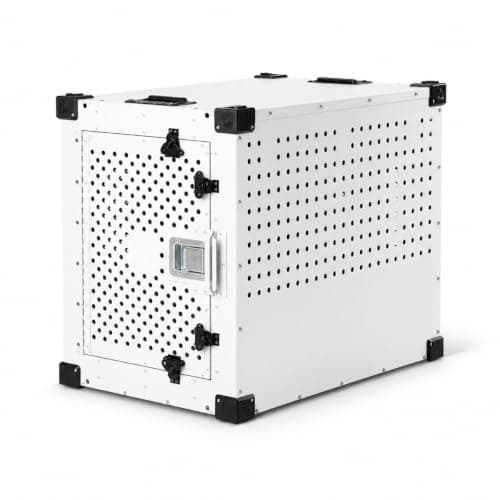 | Impact High Anxiety CrateThe genuine escape artist — and the only warranty that pays out when a dog wins | 91/100 | Check price |
| 2 | 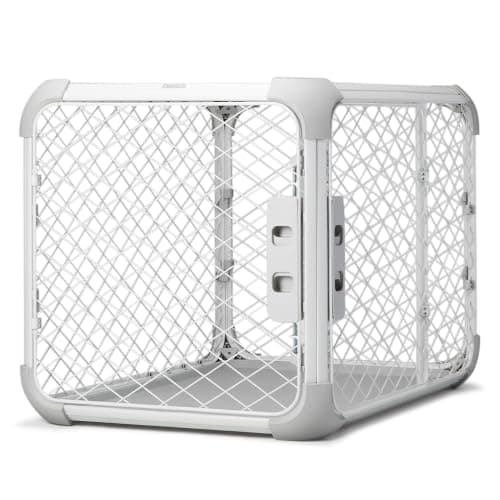 | Diggs Evolv Modular CrateA crate you can live with in a living room | 70/100 | $381.65 · Amazon |
| 3 | 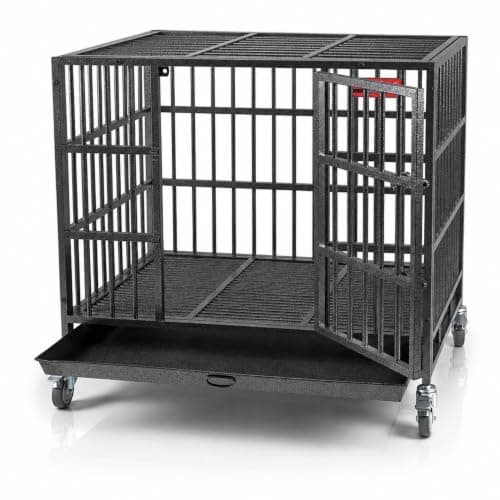 | ProSelect Empire Dog CageRaw steel strength per dollar | 73/100 | $389.85 · Amazon |
Tap any row to jump to the full review. Prices are pulled live from Amazon as of October 18, 2026; where we have no verified live price we show none rather than a stale number. #ad — how our links work.
The picks, ranked
1. Impact High Anxiety Crate
Durability score 91/100Best for: The genuine escape artist — and the only warranty that pays out when a dog wins
The only heavy-duty crate whose maker will stand behind it when the dog wins — which, in a category built on excluding exactly that, is the whole argument.
- Material
- Powder-coated aluminum
- Warranty
- Lifetime Dog Damage Guarantee — 'If your dog breaks it, we'll replace it'
- Warranty scope
- High Anxiety crates ONLY — not the Collapsible or Stationary models
- Aluminum gauge
- Not published for this model
Pros
- This is the only crate we found, at any price, whose standard warranty actually covers your dog destroying it
- Every other heavy-duty brand — Gunner, Lucky Duck, ProSelect, Diggs, and even Impact's own other crates — excludes dog damage
- Aluminum, powder-coated, built for dogs that defeat everything else
Cons
- The most expensive crate here by a wide margin
- The Dog Damage Guarantee applies ONLY to the High Anxiety line. Buy the Collapsible instead and you lose it
- Heavy and not genuinely portable
- Impact does not publish the aluminum gauge
How we assessed it: on published materials, hardware specs and construction — not long-term chew-tested. We say so because it is true, and because a claim we cannot back is worth nothing to you.
#ad We only show a price when we have a live one from Amazon. We don’t have one for this product right now, so we’re not going to guess. How our links work.
2. Diggs Evolv Modular Crate
Durability score 70/100Best for: A crate you can live with in a living room
The best-designed crate here and a genuinely clever latch — but it is not crash-certified, and its warranty walks away from chewers.
- Materials
- High-strength steel wire on a reinforced frame; nylon-coated steel, diamond mesh, rounded pet-safe edges (Diggs)
- Latch
- Dual latching system — Diggs states the two locks cannot be opened from inside the crate
- Capacity
- S up to 16 in / 30 lb; M 16–18 in / 30–50 lb; Intermediate 18–22 in / 50–70 lb; L 22–28 in / 70–90 lb; XL up to 29 in / 90–110 lb
- Size on this listing
- Intermediate — dogs 18–22 in tall (50–70 lb), Ash
- Warranty
- 1 year — and Diggs' warranty terms exclude 'damage caused by dogs who are not crate-trained or who chew on the product'
- Steel gauge
- Not published
- Crash certification
- None. Diggs holds no CPS certification at all today - its Passenger Carrier was certified at 18 lb in October 2021 and has since been delisted
Pros
- The dual latch genuinely defeats the paw-and-nose crate escapes that beat a single slide bolt — Diggs states it cannot be worked from inside
- Five sizes with published height AND weight bands, which is more than almost any crate maker publishes
- Modular panel construction, so it comes apart for storage without tools
- The only crate here that does not look like a piece of kennel equipment
Cons
- Diggs is sometimes remembered as a certified brand; its only CPS certificate was on the Passenger Carrier and it has been delisted. Nothing Diggs sells is crash-certified
- The warranty excludes chewers outright, which is a strange exclusion on a crate this expensive
- Diggs will not publish the steel gauge
- It breaks down into panels rather than folding flat — easier to store than a rigid crate, not as quick as a true collapsible
How we assessed it: on published materials, hardware specs and construction — not long-term chew-tested. We say so because it is true, and because a claim we cannot back is worth nothing to you.
#ad Price as of October 18, 2026; Amazon prices change often, so check before you buy. How our links work.
3. ProSelect Empire Dog Cage
Durability score 73/100Best for: Raw steel strength per dollar
The most steel for the money and the most honest spec sheet in the category — sold with a warranty that excludes the exact thing you are buying it for.
- Steel
- 20-gauge steel reinforced by 1/2 in diameter steel tubes
- Frame
- 3/4 in tube frame
- Latches
- Dual door latches
- Warranty
- 1 year — explicitly excludes 'breakage or damage caused by user or dog'
Pros
- It publishes an actual steel gauge — 20-gauge, with 1/2 in reinforcing tubes — which MidWest will not do
- Genuinely heavy, welded steel construction at a mid-range price
- Dual latches on the door
Cons
- The warranty is the category's central absurdity: this crate is sold 'for powerful dogs that are able to claw or chew their way out of other cages', and the warranty then excludes damage caused by the dog
- One year only
- Extremely heavy; the casters are doing real work
How we assessed it: on published materials, hardware specs and construction — not long-term chew-tested. We say so because it is true, and because a claim we cannot back is worth nothing to you.
#ad Price as of October 18, 2026; Amazon prices change often, so check before you buy. How our links work.
The bottom line
A pen is floor space inside a boundary for a dog that respects boundaries. A crate is containment for a dog that does not, and the only crate warranty that survives contact with a determined dog is Impact’s on the High Anxiety line. If you are choosing one for a puppy, you will probably use both and in that order. If you are choosing one because the dog escapes, it is a crate, and the pen you were considering would not have held it. And whatever you buy, buy the car restraint separately — neither of these is one. The adjacent comparison, if what you actually meant was an outdoor run rather than a pen, is crate against kennel, and the outdoor field is the outdoor kennels.
Frequently asked questions
Is a crate or a playpen better for a dog?
They do different jobs. A crate is a closed box with a latching door: it contains a dog that wants out, provides a den effect many dogs settle better in, and is the tool for unsupervised time and house-training. A playpen is an open-topped fence with no fixed anchorage: it buys several times a crate's floor space and contains nothing - a dog that can climb, lean steadily or push with its back legs will get out or simply move the pen. Choose by job: containment when nobody is watching means a crate; space inside a boundary while you are watching means a pen.
Can a dog escape a playpen?
Easily, and the failure modes are structural rather than material. A pen has no roof, so a dog that gets its front feet onto the top rail can go over it. It is not anchored, so a dog that leans on one wall moves it, and a dog that lies against a wall and pushes with its back legs can walk the whole pen across a smooth floor. Height is effectively the only specification that matters, which is why pen marketing leads on it. If escape is your actual problem, the answer is a crate with a dual latch, not a taller pen.
Can you use a playpen instead of a crate for house-training?
Not for the same purpose. The logic of crate training is that the space is too small for the dog to toilet in and far enough from its bed that the dog learns to hold - which is exactly the room a pen is designed to provide. A pen is genuinely useful earlier than that: in the first weeks it gives a puppy a bed at one end and a toileting surface at the other, safely, while you are nearby. Most households need both, at different stages, which is why buying one as a substitute for the other tends to end with owning both anyway.
Can you use a dog crate or playpen in a car?
A pen, never - it is not a restraint in any configuration. A crate only if that specific crate has been independently crash-certified, and certification is issued per product and per dog weight by the Center for Pet Safety. CPS's own finding on wire crates is that they will not provide significant protection in an accident, so a wire crate in a cargo area is distraction prevention rather than safety equipment. Treat the car restraint as a separate purchase with its own certification question.
Which dog crate warranty actually covers damage caused by the dog?
One line that we have found: Impact's High Anxiety crate, which carries a lifetime Dog Damage Guarantee - if the dog breaks it, Impact replaces it. The scope limit is strict and worth repeating, because it is easy to buy the wrong model: the guarantee applies to the High Anxiety line only, not to Impact's Collapsible or Stationary crates. Everywhere else the exclusion is standard. ProSelect's Empire is marketed for dogs that claw or chew out of other cages and its one-year warranty excludes breakage or damage caused by the dog; Diggs' one-year warranty excludes dogs that are not crate-trained or that chew the product.
Do you recommend a particular exercise pen?
No, and we would rather say so than rank a category we have not examined. We do not currently assess exercise pens, so there is no pen in our registry and none on this page - the picks here are crates. What we can tell you about pens is structural and applies to all of them: no roof, no anchorage, height as the only meaningful specification, and no role whatsoever as a vehicle restraint.
Sources
Every spec on this page traces to one of these. Where a manufacturer does not publish a figure, we say “not published” rather than estimating it.
- Impact Dog Crates — lifetime guarantee page: the Dog Damage Guarantee and its scope limit to the High Anxiety line
- Diggs — warranty terms: one year, excluding damage caused by dogs who are not crate-trained or who chew on the product
- Center for Pet Safety — certified products, and its finding that wire crates will not provide significant protection in an accident