The Best Martingale Collars
The collar for a dog whose neck is narrower than its head. It closes to a limit and no further, which is the entire point and the thing most people misunderstand.
Buy the Mighty Paw martingale for stainless hardware at a low price, or the Ruffwear Chain Reaction if you want the named-hardware build from a brand that specifies its components.
Buy the Blueberry if you want the structurally strongest layout — a continuous loop with no buckle on the load path — and the PetSafe quick-snap if the daily reality of posting a collar over your dog’s head is what will stop you using one at all.
What a martingale actually does
A martingale is a limited-slip collar. It is a main loop of webbing or leather with a smaller control loop; the leash attaches to the control loop, and pulling on it draws the two ends of the main loop towards each other, tightening the collar.
The critical part is the word limited. A correctly sized martingale tightens to a stop — the point where the two rings on the main loop meet — and no further. It cannot continue to close. That is the entire difference between a martingale and a choke chain, and it is a mechanical difference built into the geometry rather than a matter of handler skill.
Sizing is therefore not cosmetic. A martingale sized too large will have a stop point that is still loose enough for the dog to back out of; one sized too small has a stop point that is already tight when the collar is at rest. The stop is the specification.
Which dogs need one
- Any dog whose neck is narrower than its skull. Sighthounds — greyhounds, whippets, lurchers, salukis — are the canonical case, and it is why martingales are sometimes called greyhound collars. A flat collar that is loose enough to be comfortable on a whippet is loose enough to slip straight off over the head.
- Any dog that has ever backed out of a flat collar. Once is enough. It is self-reinforcing behavior.
- Newly adopted and fearful dogs, during the period before you know what they will do when startled. Rescue organizations default to martingales for exactly this reason.
What it is not, and one thing the evidence shows
It is not a training tool, and it is not a substitute for a harness on a dog that pulls.
That last point is worth stating with the evidence attached, because it is counterintuitive. Johnson and Wynne (2024, PeerJ) measured pull force on 23 dogs across four pieces of equipment, using a martingale collar as the baseline. Dogs pulled significantly more on the martingale than on the front-connection harness, the Starmark collar or the metal prong collar — p < 0.001 in each comparison.
So a martingale is the right answer to escaping and the wrong answer to pulling. If the dog does both, that is a martingale for security and a front-clip harness for the walk, and we cover the measured picture in do harnesses help with pulling.
The clearest case for a limited-slip collar is a double-coated dog, where a strap fitted over fur is loose over skin. The best dog gear for huskies works that through, along with the crate and cooling questions the same dog creates.
Quick picks
The short answer, ranked and scored against our published durability rubric. Where a manufacturer does not publish a spec, we say so rather than estimating it.
| # | Photo | Product | Durability | Price |
|---|---|---|---|---|
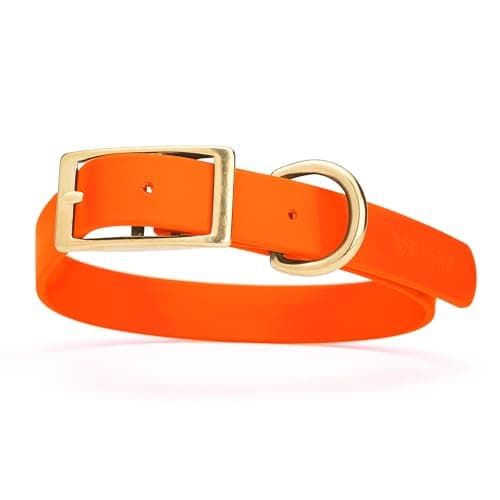
| 1 | 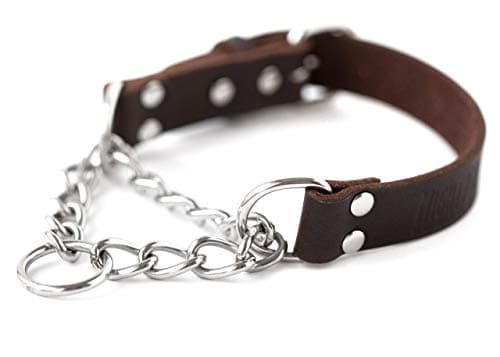 | Mighty Paw Martingale CollarStainless hardware on a limited-slip collar, cheap | 69/100 | $14.39 · Amazon |
| 2 | 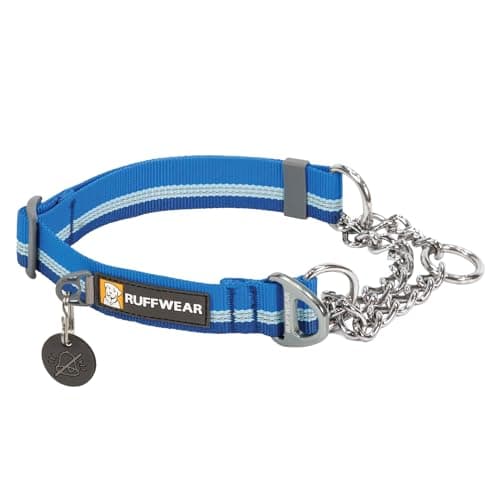 | Ruffwear Chain Reaction CollarA dog that backs out of a flat collar | 70/100 | $29.99 · Amazon |
| 3 | 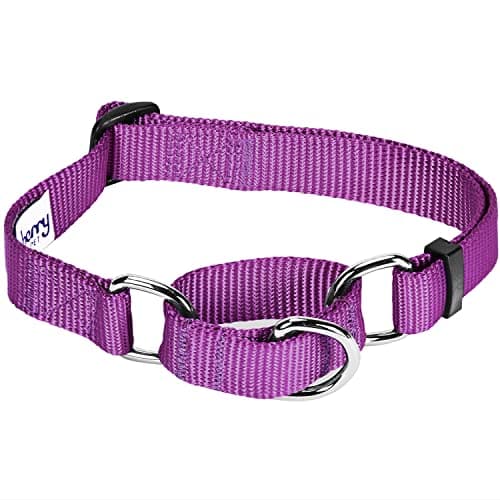 | Blueberry Pet Martingale CollarThe cheapest continuous-loop martingale | 51/100 | Check price |
| 4 | 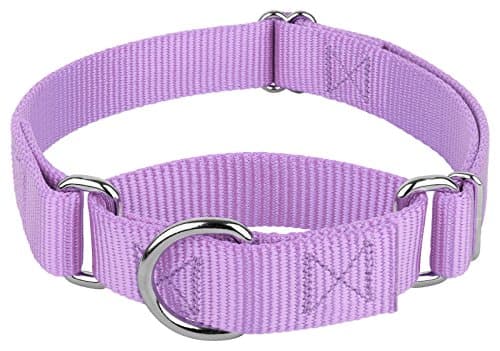 | Country Brook Petz Martingale CollarBuying martingales in quantity | 52/100 | $16.99 · Amazon |
| 5 | 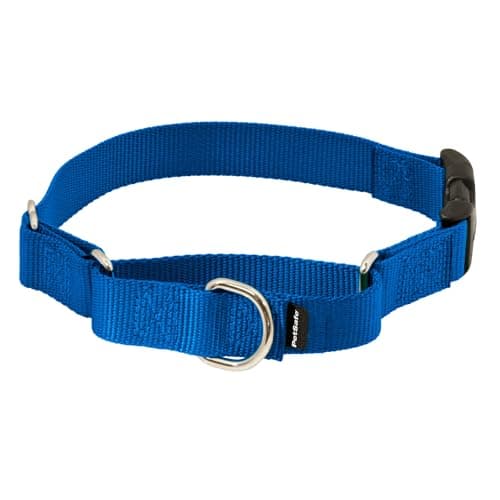 | PetSafe Martingale Collar with Quick SnapA martingale you can put on without going over the head | 48/100 | $7.99 · Amazon |
Tap any row to jump to the full review. Prices are pulled live from Amazon as of October 18, 2026; where we have no verified live price we show none rather than a stale number. #ad — how our links work.
The picks, ranked
1. Mighty Paw Martingale Collar
Durability score 69/100Best for: Stainless hardware on a limited-slip collar, cheap
Stainless hardware and a lifetime warranty for under twenty dollars; just do not expect the warranty to cover a chewer.
- Hardware
- Stainless steel (Amazon listing)
- Design
- Martingale limited-slip
- Warranty
- Lifetime of the product — but excessive chewing is explicitly excluded
Pros
- Stainless hardware at this price is unusual — it will not rust or plate off
- Mighty Paw's warranty runs for the lifetime of the product and needs no registration
Cons
- The warranty explicitly excludes excessive chewing and cutting
- No published webbing spec
- Martingale — not for unsupervised wear
How we assessed it: on published materials, hardware specs and construction — not long-term chew-tested. We say so because it is true, and because a claim we cannot back is worth nothing to you.
#ad Price as of October 18, 2026; Amazon prices change often, so check before you buy. How our links work.
2. Ruffwear Chain Reaction Collar
Durability score 70/100Best for: A dog that backs out of a flat collar
The right answer for a dog that slips its collar, with the standard martingale caveat: not for unsupervised wear.
- Design
- Martingale-style limited-slip with a chain control loop (Amazon listing)
- Hardware
- Metal chain loop, aluminum V-ring
- Load rating
- Not published
Pros
- The limited-slip loop tightens just enough to stop a dog reversing out of it
- Metal control loop instead of a fabric one
Cons
- A martingale must never be left on an unsupervised dog — the loop is a snag hazard
- No published load rating
How we assessed it: on published materials, hardware specs and construction — not long-term chew-tested. We say so because it is true, and because a claim we cannot back is worth nothing to you.
#ad Price as of October 18, 2026; Amazon prices change often, so check before you buy. How our links work.
3. Blueberry Pet Martingale Collar
Durability score 51/100Best for: The cheapest continuous-loop martingale
The structurally correct martingale layout at the lowest price. What it will not tell you is what the rings are made of.
- Type
- Limited-slip martingale, continuous loop
- Webbing
- Polyester; denier not published
- Hardware
- Rings; material not published
- Warranty
- Not published in detail
Pros
- No buckle in the load path — a continuous loop is structurally the strongest martingale layout
- Very inexpensive, and available in a wide size range
Cons
- Goes over the head every time, which is the trade-off for having no buckle
- Ring material not published, and the rings are where a martingale takes its load
- No published warranty
How we assessed it: on published materials, hardware specs and construction — not long-term chew-tested. We say so because it is true, and because a claim we cannot back is worth nothing to you.
#ad We only show a price when we have a live one from Amazon. We don’t have one for this product right now, so we’re not going to guess. How our links work.
4. Country Brook Petz Martingale Collar
Durability score 52/100Best for: Buying martingales in quantity
A functional, disposable martingale. Buy it for the price, not for the build.
- Design
- Heavy-duty martingale (Amazon listing)
- Materials
- Not published
- Load rating
- Not published
Pros
- Cheap, and available in a lot of sizes and patterns
Cons
- Nothing about the webbing or hardware is published
- Martingale — not for unsupervised wear
How we assessed it: on published materials, hardware specs and construction — not long-term chew-tested. We say so because it is true, and because a claim we cannot back is worth nothing to you.
#ad Price as of October 18, 2026; Amazon prices change often, so check before you buy. How our links work.
5. PetSafe Martingale Collar with Quick Snap
Durability score 48/100Best for: A martingale you can put on without going over the head
The convenient martingale. Understand that the convenience is a plastic buckle in the load path, and decide whether you want that on a dog that backs out.
- Type
- Limited-slip martingale with a quick-snap buckle
- Webbing
- Nylon; denier not published
- Hardware
- Acetal quick-snap buckle; rings not specified
- Limits closure
- Yes — tightens to a stop, not indefinitely
Pros
- The quick-snap buckle solves the main practical objection to martingales, which is having to post them over the dog's head every time
- Limited-slip by design: it tightens to a stop rather than continuing to close, which is what separates a martingale from a choke
- Cheapest collar in this roundup
Cons
- A plastic quick-snap buckle reintroduces the exact failure point a martingale's continuous loop avoids
- No published webbing or hardware specification
- The buckle is on the load path, unlike a buckle-free martingale
How we assessed it: on published materials, hardware specs and construction — not long-term chew-tested. We say so because it is true, and because a claim we cannot back is worth nothing to you.
#ad Price as of October 18, 2026; Amazon prices change often, so check before you buy. How our links work.
The buckle question, which is a genuine trade-off
Martingales come in two layouts and the difference matters.
Continuous loop (Blueberry, Country Brook): no buckle anywhere. The collar goes over the head every time. It is structurally the strongest arrangement because there is no plastic component on the load path at all — the load runs webbing, ring, webbing.
Quick-snap (PetSafe): a side-release buckle in the main loop so the collar can be put on without going over the head. Enormously more convenient, and it puts an acetal buckle directly into the load path of a collar whose entire purpose is preventing an escape.
We would take the continuous loop on a dog that genuinely escapes and accept the inconvenience, and take the quick-snap on a dog that merely might. The honest point is that the convenient version reintroduces exactly the failure mode the design exists to avoid.
Chain versus fabric on the control loop
Some martingales use a chain for the small control loop rather than webbing — the Ruffwear Chain Reaction is the obvious example.
The functional argument is that a chain runs freely through the rings and cannot bind, so the collar releases cleanly the moment tension comes off. Webbing can catch, particularly when wet or dirty, and a collar that stays tight after the pull has stopped is not doing what a martingale is supposed to do.
The counter-argument is that chain adds weight, is noisy, and can catch long coat. On a short-coated dog we would take the chain; on a heavily feathered one, webbing.
Fitting: the one measurement that matters
- Measure the widest part of the skull, not the neck. The main loop at full extension has to pass over that.
- Measure the neck at the base, where the collar sits.
- The stop point should be neck measurement plus roughly two fingers. At full tension the collar should be snug, not tight — you are removing slack, not applying pressure.
- Check it at rest. A martingale should hang comfortably loose when nothing is pulling on it. If it is snug at rest, it is too small and it is a pressure collar rather than a limited-slip one.
And do not leave a martingale on an unsupervised dog. The trailing control loop is a snag hazard on crates, fences and furniture in a way a flat collar is not. Full sizing method is in our measuring guide.
Buying one for a puppy is a slightly different question, and the answer is yes with two conditions: never on an unsupervised or crated puppy, and re-measured every two to three weeks, because a growing neck turns a correctly fitted martingale into a loose one faster than owners expect. The sizing method, the quick-snap trade-off and the three worth buying are on is a martingale collar safe for a puppy.
Frequently asked questions
What is a martingale collar?
A limited-slip collar: a main loop with a smaller control loop, where pulling the leash draws the ends of the main loop together and tightens the collar. The critical word is limited — a correctly sized martingale tightens to a stop, where the two rings meet, and cannot close further. That mechanical limit is what separates it from a choke chain, and it is built into the geometry rather than depending on the handler.
Is a martingale collar cruel?
No, provided it is sized correctly. It closes to a fixed stop and cannot continue tightening, which is the design difference from a choke chain. The safety depends entirely on sizing: the stop point should be about the neck measurement plus two fingers, so at full tension the collar is snug rather than tight. A martingale that is snug at rest is too small and is functioning as a pressure collar instead.
Do martingale collars stop pulling?
No, and there is measured evidence on this. Johnson & Wynne (2024) used a martingale as the baseline in a four-equipment trial with 23 dogs, and dogs pulled significantly more on the martingale than on a front-connection harness, a Starmark collar or a metal prong collar — p < 0.001 in each comparison. A martingale is the right answer to a dog that backs out of collars and the wrong answer to a dog that pulls.
Should I get a martingale with a buckle or without?
Without, if the dog genuinely escapes. A continuous-loop martingale has no plastic component anywhere on the load path — the load runs webbing, ring, webbing — which is structurally the strongest arrangement, at the cost of going over the head every time. A quick-snap version is far more convenient and puts an acetal buckle directly into the load path of a collar whose purpose is preventing escapes.
How do you size a martingale collar?
Two measurements. The main loop at full extension must pass over the widest part of the skull, so measure that first. Then measure the neck at the base where the collar sits, and set the stop point to roughly that measurement plus two fingers. The collar should hang comfortably loose at rest and be snug — not tight — at full tension. If it is snug when nothing is pulling, it is too small.
Can a dog wear a martingale all the time?
We would not leave one on an unsupervised dog. The trailing control loop is a snag hazard on crate bars, fence wire and furniture in a way a flat collar is not. Use the martingale for walks and a well-fitted flat collar with the ID tag the rest of the time — and check that flat collar's fit monthly, because embedded collars on growing or long-coated dogs are one of the few genuinely documented collar injuries.
Sources
Every spec on this page traces to one of these. Where a manufacturer does not publish a figure, we say “not published” rather than estimating it.
- Johnson & Wynne (2024) — “Comparing efficacy in reducing pulling and welfare impacts of four types of leash walking equipment”, PeerJ 12:e18131
- Ridgway (2026) — “Health implications of dog-worn equipment: a review of known and alleged physical risks”, Frontiers in Veterinary Science 13:1711781
- Ruffwear — warranty terms (chewing excluded; no duration stated)
- Mighty Paw — warranty policy (excessive chewing and cutting excluded)