The Best Dog Gates
One rule governs this entire category, and it is a safety rule rather than a preference: a pressure-mounted gate must never go at the top of stairs.
Buy the Cardinal Gates Stairway Special for the top of stairs, because it is hardware-mounted and built for the awkward newel-post geometry that defeats generic gates.
Buy the Carlson Extra Wide for a wide doorway on one level and the Richell freestanding gate for a small dog in an open-plan space with nothing to mount to — Richell rates it for dogs 6.6–17.6 lb, and a freestanding gate is a boundary rather than a barrier at any size.
Mounting method is the whole decision
Hardware-mounted
Screws into the wall studs or the newel post. It cannot be pushed out, it swings on a hinge, and it is the only acceptable choice at the top of stairs. The cost is holes in your walls and, in a rental, a conversation with your landlord.
Pressure-mounted
Held by four adjustable feet pushing outwards against the frame. No drilling, easy to move, and it will loosen over time — pressure gates need periodic re-tensioning and most owners never do it. Fine across a doorway on one level. Never at the top of stairs.
Freestanding
A folding panel that stands on the floor. It works across an open-plan space where there is nothing to mount to, and it is a visual boundary: a dog that respects it stays, and a dog that does not simply pushes it over. Buy it for a dog that already respects boundaries.
The walk-through door is what decides whether a gate gets used
This is the practical point people underrate. A gate you have to step over gets stepped over, then climbed, then propped open, and eventually left open — at which point you own a decorative obstacle.
A walk-through door means the gate stays shut because using it is easy. Both the Carlson and the Regalo have one, and it is the single feature most correlated with a gate still being in use a year later.
The counterpoint is the bottom rail: most walk-through gates have one, and it is a trip hazard for humans, particularly at night. Step-through designs without a bottom rail exist and are worth seeking out if anyone in the house is unsteady.
Height, and the dog that jumps
Most standard gates are around 30 inches. A motivated medium dog clears that from standing.
If your dog jumps, you need an extra-tall gate rather than a standard one — and it is worth being realistic that a gate is a management tool for a dog that has decided not to bother, not a physical barrier for a dog that has decided to try. A dog that is genuinely determined to get past a gate will get past a gate, and the answer is a closed door or a crate.
Quick picks
The short answer, ranked and scored against our published durability rubric. Where a manufacturer does not publish a spec, we say so rather than estimating it.
| # | Photo | Product | Durability | Price |
|---|---|---|---|---|
| 1 | 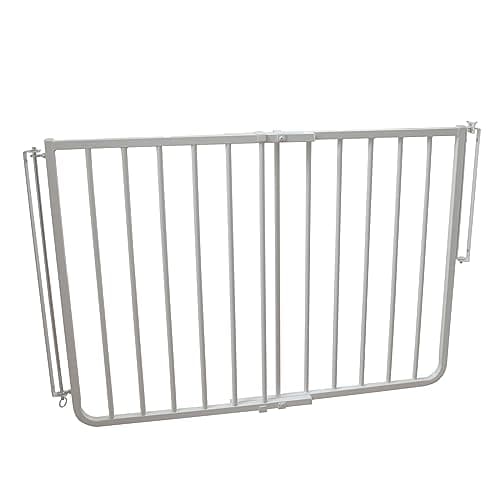 | Cardinal Gates Stairway Special GateThe top of a staircase — the one place a pressure gate must never go | 79/100 | $99.95 · Amazon |
| 2 | 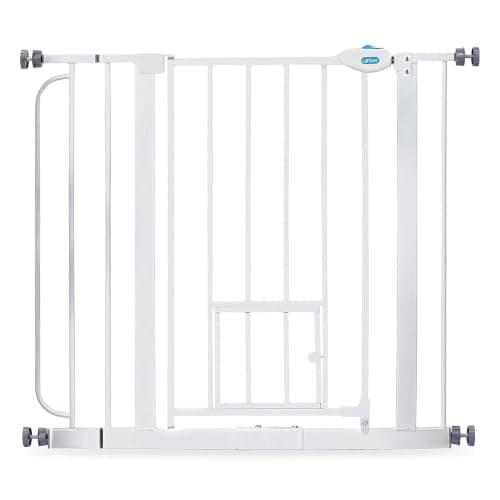 | Carlson Extra Wide Walk-Through GateA wide doorway you still need to walk through | 59/100 | $44.99 · Amazon |
| 3 | 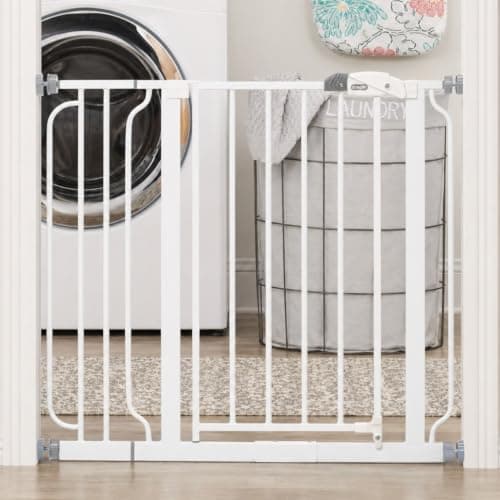 | Regalo Easy Step Walk-Through GateThe cheapest walk-through gate that is not flimsy | 49/100 | $44.98 · Amazon |
| 4 | 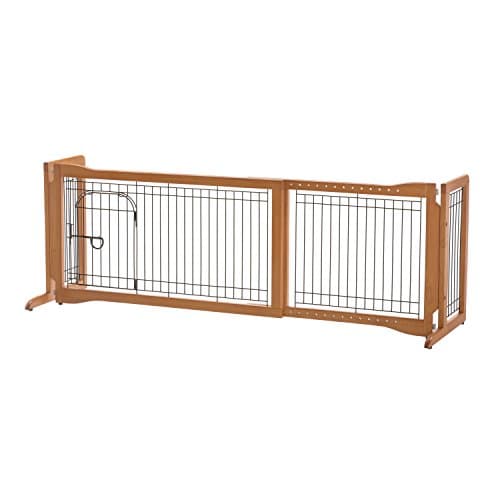 | Richell Pet Sitter Freestanding Gate PlusA small dog, in a room with no doorframe to mount to | 49/100 | $174.99 · Amazon |
Tap any row to jump to the full review. Prices are pulled live from Amazon as of October 18, 2026; where we have no verified live price we show none rather than a stale number. #ad — how our links work.
The picks, ranked
1. Cardinal Gates Stairway Special Gate
Durability score 79/100Best for: The top of a staircase — the one place a pressure gate must never go
The correct gate for the top of stairs, and the reason to buy it is not durability but the mounting method.
- Mounting
- Hardware-mounted — screws into the wall or newel post
- Intended use
- Top of stairs
- Material
- Powder-coated steel
- Weight rating
- Not published as a force figure
Pros
- Hardware-mounted, which is the only acceptable mounting at the top of a staircase — a pressure gate at the top of stairs can be pushed out and fall down them with the dog
- Steel construction rather than plastic or wood
- Built specifically for the awkward newel-post geometry that defeats generic gates
Cons
- Requires drilling into walls or a newel post, which not every renter can do
- No published force rating
- More expensive than a pressure gate
How we assessed it: on published materials, hardware specs and construction — not long-term chew-tested. We say so because it is true, and because a claim we cannot back is worth nothing to you.
#ad Price as of October 18, 2026; Amazon prices change often, so check before you buy. How our links work.
2. Carlson Extra Wide Walk-Through Gate
Durability score 59/100Best for: A wide doorway you still need to walk through
The right gate for a wide doorway on one level. Never the right gate for the top of stairs.
- Mounting
- Pressure-mounted
- Width range
- Extra-wide; published on the listing
- Walk-through door
- Yes, with a small pet door in some configurations
- Material
- Steel
Pros
- The walk-through door is the feature that decides whether a gate gets used or stepped over and eventually left open
- Steel construction and a genuinely wide span
- No drilling, which matters in a rental
Cons
- Pressure-mounted, which means it must NOT be used at the top of a staircase
- Pressure mounts loosen and need re-tensioning periodically
- The bottom rail of a walk-through gate is a trip hazard for humans
How we assessed it: on published materials, hardware specs and construction — not long-term chew-tested. We say so because it is true, and because a claim we cannot back is worth nothing to you.
#ad Price as of October 18, 2026; Amazon prices change often, so check before you buy. How our links work.
3. Regalo Easy Step Walk-Through Gate
Durability score 49/100Best for: The cheapest walk-through gate that is not flimsy
The value pick for a standard doorway on one level.
- Mounting
- Pressure-mounted
- Material
- Steel
- Walk-through door
- Yes
- Width range
- Published on the listing
Pros
- Steel at a price where most gates are plastic
- Walk-through door on a budget gate
- Widely available and easy to add a second one
Cons
- Pressure-mounted, so again: never at the top of stairs
- Narrower span than the extra-wide gates
- The pressure feet mark paintwork over time
How we assessed it: on published materials, hardware specs and construction — not long-term chew-tested. We say so because it is true, and because a claim we cannot back is worth nothing to you.
#ad Price as of October 18, 2026; Amazon prices change often, so check before you buy. How our links work.
4. Richell Pet Sitter Freestanding Gate Plus
Durability score 49/100Best for: A small dog, in a room with no doorframe to mount to
A boundary for a dog that respects boundaries. Do not buy it to contain a dog that does not.
- Mounting
- Two ways: freestanding with side panels, or tension-mounted in an opening (Richell)
- Material
- Rubberwood (Richell)
- Span
- 39.8–59.8 in freestanding; 39.8–61.8 in tension-mounted (Richell)
- Height
- 20.9 in (Richell)
- Slat spacing / door
- 1-1/4 in between slats; 9.8 in walk-through door (Richell)
- Dog size rating
- 6.6–17.6 lb (Richell) — this is a small-dog gate
Pros
- Works freestanding with its own side panels, so it holds a line across an open-plan space where there is nothing to mount to
- Rubberwood and furniture-finished rather than white plastic
- Richell publishes span, height, slat spacing, door width and a dog-weight rating — more numbers than anyone else in this category
- Converts to a tension mount if you later want it in a doorway
Cons
- Rated for dogs 6.6–17.6 lb. It is not a barrier for a medium or large dog and Richell does not claim it is
- A freestanding gate is a visual barrier, not a physical one — a determined dog pushes it over
- Expensive for what it does
- The dog-weight rating is a guidance figure, not a force rating; nobody in this category publishes one
How we assessed it: on published materials, hardware specs and construction — not long-term chew-tested. We say so because it is true, and because a claim we cannot back is worth nothing to you.
#ad Price as of October 18, 2026; Amazon prices change often, so check before you buy. How our links work.
The stairs rule, expanded
We put it at the top of the page and we will repeat it, because it is the one thing on this page that is a safety issue rather than a preference.
- Top of stairs: hardware-mounted only. A pressure gate that lets go at the top of a staircase does not just fail — it becomes a falling object with the dog attached to the situation.
- Bottom of stairs: pressure is acceptable. The consequence of failure is a dog going upstairs.
- Mount into studs or the newel post, not into plasterboard alone. A hardware gate screwed into hollow plasterboard is a pressure gate with extra steps.
- Check the fixings twice a year. Every time a dog leans on a gate, the screws work a little.
The US Consumer Product Safety Commission publishes the same distinction for child safety gates, and the physics does not change for a dog.
Measuring, which people get wrong
- Measure at the height the gate will sit, not at the floor. Skirting boards, door frames and the flare at the base of a wall all change the opening.
- Measure at three heights. Old houses are not square, and the narrowest measurement is the one that matters.
- Check what the pressure feet will bear on. A pressure gate against a plaster arch or a stair spindle can crack the surface — spindle adapters exist for exactly this.
- Account for extensions. Extra-wide gates are usually a base gate plus extension panels, and each joint is a hinge point.
The short version
Top of stairs: Cardinal Gates Stairway Special. Hardware-mounted, steel, built for the geometry.
Wide doorway: Carlson Extra Wide, with the walk-through door.
Standard doorway on a budget: Regalo Easy Step. Steel where most budget gates are plastic.
Open plan: Richell freestanding, for a dog that respects a boundary.
A dog that genuinely will not be contained: none of these. That is a closed door or a crate question.
Frequently asked questions
Can I use a pressure-mounted gate at the top of stairs?
No. A pressure gate is held in place by friction against the frame, and friction fails — at the top of a staircase that means the gate and the dog go down the stairs together. Use a hardware-mounted gate that screws into wall studs or the newel post. The US Consumer Product Safety Commission draws the same distinction for child safety gates, and the physics is identical for a dog.
What is the best dog gate?
It depends entirely on where it goes. For the top of stairs, a hardware-mounted gate — the Cardinal Gates Stairway Special is built for the awkward newel-post geometry that defeats generic gates. For a wide doorway on one level, the Carlson Extra Wide, mainly for its walk-through door. For an open-plan space with nothing to mount to, a freestanding gate, accepting that it is a visual boundary rather than a physical barrier.
How tall does a dog gate need to be?
Most standard gates are around 30 inches, and a motivated medium dog clears that from standing. If your dog jumps, buy an extra-tall gate — but be realistic: a gate is a management tool for a dog that has decided not to bother, not a physical barrier for one that has decided to try. A genuinely determined dog gets past any gate, and the answer to that is a closed door or a crate.
Does a dog gate need a walk-through door?
It is the feature most correlated with a gate still being used a year later. A gate you have to step over gets stepped over, then climbed, then propped open, then left open. The counterpoint is the bottom rail most walk-through gates have, which is a trip hazard for humans at night — step-through designs without a bottom rail are worth seeking out if anyone in the house is unsteady.
How do I measure for a dog gate?
Measure at the height the gate will actually sit rather than at the floor, because skirting boards and door frames change the opening. Measure at three heights, since old houses are not square and the narrowest measurement is the one that matters. Check what the pressure feet will bear on — a pressure gate against a plaster arch or a stair spindle can crack the surface, and spindle adapters exist for that. And remember extra-wide gates are usually a base gate plus extension panels, with a hinge point at each joint.
Sources
Every spec on this page traces to one of these. Where a manufacturer does not publish a figure, we say “not published” rather than estimating it.