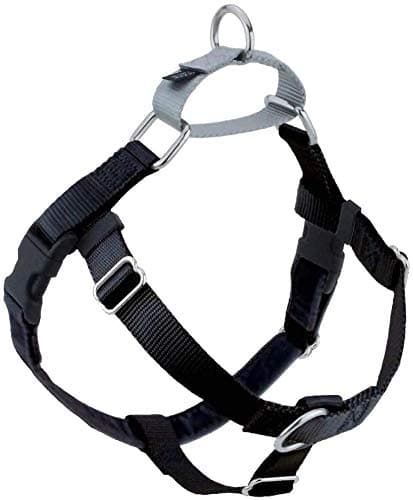
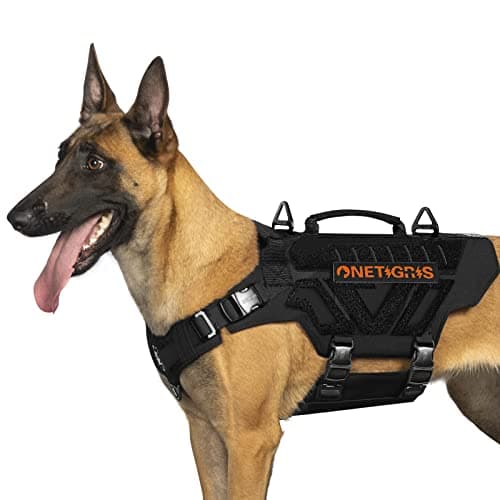
The Best Dog Harnesses for Medium Dogs
Small-dog buyers are limited by the 13 in floor. Giant-dog buyers are limited by the 42 in ceiling. In the middle you have the entire market - which sounds like an advantage and is actually why most people in this size band buy the wrong harness.
The verdict
Buy the Ruffwear Flagline. In a size band where every harness fits, the spec that decides it is adjustment, and the Flagline has six independent adjustment points— the most of anything we have scored — plus the only front leash connection in this field specified to its composition (87.5% UHMWPE / 12.5% nylon). If your dog has already learned to reverse out of something, the Web Master is the one built around that failure: five adjusters and a third strap behind the ribcage, which is the only geometry that physically stops a dog backing out. For a mid-size dog that pulls hard, the 2 Hounds Freedom pairs stainless hardware with the only published webbing figure in the category (3,800 lb test, the maker’s own claim) — and in this size band you can actually buy it in the full 1 in width, which matters, because 2 Hounds couples strap width to size and the small sizes are 5/8 in. The Blue-9 Balance is the cheapest route to six adjusters and the worst-documented product here. The Front Range is the everyday default with the heaviest shell of the three Ruffwears (300D against 150D) and the fewest adjusters, which is the trade this whole page is about.
Quick picks
The short answer, ranked and scored against our published durability rubric. Where a manufacturer does not publish a spec, we say so rather than estimating it.
| # | Photo | Product | What the maker publishes | Durability | Price |
|---|---|---|---|---|---|
| 1 | 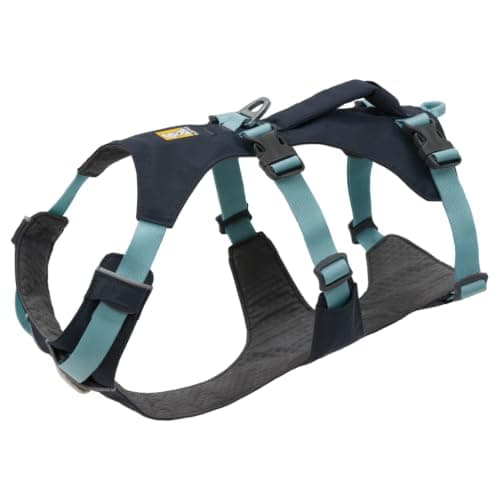 | Ruffwear Flagline HarnessSix adjustment points and a lift panel — the best-fitting escape-resistant harness |
| 81/100 | $69.99 · Amazon |
| 2 | 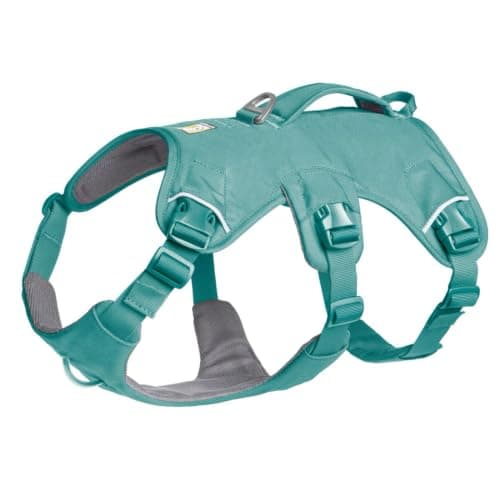 | Ruffwear Web Master HarnessLifting and controlling a dog over real terrain |
| 77/100 | $79.99 · Amazon |
| 3 | 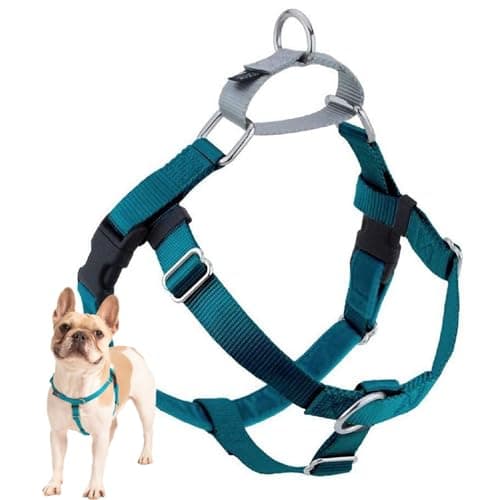 | 2 Hounds Design Freedom No-Pull HarnessA hard puller, if you buy the chew coverage with it |
| 82/100 | $34.98 · Amazon |
| 4 | 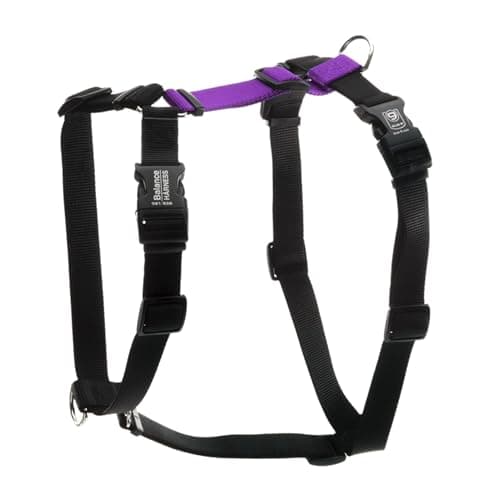 | Blue-9 Balance HarnessFit — if you can live with a brand that publishes almost nothing |
| 60/100 | $45.95 · Amazon |
| 5 | 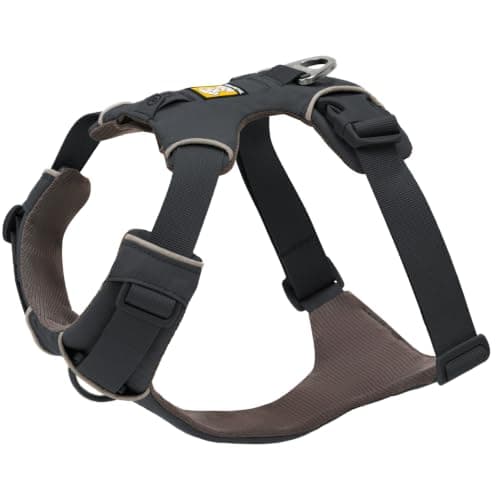 | Ruffwear Front Range HarnessThe everyday harness for a dog that does not pull hard |
| 77/100 | $59.99 · Amazon |
Tap any row to jump to the full review. Specs are the manufacturer's own published figures; where a maker does not publish one we say "not published" rather than estimating it. Prices are pulled live from Amazon as of October 20, 2026; where we have no verified live price we show none rather than a stale number. #ad — how our links work.
What decides a mid-size harness, in order
Start with the thing that makes this size band different, because it is the opposite of what you would expect. The two pages either side of this one are both constrained by sizing. A small-dog buyer is working against a floor: Ruffwear publishes girth sizing from 13 in and 2 Hounds from 14 in, and plenty of harnesses simply do not exist below that. A giant-breed buyer is working against a ceiling: Ruffwear stops at 42 in, Non-stop at 42.5, the Freedom at 44.
A 30 to 60 lb dog — call it 24 to 34 in of chest girth — is inside every one of those runs with room to spare. Nothing is ruled out for you. That is why so much mid-size harness buying goes wrong: with sizing decided, people fall back on price, color and the photograph, and the actual differences between these five products are invisible in all three. Here is what we rank on instead.
- Adjustment points, first and by a distance. A dog does not break a harness; it reverses out of one. Reversing is a geometry problem, and the only cure is enough independent adjusters to close the chest opening around this dog. Six beats five beats four, and the gap between six and four is larger than any fabric difference on this page.
- Named hardware.“Metal buckle” is not a specification. “ITW Nexus Airloc” and “anodized 6061-T6 aluminum V-ring” are. A brand willing to name its components is a brand that can be held to them.
- Whether the published figure applies to the size you are buying. This is the mid-size trap and it has one clear example, below.
- Shell denier, honestly weighted. It matters less than the first two, and in this field it runs backwards: the cheapest Ruffwear has the heaviest shell.
- What the warranty excludes. In this category the answer is always chewing. What differs is whether you can buy the cover.
Why adjustment outranks strength at this size
A 45 lb dog is not out-pulling 3,800 lb of webbing and it is not out-pulling a 6061-T6 aluminum V-ring. Strength is effectively a solved problem in the middle of the size range, which is exactly why strength marketing is so heavy here — it is a claim that costs the brand nothing.
What is not solved is fit. A dog backs out of a harness by pulling its shoulders rearward through the chest opening, and we set out the mechanics of that on the escape-proof harness roundup: the thing that stops it is a third strap behind the ribcage, and after that, adjusters. Every adjuster is a place where the harness can be made to match the dog rather than the pattern. The Flagline has six of them. Blue-9 also has six, which is why trainers reach for it. The Web Master has five plus the three-strap geometry, which is why it is the pick for a dog that has already escaped once. The Front Range has four, and that is the single reason it ranks fifth on a page where it would otherwise rank second.
The corollary is worth saying plainly: in this size band, a cheaper harness with more adjusters is a better buy than a dearer one with fewer. That is not a statement we could make on the large-dog page, where hardware is genuinely loaded, or on the small-dog page, where over-built hardware is itself a design failure. It is specific to the middle.
The mid-size trap: a published figure that changes with the size
The 2 Hounds Freedom carries the only published webbing strength figure anywhere in this category — 3,800 lb test strength, 2 Hounds’ own claim rather than a third-party verification, and we treat it as a manufacturer’s number. It is also the one product here where the size you order changes the product you get.
2 Hounds publishes its run as 5/8 in XS (14–20 in girth) through 1 in XXL (36–44 in). Strap width is coupled to size. A small-dog buyer is getting 5/8 in webbing; the test figure was not measured on their harness. In the middle of the range you are in the fortunate position of being able to buy the wide version — the listing we resolved for this page is sold explicitly as a 1 inch MD— but you have to read the listing title to know which one is in your cart, because the same product name covers both.
That is the generalizable lesson for this size band, and it applies well beyond 2 Hounds: a published number belongs to a specific configuration, and the middle of a size run is where configurations change. The other documented version of the same problem is sizing overlap. Julius-K9 is the one brand in this registry that publishes enough of its chart to see it — size 3 starts at 32.5 in while size 4 starts at 38 in, a 5.5 in band where two different sizes both claim your dog. Buying by the size letter cannot work in an overlap. Measure, then read the chart attached to the exact listing, using the method on how to measure a dog for a harness.
The Ruffwear inversion: the cheap one has the heavier fabric
Three of the five picks here are Ruffwear, and the fabric picture is the opposite of the price picture. The Front Range— the cheapest of the three — has a 300D recycled polyester ripstop shell. The Flagline and the Web Master, both dearer, are built on 150D. That is half the yarn weight on the more capable harnesses.
This is not a manufacturing error, it is a deliberate choice: the Flagline is sold as a low-profile, lightweight harness and the weight has to come from somewhere. But it means the honest ranking depends on what you are actually buying for. If you want the toughest fabric on a dog that walks politely through brush, the Front Range is the heavier cloth for less money. If you want the harness least likely to come off a dog that works at the problem, the Flagline’s six adjusters and UHMWPE front connection beat 150 extra denier.
One more Ruffwear-wide note: the webbing differs too. Front Range webbing is polyester, Web Master webbing is polypropylene, and polyester resists abrasion better. None of the three publishes a load rating, which for a premium brand remains a real gap — and it is the complaint running through the most durable harnesses page.
The documentation problem, and the one brand that fails it
The Blue-9 Balanceis the hardest product on this page to place. It has six points of adjustment and front and back attachment on every size, it is genuinely washable, and professional trainers use it constantly — on fit, it is excellent. It is also the thinnest-specified product we have assessed in this category: no buckle material, no ring type, no load ratinganywhere on Blue-9’s own product page.
On a site that scores durability from published specifications, that is close to disqualifying, and it is why a harness with joint-best adjustment ranks fourth. You cannot substantiate a single durability claim about it from the maker. We keep it in the field because the fit advantage is real and because for a 40 lb dog the loads are modest — but buy it knowing you are buying on reputation rather than on evidence. The general case against unpublished specs is on the materials guide.
If the problem is pulling rather than escaping
Mid-size dogs are where front-clip harnesses get bought most, and the honest position is that a front attachment changes the mechanics of pulling without training the dog not to pull. The Freedom is the one we would own: its martingale loop tightens the chest strap rather than the neck, the hardware is stainless rather than plated zinc, and it is made in North Carolina. Budget for the paid chew warranty if your dog chews, because the base warranty explicitly excludes chewed webbing and buckles.
The wider field, and the evidence on whether any of this works, is on the no-pull harness roundup and do harnesses help with pulling. If you are weighing a front-clip against a plain back-clip at this size, no-pull against regular is the comparison.
What to look for, in order
- Count the adjusters before you read anything else. Six, five, four, in that order of preference.
- Look for a third strap behind the ribcage if the dog has ever backed out of anything.
- Check the width and size on the listing title, not the product name. On the Freedom in particular, the strap width changes with the size.
- Require named hardware. If the maker will not say what the buckle is made of, the durability claim is unverifiable.
- Assume chewing is excluded, then find out whether cover can be bought. 2 Hounds and Blue-9 both sell it as a paid add-on; Ruffwear does not.
- Treat denier as a tiebreaker, and remember it runs backwards across the Ruffwear line.
The picks, ranked
1. Ruffwear Flagline Harness
Durability score 81/100Best for: Six adjustment points and a lift panel — the best-fitting escape-resistant harness
The best-fitting harness Ruffwear makes and the one we would put on an escape artist — six adjusters and a named high-strength front connection, on a deliberately light shell.
- Shell
- 150D polyester ripstop with DWR and PU coating
- Adjustment
- Six points
- Handle
- Padded, for balanced lifting
- Lift panel
- Load-dispersing chest/belly panel
- Buckles
- ITW Nexus Mach 1 side-release
- Rear leash ring
- Anodized 6061-T6 aluminum V-ring
- Front leash connection
- 87.5% UHMWPE / 12.5% nylon
- Sizes
- XXS (13–17 in) to L/XL (32–42 in) girth
- Lift load rating
- Not published
Pros
- Six independent adjustment points — the most of any harness we have scored, and adjustment is what actually stops a dog reversing out
- The front leash connection is specified to the composition: 87.5% UHMWPE, 12.5% nylon. UHMWPE is genuinely high-strength fiber and almost nobody names it
- Named ITW Nexus Mach 1 buckles and an anodized 6061-T6 aluminum V-ring
- Load-dispersing chest and belly panel means the lift handle is not just sewn to a strap
Cons
- 150D shell — half the denier of the cheaper Front Range's 300D, so this is the lighter fabric despite being the more capable harness
- No published load rating for the handle or the lift panel, on a harness sold for lifting
- Expensive
- Chewing excluded from the warranty, like everything else in Ruffwear's line
How we assessed it: on published materials, hardware specs and construction — not long-term chew-tested. We say so because it is true, and because a claim we cannot back is worth nothing to you.
#ad Price as of October 20, 2026; Amazon prices change often, so check before you buy. How our links work.
2. Ruffwear Web Master Harness
Durability score 77/100Best for: Lifting and controlling a dog over real terrain
Buy it for the three-point structure and the handle — not for the shell, which is thinner than the harness Ruffwear sells for twenty dollars less.
- Shell
- 150D polyester ripstop, PU coating (40% recycled)
- Padding
- Closed-cell foam
- Webbing
- Polypropylene
- Buckles
- ITW Nexus Airloc
- Rear attachment
- Anodized 6061-T6 aluminum V-ring
- Sizes
- XXS–L/XL, 13–42 in girth
- Handle lift rating
- Not published
Pros
- Five points of adjustment and a three-strap design that is genuinely hard for a dog to reverse out of
- Named hardware — ITW Nexus buckles and an anodized 6061-T6 aluminum V-ring, not a generic stamped D-ring
- Reinforced handle makes it the tool of choice for lifting a dog over an obstacle
Cons
- The shell is 150D — literally half the denier of the cheaper Front Range's 300D. You are paying for structure, not fabric
- Ruffwear publishes no lift rating for the handle, on a harness sold specifically for lifting dogs
- Polypropylene webbing is less abrasion-resistant than the polyester Ruffwear uses on the Front Range
How we assessed it: on published materials, hardware specs and construction — not long-term chew-tested. We say so because it is true, and because a claim we cannot back is worth nothing to you.
#ad Price as of October 20, 2026; Amazon prices change often, so check before you buy. How our links work.
3. 2 Hounds Design Freedom No-Pull Harness
Durability score 82/100Best for: A hard puller, if you buy the chew coverage with it
The strongest published webbing in the category paired with stainless hardware — but budget for the paid chewing warranty if your dog is a chewer.
- Webbing
- 3,800 lb test strength (manufacturer's own claim)
- Lining
- Swiss velvet
- Hardware
- Stainless steel
- Control
- Martingale tightening loop on the back
- Sizes
- 5/8 in XS (14–20 in) to 1 in XXL (36–44 in)
- Made in
- North Carolina, globally sourced materials
Pros
- The 3,800 lb webbing figure is the highest published rating we found on any harness in this category
- Stainless steel hardware — rust-resistant and washable, unlike plated zinc
- The martingale loop tightens the chest strap rather than choking the neck
- Made in the USA, which is rare at this price
Cons
- The 3,800 lb figure is 2 Hounds' own claim, not third-party verified — treat it as a manufacturer's number
- Base warranty explicitly excludes chewed webbing and buckles; chew coverage is a separate paid add-on
- Velvet lining is comfortable but holds dirt and dries slowly
How we assessed it: on published materials, hardware specs and construction — not long-term chew-tested. We say so because it is true, and because a claim we cannot back is worth nothing to you.
#ad Price as of October 20, 2026; Amazon prices change often, so check before you buy. How our links work.
4. Blue-9 Balance Harness
Durability score 60/100Best for: Fit — if you can live with a brand that publishes almost nothing
The best-fitting harness here and the worst-documented — a real problem when durability is the thing you are buying.
- Material
- Washable soft-touch nylon
- Adjustment
- Six points
- Attachment
- Front and back rings
- Buckle material
- Not published
- Ring type (welded or split)
- Not published
- Load rating
- Not published
Pros
- Six points of adjustment — the most in this roundup, and the reason trainers reach for it
- Front and back attachment on every size
- Genuinely washable
Cons
- Blue-9 is the thinnest-specified brand we looked at: no buckle material, no ring type, no load rating anywhere on its product page
- Chewing is not covered by default — Blue-9 sells a $4 one-year chew warranty as an add-on
- You cannot substantiate a single durability claim about this harness from the manufacturer's own site
How we assessed it: on published materials, hardware specs and construction — not long-term chew-tested. We say so because it is true, and because a claim we cannot back is worth nothing to you.
#ad Price as of October 20, 2026; Amazon prices change often, so check before you buy. How our links work.
5. Ruffwear Front Range Harness
Durability score 77/100Best for: The everyday harness for a dog that does not pull hard
The best-specified everyday harness here, and the rare case where the cheaper Ruffwear has the heavier fabric.
- Shell
- 300D polyester ripstop (100% recycled), PU coating + non-fluorinated DWR
- Padding
- PE foam
- Webbing
- Polyester (30% recycled)
- Buckles
- ITW Nexus Airloc side-release
- Rear attachment
- Anodized 6061-T6 aluminum V-ring
- Front attachment
- Nylon webbing in a TPU tube
- Sizes
- XXS–L/XL, 13–42 in girth
- Load rating
- Not published
Pros
- 300D recycled ripstop is a genuinely heavier shell than the Web Master's 150D, for less money
- Named, specified hardware — ITW Nexus Airloc buckles, anodized aluminum V-ring
- Two leash points, four points of adjustment
- Polyester webbing resists abrasion better than polypropylene
Cons
- No published load rating — a real gap for a premium brand
- Ruffwear's warranty states no duration at all and explicitly excludes chewing damage
- Hand wash, mild detergent, air dry
How we assessed it: on published materials, hardware specs and construction — not long-term chew-tested. We say so because it is true, and because a claim we cannot back is worth nothing to you.
#ad Price as of October 20, 2026; Amazon prices change often, so check before you buy. How our links work.
Every warranty here excludes the dog
It is worth stating together, because read individually these warranties sound generous and read together they say one thing. Ruffwear covers defects in materials and craftsmanship, states no duration at all, and excludes chewing, normal wear and alterations. 2 Hounds excludes chewed webbing and buckles from the base warranty and sells chew coverage separately. Blue-9 does not cover chewing by default and offers a low-cost one-year chew warranty as an add-on.
In other words: in this entire category, the most likely cause of failure is the only cause that is never covered as standard. For a mid-size dog that chews its gear, the two brands that will sell you the cover are the two worth paying attention to, and the add-on is cheap relative to replacing the harness. The same pattern across beds, leashes and collars is set out on how often to replace a dog harness.
The bottom line
At 30 to 60 lb nothing is chosen for you, so choose on the spec sheet. The Flagline is the best-fitting and best-documented harness in the band and the one we would buy without a specific reason not to. The Web Master is the answer to a dog that has already escaped. The Freedom is the answer to a dog that pulls, bought in the 1 in width. The Blue-9 is the cheap route to six adjusters, bought on trust rather than evidence. The Front Range is the heavier cloth and the lighter spec, and it is a perfectly good harness for a dog that walks politely — which, if we are honest about it, is most dogs most days. If your dog is at either edge of the band, the neighboring pages are sized differently and reach different answers: harnesses for small dogs and harnesses for large dogs.
Frequently asked questions
What is the best harness for a medium-sized dog?
The Ruffwear Flagline. In the middle of the size range every harness on the market fits, so sizing decides nothing and the spec sheet decides everything - and the Flagline has six independent adjustment points, the most of anything we have scored, plus the only front leash connection in this field specified to its composition at 87.5% UHMWPE and 12.5% nylon. Two honest caveats: its 150D shell is half the denier of the cheaper Front Range's 300D, and Ruffwear publishes no load rating for the handle or the lift panel on a harness sold for lifting.
What is the best escape-proof harness for a medium dog?
The Ruffwear Web Master, because it is the only pick here whose geometry addresses the actual failure. A dog escapes by pulling its shoulders rearward through the chest opening, and the thing that physically stops that is a third strap behind the ribcage - which the Web Master has, along with five points of adjustment. The Flagline is the close second on six adjusters. What does not solve escaping is buying heavier webbing: at 30 to 60 lb the dog is not breaking anything, it is getting out of it.
How do I know what size harness a medium dog needs?
Measure the chest girth at the widest point behind the front legs, then read the size chart on the exact listing you are buying rather than the brand's general chart. Two specific traps sit in the middle of the size range. The first is overlap: Julius-K9 publishes size 3 starting at 32.5 in and size 4 starting at 38 in, so there is a 5.5 in band where two sizes both claim your dog and the size letter cannot tell you which to buy. The second is configuration: on the 2 Hounds Freedom the strap width is tied to the size, running from 5/8 in at XS to 1 in at XXL, so the size you pick changes the product you get.
Is a more expensive harness stronger?
Not in this size band, and the Ruffwear line is the clearest example. The cheapest of the three Ruffwears here, the Front Range, has the heaviest shell at 300D recycled polyester ripstop; the dearer Flagline and Web Master are both built on 150D. Price is buying capability - adjustment points, a lift panel, a named high-strength front connection - rather than fabric weight. For a 45 lb dog, strength is largely a solved problem, which is exactly why strength claims are marketed so heavily here: they cost the brand nothing to make.
Do any of these harnesses cover chewing damage?
None as standard, and that is the single most useful thing to know before you buy. Ruffwear covers defects in materials and craftsmanship, states no duration, and explicitly excludes chewing, normal wear and alterations. 2 Hounds Design excludes chewed webbing and buckles from its base warranty but sells chew coverage as a paid add-on. Blue-9 does not cover chewing by default and offers a low-cost one-year chew warranty as an add-on. If your dog chews its gear, the two brands that will sell you the cover are the two to look at, and the add-on costs a fraction of a replacement.
Why does the Blue-9 Balance rank fourth if trainers recommend it?
Because fit and documentation are different things and this site scores durability from published specifications. On fit the Blue-9 is genuinely excellent: six points of adjustment, front and back attachment on every size, properly washable. On documentation it is the thinnest-specified product we have assessed in the category - Blue-9 publishes no buckle material, no ring type and no load rating anywhere on its own product page, so not one durability claim about it can be substantiated from the maker. We keep it in the field because the fit advantage is real and the loads on a 40 lb dog are modest, but it is bought on reputation rather than evidence.
Harness or collar for a medium dog?
A collar for identification and a harness for the leash, in almost every case. A mid-size dog is strong enough to put real force through a flat collar and therefore through its own trachea, and it is light enough that owners routinely under-buy and assume a collar is sufficient. The full argument, including the cases where a collar is genuinely the right leash attachment, is on our harness against collar comparison.
How many adjustment points does a dog harness need?
More is better, and the practical floor is four. Each adjuster is a point where the harness can be matched to your dog rather than to the pattern it was cut from, which is what closes the chest opening and stops a dog reversing out. In this field the Flagline and the Blue-9 Balance have six, the Web Master has five plus a third strap behind the ribcage, and the Front Range has four - and that last figure is the only reason a well-made, well-specified harness ranks fifth here.
Sources
Every spec on this page traces to one of these. Where a manufacturer does not publish a figure, we say “not published” rather than estimating it.
- Ruffwear — Flagline product page: six points of adjustment, the load-dispersing lift panel, the 150D polyester ripstop shell, ITW Nexus Mach 1 buckles, the anodized 6061-T6 aluminum V-ring and the 87.5% UHMWPE / 12.5% nylon front leash connection
- Ruffwear — Web Master product page: the three-strap design, five points of adjustment, 150D polyester ripstop shell, polypropylene webbing, ITW Nexus Airloc buckles and the 13-42 in girth run
- Ruffwear — Front Range product page: 300D recycled polyester ripstop shell, four points of adjustment, ITW Nexus Airloc buckles, anodized 6061-T6 aluminum V-ring and the 13-42 in girth run
- 2 Hounds Design — Freedom No-Pull product page: the 3,800 lb webbing test figure, stainless hardware, the martingale chest loop, US manufacture, and the 5/8 in XS (14-20 in) through 1 in XXL (36-44 in) size run
- Blue-9 — Balance Harness product page: six points of adjustment and front and back attachment, and the absence of any published buckle material, ring type or load rating
- Ruffwear — warranty terms: defects in materials and craftsmanship, with no stated duration; chewing, normal wear and alterations excluded
- Julius-K9 — IDC Powerharness size chart: the documented overlap, with size 2 and size 3 both covering part of the mid-size band and size 3 starting at 32.5 in while size 4 starts at 38 in