Dog Hiking Gear Checklist
Most lists for this are a shopping trolley. This one is ordered by how likely each item is to matter, and four of the eleven cost nothing.
The four that go on every hike
Start here. If you take nothing else, take these — and two of them are free.
Water, and a way to give it. The first and most important item, and the one people most often assume the trail will provide. Carry it yourself rather than on the dog. A collapsible bowl that stands up when full is the difference between a drink and a puddle; a Cordura bowl with a polyurethane-coated liner packs to nothing and washes.
A leash you can actually hold, and a well-fitted harness. Not a retractable. A 6 ft lead with a traffic handle, on a harness rather than a collar, because on uneven ground you will need to physically control the dog at some point. Ranked options in leashes with traffic handles.
ID that survives water. Free. A tag with your phone number and a collar that has not been chewed to a thread. A microchip is only as good as the registration behind it — check yours is current before the trip, not after.
A plan for carrying the dog out. Also free, and the one nobody thinks about. A dog that cuts a pad or strains a leg two miles in has to get back somehow. Know whether you can carry yours, and if you cannot, know that before you choose the route.
The four that depend on the ground and the weather
Boots — for terrain, not for temperature. Sharp rock, scree, ice and de-icing salt are the real cases. The specification that matters is the outsole, and almost nobody names theirs: Ruffwear’s Grip Trex uses a Vibram outsole and is the exception. Sizing is by paw width, measured with the dog standing so the paw is loaded — 1.50 to 3.25 in across Ruffwear’s range.
A cooling vest, in real heat. Evaporative vests work by evaporation, so they work poorly in humidity — which is exactly when heat is most dangerous. Read are dog cooling vests worth it before you rely on one.
Insulation, for a thin-coated dog in cold. Short-coated and lean dogs genuinely need it. Double-coated dogs generally do not, and a coat on a working double-coated dog is more likely to overheat it.
A light, if you might finish in the dark. A lit collar rather than a reflective one — reflection needs somebody else’s light source, which is the thing you will not have. See reflective and LED collars.
The dog pack, and the number Ruffwear publishes
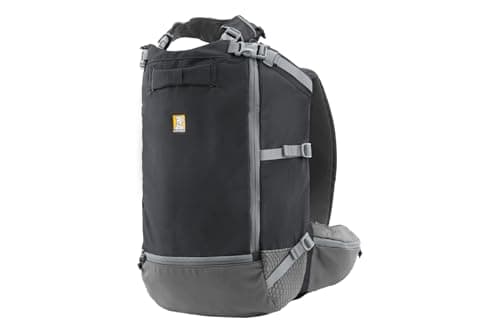
A pack is item nine, not item one, and it comes with the only hard number in this whole category. Ruffwear’s published guidance is no more than 25% of the dog’s body weight, including the weight of the pack itself. Most hiking checklists give no limit at all.
Ruffwear also publishes what almost no other pack maker does — the volume and the empty weight of each size: 5 L, 10 L, 13 L and 21 L, at 0.73 lb to 1.3 lb. You need both figures to calculate a load, which is presumably why they are published together and why nobody else does it.
Three practical rules on top of the number:
- Start empty. A dog needs to learn to move in a pack before it carries anything — the width changes what it can get through and the weight changes its balance.
- Balance the sides. An unbalanced pack rubs on one side and shifts on every descent.
- Nothing hard against the spine, and never load a young dog whose growth plates have not closed.
Item ten: the kit, and what it must contain
A dog first aid kit is not a human one with a paw sticker. The AVMA publishes owner-facing first aid guidance, and the items most consistently missing from off-the-shelf pet kits are the same every time:
- A muzzle — or a length of gauze you know how to use as one. An injured, frightened dog bites, including yours, and you cannot treat a wound you cannot reach.
- A tick removal tool that is not tweezers.
- Styptic powder for a torn nail, which is the single most common trail injury nobody plans for.
- Self-adhesive bandage that grips itself rather than fur.
- Your vet’s number and the nearest emergency clinic to the trailhead, written down. Free, and worth more than most of the kit.
Note that none of the kits we rank contain medication, and that is correct — do not carry human painkillers for a dog. We audit each kit against the checklist in the best dog first aid kits, and the full list is in what should be in a dog first aid kit.
Quick picks
The short answer, ranked and scored against our published durability rubric. Where a manufacturer does not publish a spec, we say so rather than estimating it.
| # | Photo | Product | Durability | Price |
|---|---|---|---|---|
| 1 | 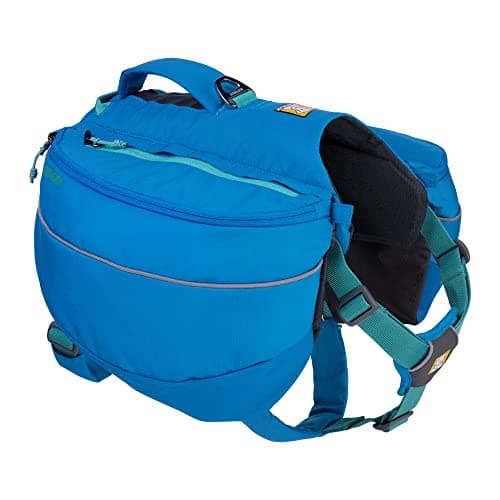 | Ruffwear Approach PackThe pack that publishes its volume, its weight and a load limit | 78/100 | $59.99 · Amazon |
| 2 | 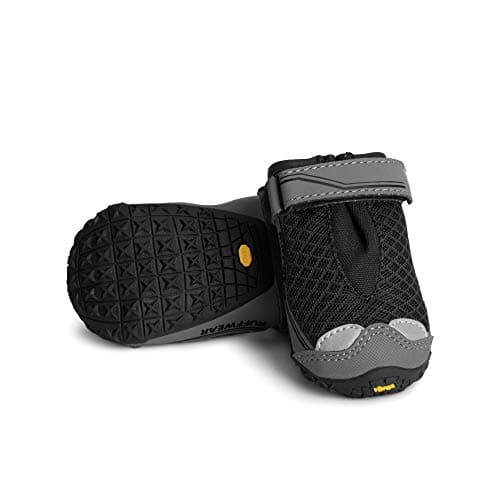 | Ruffwear Grip Trex BootsSharp rock and scree — the only boot here with a named outsole | 80/100 | $49.99 · Amazon |
| 3 | 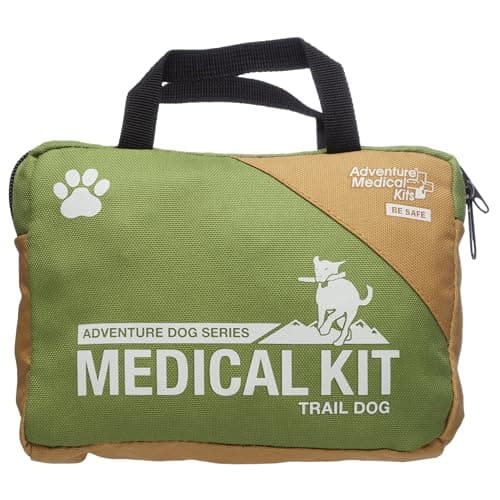 | Adventure Medical Kits Trail Dog Medical KitA kit built by a wilderness-medicine company rather than a pet brand | 72/100 | $20.99 · Amazon |
| 4 | 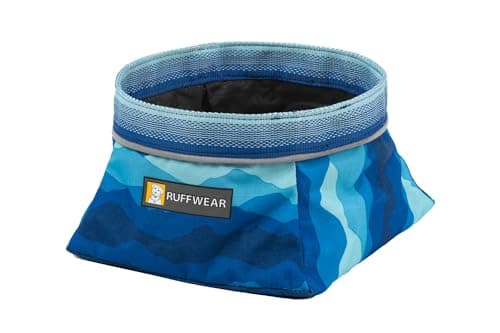 | Ruffwear Quencher BowlA packable bowl that stands up on its own when full | 69/100 | $24.99 · Amazon |
Tap any row to jump to the full review. Prices are pulled live from Amazon as of October 18, 2026; where we have no verified live price we show none rather than a stale number. #ad — how our links work.
The picks, ranked
1. Ruffwear Approach Pack
Durability score 78/100Best for: The pack that publishes its volume, its weight and a load limit
The best-documented dog pack on the market, and the only one that tells you in the same breath how much it holds, what it weighs and how much your dog should carry.
- Shell
- 150D polyester ripstop with DWR and PU coating
- Harness
- Laminated, molded bonded polyester mesh and perforated PE foam
- Adjustment
- Five points
- Volume
- 5 L (XS) / 10 L (S) / 13 L (M) / 21 L (L–XL)
- Weight
- 0.73 lb (XS) to 1.3 lb (L–XL)
- Buckles
- ITW Nexus Airloc side-release
- Leash ring
- Anodized 6061-T6 aluminum V-ring
- Load guidance
- No more than 25% of body weight, including the pack
- Sizes
- XS (17–22 in) to L/XL (32–42 in) girth
Pros
- Publishes volume in liters AND weight AND a load limit for every size — no other pack in this roundup publishes all three
- Ruffwear states the load rule plainly: no more than 25% of body weight including the pack itself
- Named hardware throughout — ITW Nexus buckles, an anodized 6061-T6 aluminum V-ring, YKK zippers
- Five points of adjustment, which is what a loaded pack needs to stop it rolling
Cons
- 150D shell is light for a pack that will be dragged along rock — the Front Range harness uses 300D
- The saddlebags do not detach, so it is a pack or nothing
- Chewing excluded from the warranty, as everywhere in Ruffwear's line
How we assessed it: on published materials, hardware specs and construction — not long-term chew-tested. We say so because it is true, and because a claim we cannot back is worth nothing to you.
#ad Price as of October 18, 2026; Amazon prices change often, so check before you buy. How our links work.
2. Ruffwear Grip Trex Boots
Durability score 80/100Best for: Sharp rock and scree — the only boot here with a named outsole
The reference boot for sharp ground, and the only one here whose sole is a specification rather than a description.
- Outsole
- Non-marking Vibram, lug pattern
- Upper
- 100% polyester tightly woven air mesh
- Closure
- YKK hydrophobic hook-and-loop cinch with hardware
- Sizing
- Eight widths, 1.50–3.25 in in 0.25 in steps
- How to measure
- Across the widest part of the paw when bearing weight
- Sold as
- Sets of two
- Weight
- Not published
Pros
- A named Vibram outsole — the only boot in this roundup where the rubber has an identity rather than an adjective
- Eight sizes in quarter-inch steps, which is the level of granularity boot fit actually requires
- Ruffwear publishes the correct measuring method: across the widest part of the paw, bearing weight
- YKK hydrophobic hook-and-loop, specified to maintain holding power when wet — the usual reason boots come off
Cons
- Sold in sets of two, so a full set of four is two purchases and most dogs need two different sizes
- No published weight
- Ruffwear's standard warranty excludes chewing, which is exactly how boots most often die
- Air mesh upper is built for breathability, not for warmth — this is a summer and rock boot, not a winter one
How we assessed it: on published materials, hardware specs and construction — not long-term chew-tested. We say so because it is true, and because a claim we cannot back is worth nothing to you.
#ad Price as of October 18, 2026; Amazon prices change often, so check before you buy. How our links work.
3. Adventure Medical Kits Trail Dog Medical Kit
Durability score 72/100Best for: A kit built by a wilderness-medicine company rather than a pet brand
The best starting point, precisely because it was assembled by people who treat humans in the backcountry — but it is a starting point, not a finished kit.
- Contents
- Dressings, bandages, tools; per the live Amazon listing
- Instructions
- Includes a printed instruction manual
- Format
- Lightweight, compact pack
- Contains medication
- No
- AVMA checklist coverage
- Partial — see the checklist comparison on this page
Pros
- Built by a wilderness-medicine company, and it shows in the dressing selection rather than in the packaging
- Includes a printed manual, which matters because you will be reading it one-handed in poor light
- Genuinely light and compact enough to live in a pack rather than in a cupboard
Cons
- Like every commercial kit, it does not contain the AVMA's first listed item — your vet's phone numbers. You add those
- No thermometer in the compact configuration
- Contents lists vary between retailers and configurations, so check the pack you are actually buying
How we assessed it: on published materials, hardware specs and construction — not long-term chew-tested. We say so because it is true, and because a claim we cannot back is worth nothing to you.
#ad Price as of October 18, 2026; Amazon prices change often, so check before you buy. How our links work.
4. Ruffwear Quencher Bowl
Durability score 69/100Best for: A packable bowl that stands up on its own when full
The best fabric travel bowl, and the only one in this roundup built from a fabric with a name.
- Construction
- Cordura shell with a waterproof polyurethane-coated liner
- Format
- Collapsible, cinch closure
- Care
- Machine washable
- Capacity
- Published per size by Ruffwear
Pros
- A Cordura shell — a named, specified fabric rather than 'durable nylon'
- Holds its shape when full, which the silicone bowls do not do as well on uneven ground
- Machine washable, which matters more than it sounds after a season of dog spit and pond water
- Packs flat rather than collapsing to a disc, so it stuffs into a pocket
Cons
- Fabric bowls stay damp and will grow mildew if they are packed away wet
- More expensive than a silicone bowl that does most of the same job
- Not rigid, so a determined dog can knock it over
How we assessed it: on published materials, hardware specs and construction — not long-term chew-tested. We say so because it is true, and because a claim we cannot back is worth nothing to you.
#ad Price as of October 18, 2026; Amazon prices change often, so check before you buy. How our links work.
Item eleven: a plan for the heat
The most likely thing to go wrong on a summer hike is not an injury. It is heat, and the gear that matters is mostly not gear.
Washington State University’s figures on asphalt temperature are the usual reference for surface heat, and the practical rule that follows works anywhere: if you cannot hold the back of your hand on the surface for five seconds, it is too hot for a dog’s pads. That applies to rock slabs and trail sand as well as tarmac.
What actually helps, in order: go early, choose shade and water, stop before the dog needs you to, and know what heat stress looks like — the AVMA’s warm weather guidance is the source we point people to. A cooling vest is item six for a reason.
What we would leave at home
- A retractable leash. A thin cord under load with a plastic brake, on terrain where you may need to stop a dog instantly. No.
- A long line on a narrow trail. Thirty feet of line at ankle height is a hazard to other people and the liability is yours. Long lines are for open ground — see our long line roundup.
- Booties for a dog that has not worn them before. The trail is not the place to find out. Fit and practice at home first.
- Anything the dog carries that you have not weighed. See the 25% rule.
If the dog cannot walk out
The item that is not on the eleven-item list, because it is a judgment call rather than a default: something to carry the dog in. A small dog that runs out of legs at mile eight, or any dog that cuts a pad, turns a hiking day into a carrying day. The options are a pack you wear the dog in or an emergency sling that lives in the first aid kit, and we compared both in the dog carrier backpacks roundup. For a big dog the honest answer is usually the sling, because the weight ceiling that matters is yours.
After the hike, in five minutes
This is the routine that catches problems while they are still small:
- Pads and between the toes. Grit, thorns, cuts, foxtails. Foxtail awns migrate and become a surgical problem.
- Ticks, especially ears, neck, armpits and groin.
- Under the harness and pack. Rubs start as a bald patch and become raw fast.
- Nails. A split nail is easier to deal with now than at 2am.
- Rinse and dry the gear. Grit inside webbing is an abrasive, and a wet pack left in a bag is a smell you will not remove. When to retire the gear entirely is in when to replace a harness.
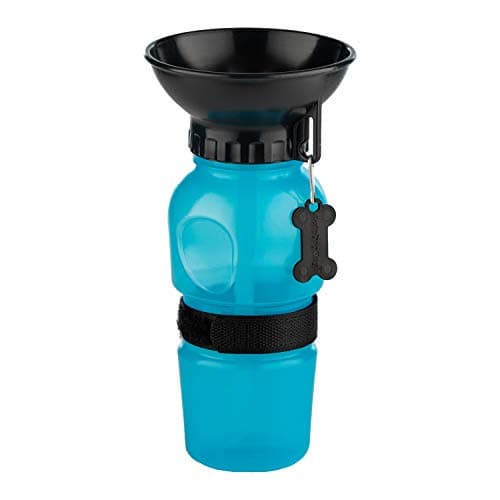
Water is the item on this list people under-plan for. A dog cannot drink from a bottle and the weight you carry is almost all water rather than bowl, so the bowl should be the lightest part of the system — and one of the options here reclaims the water you pour out rather than wasting it. The bowls and bottles worth carrying are on the collapsible dog bowls.
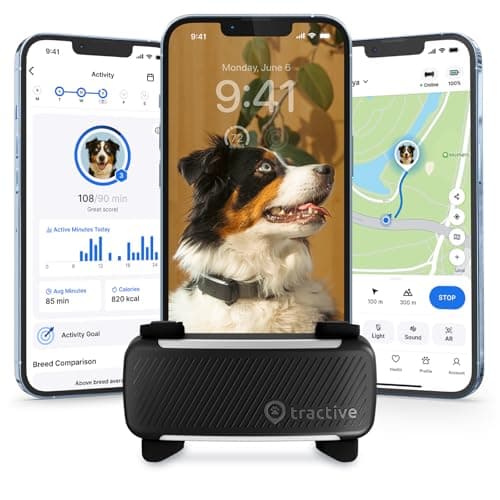
One item on this list is a service rather than a product. A GPS collar is worth carrying if your dog ranges — but a cellular tracker needs a signal, and the country that loses dogs frequently has none, which is the difference between a tracker that works where you hike and one that does not. The decision, including the subscription you are really buying, is on are GPS dog collars worth it.
The first aid line on this checklist deserves its own page, because the kit that works on a trail is not the one most people own: a compact pack or a pouch that mounts to the harness, finished off with four items no commercial kit includes. The three worth carrying are on the best dog first aid kits for hiking.
Frequently asked questions
What should I pack for a hike with my dog?
Four things go on every hike: water and a bowl you can actually pour into, a 6 ft leash with a traffic handle on a well-fitted harness, ID that survives water, and a plan for carrying the dog out if it gets hurt. After that, add by conditions — boots for sharp rock or ice, a cooling vest in real heat, insulation for a thin-coated dog in cold, and a light if you might finish after dark.
How much weight can a dog carry in a backpack?
Ruffwear's published guidance is no more than 25% of the dog's body weight, including the weight of the pack itself — which is the only hard number we have found in this category, since most hiking checklists give no limit at all. Ruffwear also publishes each size's volume (5, 10, 13 and 21 L) and empty weight (0.73 to 1.3 lb), and you need both figures to calculate a load properly.
Do dogs need boots for hiking?
For terrain rather than temperature: sharp rock, scree, ice and de-icing salt are the real cases. The specification that matters is the outsole, and almost nobody names theirs — Ruffwear's Grip Trex uses a Vibram outsole and is the exception. Size by paw width with the dog standing so the paw is loaded, and never introduce boots on the trail: fit and practice at home first.
What should be in a dog first aid kit for hiking?
The items most consistently missing from off-the-shelf pet kits: a muzzle or gauze you know how to use as one, because an injured dog bites and you cannot treat a wound you cannot reach; a proper tick removal tool rather than tweezers; styptic powder for a torn nail, which is the most common trail injury nobody plans for; self-adhesive bandage that grips itself rather than fur; and your vet's number plus the nearest emergency clinic to the trailhead, written down.
How hot is too hot for a dog to hike?
Use the surface as the test: if you cannot hold the back of your hand on it for five seconds, it is too hot for a dog's pads — and that applies to rock slabs and trail sand as well as tarmac. Beyond the surface, the things that help most are not gear: go early, choose shade and water, and stop before the dog needs you to. Evaporative cooling vests work poorly in humidity, which is exactly when heat is most dangerous.
Should my dog carry its own water on a hike?
Carry it yourself. Water is heavy, it is the first thing you will need and the last thing you want rationed by a 25%-of-body-weight limit, and a dog pack should be earning its place with light bulky items rather than dense ones. A pack is roughly the ninth item on a sensible hiking list, not the first — and a dog needs to learn to move in an empty one before it carries anything at all.
Sources
Every spec on this page traces to one of these. Where a manufacturer does not publish a figure, we say “not published” rather than estimating it.
- Ruffwear — Approach Pack specs (5/10/13/21 L volumes, published pack weights, 25%-of-body-weight load guidance)
- Ruffwear — Grip Trex boot specs (Vibram outsole; polyester air mesh upper; paw-width sizing 1.50–3.25 in)
- AVMA — first aid tips for pet owners, including what belongs in a pet first aid kit
- AVMA — Warm weather pet safety (heat stress signs; hot surfaces; never leave a pet in a car)
- Washington State University — protect your pet’s feet from heat and burns (asphalt temperature figures)