What Size Dog Ramp Do I Need?
Nobody can tell you the right ramp from your vehicle's model name - trim and suspension move the load height. But two measurements and one calculation will tell you exactly, and the answer is usually longer than you expected.
The verdict
Length is not a style choice — it is set by your vehicle’s load height and the slope your dog can actually walk. Measure the height from the ground to the loading lip, then pick the gentlest angle you can live with: as a rule of thumb we would not ask a dog with hip or spine trouble to climb much steeper than about 20 degrees, which needs a ramp roughly three times the load height. For most SUVs and almost every pickup tailgate, that puts you in telescoping territory, which is why the PetSafe Happy Ride telescoping ramp is the default pick here: it has the longest reach in this field, it lets you choosethe angle, its aluminum frame is published to 300 lb and it has raised side rails. The WeatherTech PetRampis the better-built object — the one brand in the category that will actually tell you what it is made of — but it is a bi-fold and therefore shorter, so check it against your measured height before buying. And do not buy an indoor ramp for a vehicle: the Alpha Paw PawRamp is built for beds and couches, not tailgates.
Two measurements, taken properly
We will not publish a table of vehicle load heights, and you should distrust anyone who does: heights move with trim level, tyre size, suspension, load and age. Yours takes thirty seconds to measure.
- Load height.Park on level ground. Measure vertically from the ground to the top surface the dog must reach — the tailgate lip, the boot floor, or the sill of the rear door. Not to the top of the bumper, and not to the roof of the opening.
- Clear run-out. Measure how much flat ground you have behind or beside the vehicle, where you will actually park: driveway, kerb, garage. A ramp that needs nine feet of run-out is useless in a garage with six.
Take the second measurement in the tightest place you regularly park, not in the easiest one. The common failure is a ramp that works perfectly at home and reaches into a hedge at the trailhead.
The arithmetic, once
Ramp length, load height and angle are one relationship: the ramp is the hypotenuse of a right triangle whose vertical side is your load height. The table below is simply that arithmetic worked out — not a measurement of any product, and not a published figure from anyone. Read along your measured height.
| Measured load height | ~15° (gentle) | ~20° (our working limit) | ~25° (steep) |
|---|---|---|---|
| 18 in | ~70 in | ~53 in | ~43 in |
| 24 in | ~93 in | ~70 in | ~57 in |
| 30 in | ~116 in | ~88 in | ~71 in |
| 36 in | ~139 in | ~105 in | ~85 in |
Two readings of that table matter. First, the numbers get large quickly — a 30-inch tailgate at a gentle angle wants nearly ten feet of ramp, which is not a product anyone sells for a car. That is why the practical target is the 20-degree column, and why most buyers of short folding ramps are unknowingly asking their dog for 30 degrees or more. Second, the angle is the only thing a ramp is really for. A dog that can hop into a car does not need a ramp; a dog that cannot needs the slope reduced, and length is the only lever that reduces it.
One qualifier, stated honestly: the 20-degree working limit is our editorial rule of thumb for a dog with joint or spine problems, not a clinical threshold from a published standard. If your dog is recovering from surgery, the angle is a question for your vet, and the equipment decision follows their answer rather than ours.
Format decides reach, and reach decides everything
| Format | Reach | Stowed size | Watch for |
|---|---|---|---|
| Telescoping (PetSafe) | Longest here, and adjustable | Long and awkward; takes real boot space | Grit in the telescoping sections is the usual wear point |
| Bi-fold (WeatherTech) | Shorter — steeper on a tall vehicle | Rigid halves take depth | Best build quality here; check length against your height |
| Tri-fold (Pet Gear) | Shorter again | Most compact stowed footprint | Carpet surface holds water and mud; two hinge lines instead of one |
| Stepped (Gen7Pets) | Shorter; steps rather than an incline | Folding | Steps are harder on a dog with real hip or spine trouble than a smooth incline |
| Indoor adjustable (Alpha Paw) | Furniture height only | Folds | Not designed for outdoor exposure or a tailgate |
The pattern is unavoidable: everything that stows small gives up reach, and reach is the thing you are buying. If boot space is genuinely the binding constraint, the tri-fold is the honest trade — just know what you traded.
Why the side door is the hard case
A tailgate or a boot gives you an unobstructed opening and plenty of room to the sides. A rear side door does not, and three things change:
- The sill is lower than the tailgateon most vehicles, which helps — measure it separately rather than reusing your tailgate figure.
- The opening is narrow and the door is in the way. The ramp has to land on a sill that is only as wide as the door aperture, and a ramp wider than that aperture will not seat flat.
- The dog has to turn at the top. This is the part that catches dogs out: a side-door ramp asks for a step up and then a pivot into the footwell or onto the seat, on a surface that may be upholstered rather than flat. Side rails matter more here than anywhere, because a dog that hesitates mid-ramp steps sideways.
If the dog is going on the back seat rather than into a cargo area, the ramp is only half the job: the other half is what it lands on and whether the dog is restrained once up. See the dog car seats, the seat coversand — because a seat cover is not a restraint — the crash-tested harnesses.
What to look for, in order
- Length against your measured load height. Everything else is secondary. Aim for the 20-degree column.
- A published weight capacity.PetSafe publishes 300 lb for the Happy Ride. Where a maker publishes nothing, treat it as unknown rather than adequate.
- Raised side rails. The feature that stops a nervous dog stepping off the edge, and it matters most on a side door.
- A traction surface you can hose off.Textured non-slip over carpet — carpet holds water and mud and it is the part that wears out.
- Stowed size measured against your actual boot, with the dog, the crate and the gear already in it.
- An incline, not steps, if the problem is joints. Steps are the answer to a behavioral refusal, not to a mobility problem.
Quick picks
The short answer, ranked and scored against our published durability rubric. Where a manufacturer does not publish a spec, we say so rather than estimating it.
| # | Photo | Product | Durability | Price |
|---|---|---|---|---|
| 1 | 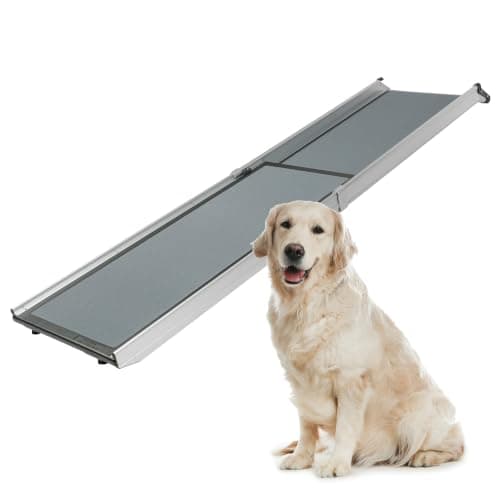 | PetSafe Happy Ride Telescoping RampThe longest reach here — telescoping to fit a tall tailgate | 73/100 | $170.99 · Amazon |
| 2 | 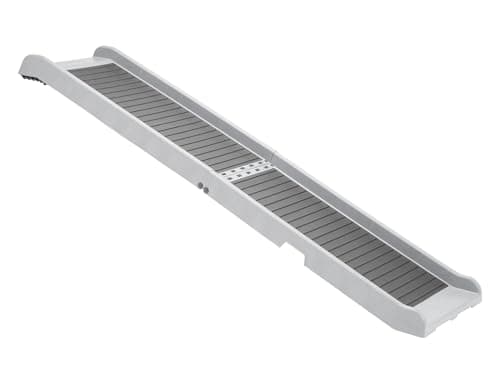 | WeatherTech PetRampThe one brand in this category with a real materials sheet | 81/100 | $126.95 · Amazon |
| 3 | 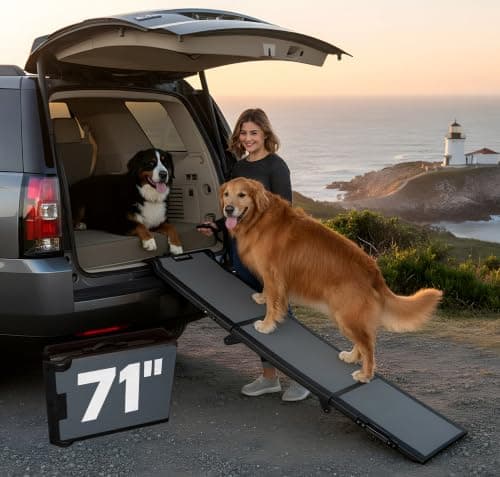 | Pet Gear Tri-Fold RampThe most compact stowed footprint | 59/100 | $84.36 · Amazon |
| 4 | 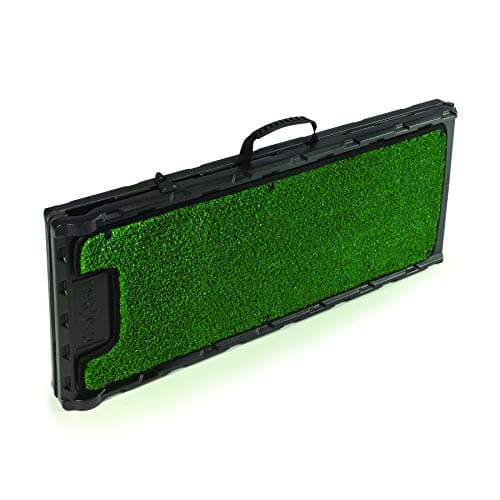 | Gen7Pets Natural Step RampA stepped surface for a dog that will not use a smooth incline | 56/100 | $99.99 · Amazon |
| 5 | 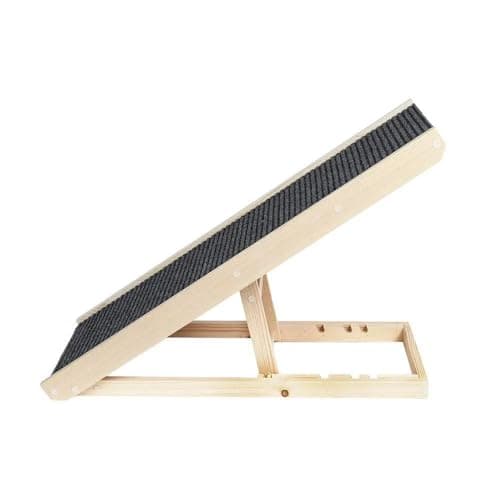 | Alpha Paw PawRampIndoor use — beds and couches rather than tailgates | 59/100 | $84.48 · Amazon |
Tap any row to jump to the full review. Prices are pulled live from Amazon as of October 18, 2026; where we have no verified live price we show none rather than a stale number. #ad — how our links work.
The picks, ranked
1. PetSafe Happy Ride Telescoping Ramp
Durability score 73/100Best for: The longest reach here — telescoping to fit a tall tailgate
The right ramp for a tall vehicle, because the angle is the whole point and this is the only one here that lets you choose it.
- Format
- Telescoping
- Surface
- High-traction, textured
- Weight capacity
- Published by PetSafe as up to 300 lb
- Rails
- Raised side rails
- Frame material
- Aluminum
Pros
- Telescoping length means you can set a shallower angle on a tall vehicle instead of accepting whatever a fixed ramp gives you
- A published weight capacity, which several ramps in this category omit entirely
- Aluminum frame, so it does not gain weight when it gets wet
- Side rails, which are the difference between a ramp a nervous dog uses and one it steps off
Cons
- Long and awkward when collapsed — it takes real boot space
- Telescoping sections are the wear point, and grit in the rails is the usual complaint
- Heavier than a folding plastic ramp
How we assessed it: on published materials, hardware specs and construction — not long-term chew-tested. We say so because it is true, and because a claim we cannot back is worth nothing to you.
#ad Price as of October 18, 2026; Amazon prices change often, so check before you buy. How our links work.
2. WeatherTech PetRamp
Durability score 81/100Best for: The one brand in this category with a real materials sheet
Buy it for the build quality and the fact that the maker will actually tell you what it is — but check the length against your tailgate height first.
- Format
- Bi-fold
- Construction
- Molded, made in the USA per WeatherTech
- Surface
- Textured non-slip walking surface
- Weight capacity
- Published by WeatherTech
- Rails
- Raised edges
Pros
- WeatherTech is the one brand across our car-gear coverage that consistently publishes real materials data rather than adjectives
- Bi-fold format stows more conveniently than a telescoping ramp
- Molded construction with no fabric surface to soak up mud and water
Cons
- Shorter than the telescoping ramps, which means a steeper angle on a tall vehicle
- Rigid halves take up more depth in a boot than a tri-fold
- Among the more expensive ramps here
How we assessed it: on published materials, hardware specs and construction — not long-term chew-tested. We say so because it is true, and because a claim we cannot back is worth nothing to you.
#ad Price as of October 18, 2026; Amazon prices change often, so check before you buy. How our links work.
3. Pet Gear Tri-Fold Ramp
Durability score 59/100Best for: The most compact stowed footprint
The right choice if boot space is the binding constraint and the ramp lives indoors between uses.
- Format
- Tri-fold
- Surface
- Carpet-style traction surface
- Weight capacity
- Published by Pet Gear
- Frame material
- Not published in detail
Pros
- Folds into three, so it takes the least boot depth of any ramp here
- The carpeted surface gives nervous dogs the most confident footing of the surfaces in this roundup
Cons
- A carpet surface holds water and mud, and it is the part that wears out
- Two hinge lines instead of one means two more things to fail
- Frame material not published in detail
How we assessed it: on published materials, hardware specs and construction — not long-term chew-tested. We say so because it is true, and because a claim we cannot back is worth nothing to you.
#ad Price as of October 18, 2026; Amazon prices change often, so check before you buy. How our links work.
4. Gen7Pets Natural Step Ramp
Durability score 56/100Best for: A stepped surface for a dog that will not use a smooth incline
A good answer to a specific behavioral problem, and the wrong answer to a mobility one.
- Format
- Folding, stepped surface
- Surface
- Molded steps rather than a continuous incline
- Weight capacity
- Published by Gen7Pets
- Frame material
- Not published in detail
Pros
- The stepped profile suits dogs that hesitate on a smooth ramp — it reads as stairs rather than as a slope
- Folds flat and is lighter than the telescoping aluminum ramps
Cons
- Steps are harder on a dog with genuine hip or spine problems than a smooth incline is — the reason many owners buy a ramp in the first place
- Frame material not published in detail
- Shorter than the telescoping options
How we assessed it: on published materials, hardware specs and construction — not long-term chew-tested. We say so because it is true, and because a claim we cannot back is worth nothing to you.
#ad Price as of October 18, 2026; Amazon prices change often, so check before you buy. How our links work.
5. Alpha Paw PawRamp
Durability score 59/100Best for: Indoor use — beds and couches rather than tailgates
The indoor ramp. Genuinely useful for an older dog at home, and the wrong tool for a truck.
- Format
- Folding, adjustable height
- Surface
- Non-slip traction surface
- Weight capacity
- Published by Alpha Paw
- Intended use
- Furniture and bed height
Pros
- Adjustable height suits a bed or couch, which is the use case most ramps here handle badly
- Folds without tools
Cons
- Built for furniture height rather than for a vehicle tailgate
- Not designed for outdoor exposure
- Frame material not published in detail
How we assessed it: on published materials, hardware specs and construction — not long-term chew-tested. We say so because it is true, and because a claim we cannot back is worth nothing to you.
#ad Price as of October 18, 2026; Amazon prices change often, so check before you buy. How our links work.
The bottom line
Measure the load height, read the 20-degree column, and buy the shortest ramp that reaches it — which for most SUVs and every pickup means a telescoping ramp rather than a folding one. Measure your run-out in the tightest place you park, not the easiest. Insist on side rails and a published capacity. And treat a stepped ramp as the fix for a dog that refuses a smooth incline, never as the fix for a dog whose hips hurt. The full ranked field, with live prices, is the dog ramps roundup; if the dog needs lifting rather than walking, the harnesses built for that are on the lifting harnesses.
Frequently asked questions
What size dog ramp do I need for an SUV?
Measure the vertical distance from level ground to the loading lip, then pick the length that gives an angle your dog can walk. As a working rule we would not ask a dog with hip or spine trouble to climb much steeper than about 20 degrees, which needs a ramp roughly three times the load height - so a 24 in tailgate wants about 70 in of ramp and a 30 in tailgate wants about 88 in. That arithmetic is why telescoping ramps exist: most folding ramps put a tall SUV well past 30 degrees. Do not shop by vehicle model name - load height moves with trim, tyres and suspension.
How steep can a dog ramp be?
Shallower than most ramps sold for cars actually achieve. Our editorial working limit for a dog with joint or spine problems is about 20 degrees, which needs roughly three times the load height in ramp length; 15 degrees is gentler again and needs closer to four times. That figure is our rule of thumb rather than a clinical threshold from a published standard - if your dog is recovering from surgery, the acceptable angle is a question for your vet and the equipment decision follows their answer. What is not in doubt is the mechanism: length is the only lever that reduces slope.
Is a telescoping or folding dog ramp better?
Telescoping, if angle is the reason you are buying a ramp at all - it has the longest reach and it lets you choose the angle rather than accept one. The PetSafe Happy Ride telescoping ramp is the example here, with an aluminum frame published to 300 lb and raised side rails. Folding ramps win on stowed size and lose on reach, which on a tall vehicle means a steeper climb. The honest trade-offs on telescoping: it is long and awkward when collapsed, it is heavier, and grit in the telescoping sections is the usual wear point.
What size ramp do I need for a side door rather than a tailgate?
Measure the side sill separately - it is usually lower than the tailgate, so the length requirement is often less. Two other things change and they both matter more than length. The aperture is narrow, so a ramp wider than the door opening will not seat flat on the sill. And the dog has to step up and then pivot into the footwell or onto the seat, which is where dogs hesitate - so raised side rails are more important on a side door than anywhere else, because a dog that stalls mid-ramp steps sideways.
Are dog steps better than a ramp?
They solve a different problem. Steps are the right answer to a behavioral refusal - a dog that will not commit to a smooth incline often will take defined steps, which is what the Gen7Pets stepped ramp is for. They are the wrong answer to a mobility problem: steps load a dog's hips and spine one at a time, which is harder on a dog with genuine joint trouble than a continuous incline is. If the reason you are shopping is arthritis, surgery recovery or a senior dog's hips, buy length and a smooth surface.
Can I use an indoor dog ramp for my car?
Not well. The Alpha Paw PawRamp, for example, is built for furniture and bed height and is not designed for outdoor exposure - a tailgate is both taller and wetter. Two practical problems follow: an indoor ramp set to furniture height will be far too steep against a vehicle load height, and surfaces and frames built for carpet and indoor air do not take hosing, grit and winter salt. Buy the vehicle ramp for the vehicle and, if you need one indoors too, accept that they are two products.
Sources
Every spec on this page traces to one of these. Where a manufacturer does not publish a figure, we say “not published” rather than estimating it.