Are Dog Backpacks Bad for Dogs?
Exactly one maker in this category publishes a load limit. That single figure is the most useful thing anyone has put in writing about whether a dog should carry a pack at all.
The verdict
A correctly loaded pack on a fit, mature, healthy dog is not harmful, and the reason we can say that with any confidence is that one maker publishes a number: Ruffwear states no more than 25% of body weight, including the pack itself, for both the Approach and the Palisades. Nobody else in the category publishes load guidance at all — Kurgo publishes none for the Baxter, and no volume either. So buy the pack whose maker tells you the limit: the Ruffwear Approach Pack is the one we would start with, because it publishes its volume per size (5 L to 21 L), its own weight (0.73 lb to 1.3 lb), a girth-based size chart from 17 in to 42 in, and a named buckle and leash ring. The honest limits are about the dog rather than the pack: a growing dog, an unfit dog, a dog with any joint or back history, and a dog in real heat should not be carrying weight, and no pack specification changes that.
The one published number in the category
Ruffwear’s guidance on both the Approach and the Palisades is that a dog should carry no more than 25% of its body weight, including the pack. Three things about that figure are worth drawing out, because almost nobody quotes it properly:
- It includes the pack. The Approach weighs 0.73 lb at XS and 1.3 lb at L/XL; the Palisades runs from 15 oz to 1 lb 11 oz. On a 40 lb dog, a 10 lb ceiling with a 1.3 lb pack leaves about 8.7 lb of contents, not 10.
- It is a ceiling, not a target. A first outing should be an empty or nearly empty pack, and the load should build over multiple walks.
- It is manufacturer guidance, not a study.We are reporting what Ruffwear publishes, which is more than anyone else does, and we are not going to dress it up as clinical evidence. Anything involving a specific dog’s joints, age or fitness is a veterinary conversation.
Against that, Kurgo publishes no load guidance and no volume for the Baxter, so you cannot calculate a limit from the product at all — you would be applying Ruffwear’s number to another brand’s pack, which is the kind of reasoning this site tries not to do.
Which dogs should not carry a pack
This is where the real answer to the question lives, and it is about the dog rather than the equipment:
- A growing dog. Weight-bearing work on a skeleton that has not finished developing is the clearest case for waiting, and when to start is a question for your veterinarian, who knows the breed and the individual.
- An unconditioned dog. A pack adds load to a dog that may already be at the edge of its fitness on a long walk. Build the walk first and the load second.
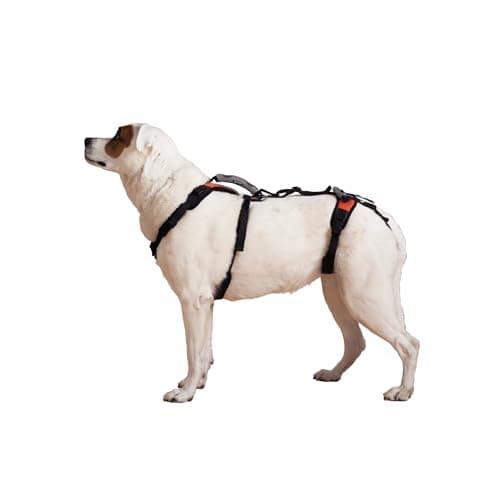
- Any dog with joint, hip or back history.If a dog is a candidate for a support harness, it is not a candidate for a loaded pack — see the lifting and support harnesses for that end of the range.
- Any dog in real heat. A pack covers surface area the dog needs for cooling and adds work at the same time, which is the wrong combination. If heat is the condition you are managing, read whether cooling vests are worth it — including the honest part about humidity — and leave the pack at home.
Fit is the part that actually causes problems
When a pack hurts a dog, the usual cause is not the weight, it is where the weight sits. Three details decide it, and the published specs let you compare them:
- Adjustment points. The Approach has five, the Palisades has six. More points means the load can be held against the ribcage rather than hanging off the shoulders, which is the difference between a pack that rides and a pack that rubs.
- The harness structure under the bags. Ruffwear specifies a laminated, moulded bonded polyester mesh and perforated PE foam on the Approach. The Palisades goes further in a genuinely useful way: the saddlebags are removable, so the harness can be worn on its own, which means you can take the load off mid-walk without taking the harness off the dog.
- Sizing on girth, not weight. Ruffwear sizes the Approach from XS at 17-22 in of girth up to L/XL at 32-42 in. A weight-based size chart is a guess about body shape; two 50 lb dogs can be several inches apart in girth. The same argument applies to measuring for any harness.
Load balance is the fourth detail and nobody can spec it for you: split the weight evenly between the two bags, put dense items low and forward, and re-check the straps after the first mile. An unbalanced pack is a rubbing pack regardless of how good it is.
This is the pack the dog wears, not the one you wear
Worth separating, because the same search term covers both products. A dog pack puts a load on the dog. A carrierbackpack puts the dog on you, and the safety questions there are completely different — heat against your back, duration guidance, weight ceilings as warranty conditions. We answer those on the carrier backpack roundup and do not restate them here. If what you want is for the dog to carry the water and the first aid kit, the dog packs roundup is the full field, and the hiking gear checklist covers what should go in it.
What to look for, in order
- A published load limit. One brand publishes one. Buy from a maker that will tell you the ceiling.
- A girth-based size chart with real inch ranges, not a weight band.
- Four or more adjustment points, so the load can be held against the body.
- Removable bags, if you hike long days. Being able to shed the load without shedding the harness is worth real money.
- A published pack weight. It counts against the limit, so a maker that hides it is hiding part of your payload.
One last specification note, because it is the kind of thing this category almost never publishes: Ruffwear names its buckles (ITW Nexus Airloc side-release) and its leash ring (anodised 6061-T6 aluminium V-ring) on both packs. Named components are checkable components. Kurgo publishes neither, and offers a lifetime warranty on manufacturing defects instead — which, as the exclusions make clear, covers a seam rather than a season. Ruffwear’s own warranty covers defects in materials and craftsmanship and excludes chewing, normal wear and alterations.
A separate question comes up about the other kind of pack — the one the dog rides in. Dog backpacks for biking and motorcycles sets out what nobody in that category publishes about speed, airflow or impact.
Quick picks
The short answer, ranked and scored against our published durability rubric. Where a manufacturer does not publish a spec, we say so rather than estimating it.
| # | Photo | Product | Durability | Price |
|---|---|---|---|---|
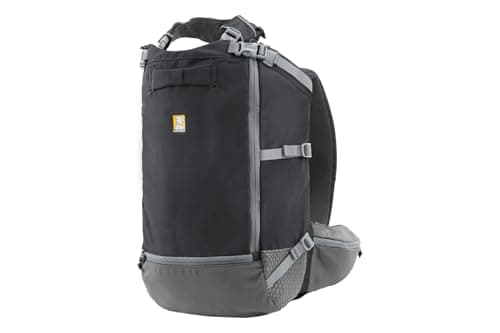
| 1 | 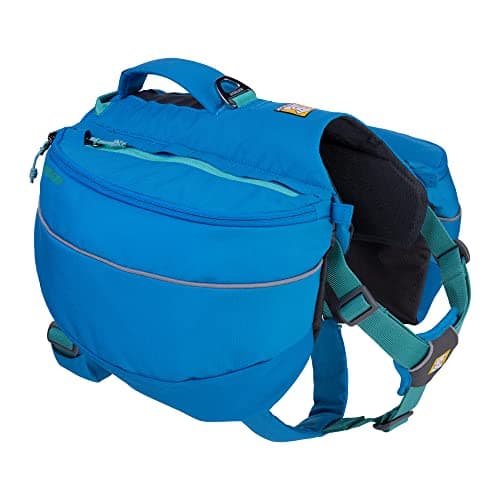 | Ruffwear Approach PackThe pack that publishes its volume, its weight and a load limit | 78/100 | $59.99 · Amazon |
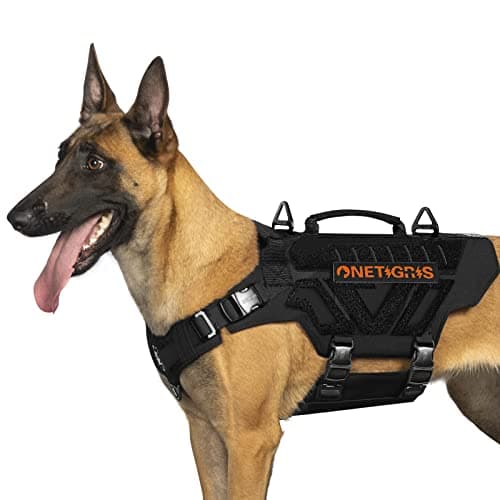
| 2 | 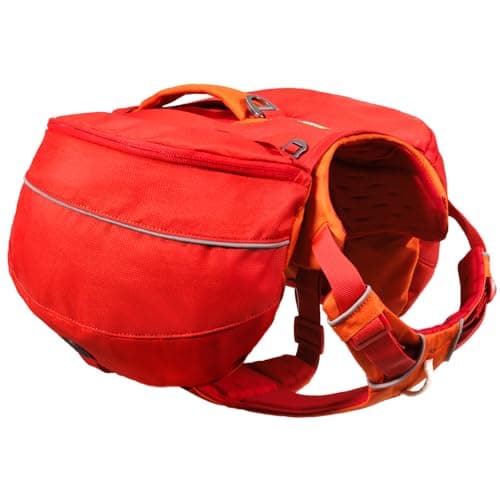 | Ruffwear Palisades PackMulti-day trips — the saddlebags come off and leave a harness behind | 78/100 | $149.99 · Amazon |
| 3 | 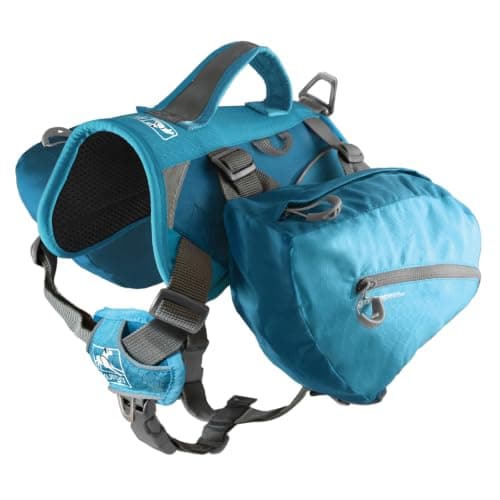 | Kurgo Baxter Dog BackpackThe cheapest pack here with a lifetime defect warranty | 58/100 | $29.39 · Amazon |
Tap any row to jump to the full review. Prices are pulled live from Amazon as of October 18, 2026; where we have no verified live price we show none rather than a stale number. #ad — how our links work.
The picks, ranked
1. Ruffwear Approach Pack
Durability score 78/100Best for: The pack that publishes its volume, its weight and a load limit
The best-documented dog pack on the market, and the only one that tells you in the same breath how much it holds, what it weighs and how much your dog should carry.
- Shell
- 150D polyester ripstop with DWR and PU coating
- Harness
- Laminated, molded bonded polyester mesh and perforated PE foam
- Adjustment
- Five points
- Volume
- 5 L (XS) / 10 L (S) / 13 L (M) / 21 L (L–XL)
- Weight
- 0.73 lb (XS) to 1.3 lb (L–XL)
- Buckles
- ITW Nexus Airloc side-release
- Leash ring
- Anodized 6061-T6 aluminum V-ring
- Load guidance
- No more than 25% of body weight, including the pack
- Sizes
- XS (17–22 in) to L/XL (32–42 in) girth
Pros
- Publishes volume in liters AND weight AND a load limit for every size — no other pack in this roundup publishes all three
- Ruffwear states the load rule plainly: no more than 25% of body weight including the pack itself
- Named hardware throughout — ITW Nexus buckles, an anodized 6061-T6 aluminum V-ring, YKK zippers
- Five points of adjustment, which is what a loaded pack needs to stop it rolling
Cons
- 150D shell is light for a pack that will be dragged along rock — the Front Range harness uses 300D
- The saddlebags do not detach, so it is a pack or nothing
- Chewing excluded from the warranty, as everywhere in Ruffwear's line
How we assessed it: on published materials, hardware specs and construction — not long-term chew-tested. We say so because it is true, and because a claim we cannot back is worth nothing to you.
#ad Price as of October 18, 2026; Amazon prices change often, so check before you buy. How our links work.
2. Ruffwear Palisades Pack
Durability score 78/100Best for: Multi-day trips — the saddlebags come off and leave a harness behind
The right pack if the saddlebags coming off changes how you use it. If they never come off, buy the Approach and keep the difference.
- Shell
- 150D polyester ripstop (bluesign approved; 40% recycled)
- Saddlebags
- Removable — the harness can be worn on its own
- Adjustment
- Six points
- Volume
- 5 L (XS) / 10 L (S) / 13 L (M) / 21 L (L–XL)
- Weight
- 15 oz (XS) to 1 lb 11 oz (L–XL)
- Buckles
- ITW Nexus Airloc side-release
- Leash ring
- Anodized 6061-T6 aluminum V-ring
- Load guidance
- No more than 25% of body weight, including pack and contents
Pros
- Removable saddlebags mean one purchase does the loaded hike and the unloaded camp walk
- Six points of adjustment — the most of any pack here, and it matters most when the bags are loaded unevenly
- Same published discipline as the Approach: volume, weight and load limit for every size
Cons
- Heaviest pack here empty, and roughly two and a half times the price of the Approach
- Same 150D shell as the cheaper pack — you are paying for the system, not for heavier fabric
- Overkill for anything shorter than an overnight
How we assessed it: on published materials, hardware specs and construction — not long-term chew-tested. We say so because it is true, and because a claim we cannot back is worth nothing to you.
#ad Price as of October 18, 2026; Amazon prices change often, so check before you buy. How our links work.
3. Kurgo Baxter Dog Backpack
Durability score 58/100Best for: The cheapest pack here with a lifetime defect warranty
A fine first pack for a dog carrying its own water on day walks. Not a pack for a loaded multi-day trip.
- Shell
- Not published in detail
- Saddlebags
- Fixed, two side pockets
- Volume
- Not published
- Warranty
- Kurgo lifetime warranty on manufacturing defects
- Load guidance
- Not published
Pros
- Lifetime defect warranty, and the lowest price of any pack here
- Simple two-pocket layout that is hard to load badly
Cons
- No published volume, fabric or load guidance
- Wear and tear sits outside the free warranty — and a pack is a wear item
- Lightly built compared with the Ruffwear packs at roughly a fifth of the price
How we assessed it: on published materials, hardware specs and construction — not long-term chew-tested. We say so because it is true, and because a claim we cannot back is worth nothing to you.
#ad Price as of October 18, 2026; Amazon prices change often, so check before you buy. How our links work.
The bottom line
Dog backpacks are not bad for dogs; badly loaded packs on the wrong dogs are. The usable rule is the one Ruffwear publishes and almost nobody quotes correctly — 25% of body weight at the absolute most, pack included, built up over time rather than loaded on day one. Size on girth, insist on four or more adjustment points, split the weight evenly, and leave the pack at home for a growing dog, an unfit dog, a dog with joint history, or a hot day. If you are not sure whether your particular dog should be carrying weight, that is a question for your veterinarian rather than for a review site, and we would rather say so than guess.
Frequently asked questions
Are dog backpacks bad for dogs?
Not inherently. A correctly fitted pack with a sensible load, on a fit, mature, healthy dog, is a normal piece of hiking equipment. The published guidance worth following is Ruffwear's: no more than 25% of body weight, including the pack itself. The dogs that should not carry one are a growing dog, an unconditioned dog, any dog with joint, hip or back history, and any dog in real heat - a pack covers surface area the dog needs for cooling while adding work. Whether your specific dog should carry weight is a veterinary question, not a shopping one.
How much weight can a dog carry in a backpack?
The only published figure in this category is Ruffwear's, and it applies to both the Approach and the Palisades: no more than 25% of body weight, including the pack. Read 'including the pack' literally - the Approach itself weighs 0.73 lb at XS and 1.3 lb at L/XL, so on a 40 lb dog a 10 lb ceiling leaves about 8.7 lb of contents. Treat it as a ceiling rather than a target, and start with an almost empty pack. Kurgo publishes no load guidance for the Baxter at all, so there is no maker figure to apply to it.
At what age can a dog start wearing a loaded backpack?
We will not put a number on it, because the answer depends on the breed, the individual dog and when its skeleton has finished developing - and that is a veterinary judgement rather than a product specification. The principle is straightforward: weight-bearing work on a growing skeleton is the clearest case for waiting. A puppy or adolescent can absolutely wear an empty pack to get used to it, which is also the best way to introduce one at any age.
What makes a dog backpack rub or hurt?
Fit and balance, far more often than weight. Three things to check: the number of adjustment points, because more points let the load sit against the ribcage rather than hang off the shoulders (the Ruffwear Approach has five, the Palisades six); the structure under the bags, where Ruffwear specifies a laminated moulded polyester mesh and perforated PE foam; and the sizing basis, where a girth chart in inches beats a weight band every time. Then split the load evenly between the bags, keep dense items low and forward, and re-check the straps after the first mile.
Is a dog backpack the same as a dog carrier backpack?
No, and conflating them is the most common confusion in this corner of the category. A dog pack is worn by the dog and carries gear. A carrier backpack is worn by you and carries the dog. The safety questions are entirely different - a carrier raises heat against a human back, duration guidance and weight ceilings that function as warranty conditions - and we answer those on the carrier backpack roundup rather than here.
Should a dog carry its own water on a hike?
It is one of the better uses of a pack, because water is dense and it is the load you most want nearby. Keep it balanced - split between both bags rather than all on one side - and remember that the water counts against the 25% ceiling while it is full and stops counting as the dog drinks it, which is a nice property for a long day. A collapsible bowl and a first aid kit are the other two things that earn their place in the bags.
Sources
Every spec on this page traces to one of these. Where a manufacturer does not publish a figure, we say “not published” rather than estimating it.
- Ruffwear — Approach Pack: the 25% of body weight load guidance, the 5-21 L volume range, the 150D polyester ripstop shell and the girth-based size chart quoted here
- Ruffwear — Palisades Pack: removable saddlebags, six adjustment points, and the same 25% of body weight load guidance
- Ruffwear — warranty terms: defects in materials and craftsmanship; chewing, normal wear and alterations excluded
- Kurgo — lifetime warranty terms: manufacturing defects only; wear and tear and unintended use excluded