Dog Collar Materials: What Actually Lasts
Four materials, one honest comparison — including what 'genuine leather' really means and why denier is not a strength rating.
The short answer. For a dog that gets wet and filthy, biothane is the most durable collar material. For a dog that stays dry and will wear one collar for life, full-grain leather. Nylon is the cheapest and least durable of the three. Steel cable exists for leashes, not collars.
The longer answer is that two pieces of terminology in this category are used wrongly almost everywhere, and both cost people money.
Denier is not a strength rating
Denier is a measure of linear density — grams per 9,000 meters of yarn, measured under the ASTM D1907 standard. A 1000D yarn has more mass per unit length than a 500D yarn.
The critical caveat comes straight from the definition: denier only compares meaningfully within the same material. 1000D polypropylene is not stronger than 500D nylon 6,6. It is thicker. Strength depends on the fiber, the weave and the finish, and denier describes none of those.
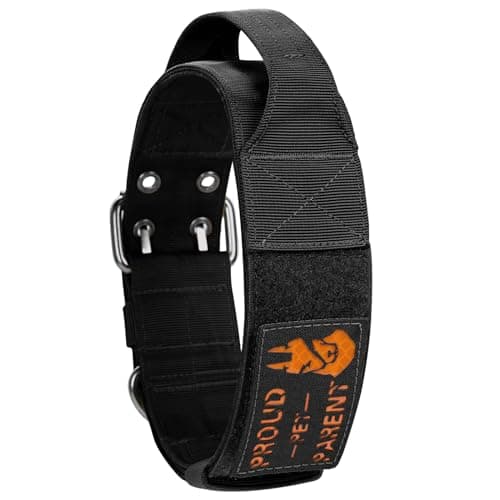
Cordura — the branded fabric everyone name-drops — publishes its yarn weights (330D, 500D, 700D, 1000D) and describes “excellent tear strength and resistance to abrasion,” but publishes no numerical abrasion or tear test results at all. So when a review tells you 1000D Cordura is “three times more abrasion resistant” than 500D, ask where that number came from. It did not come from Cordura.
And note: “1000D nylon” is not “1000D Cordura.” Cordura is a specific high-tenacity, air-jet-textured yarn. Plenty of tactical gear says 1000D nylon and means exactly that. Reviews that quietly upgrade the claim are inventing a spec.
The leather grades, correctly
After tanning, the hide is split into an upper and a lower layer. Everything follows from that:
- Top grain — leather from the upper layer of the hide. That is all it means: the layer, not the quality.
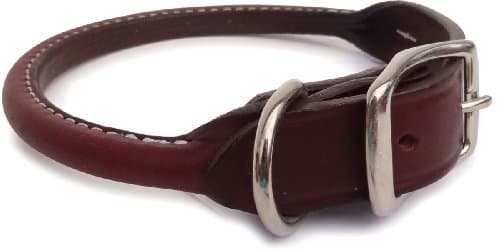
- Full grain — the upper layer with its outer surface left uncorrected: not sanded, buffed or polished. This is the most durable leather, because the tightest, strongest fibers are right at that surface.
- Corrected grain — the same upper layer, but with the surface buffed or polished to hide flaws.
- Splits — leather from the lower layer. Weaker. Often refinished to imitate grain.
- “Genuine leather” — not a grade at all. It means only that the item is really made of leather. It tells you nothing about which part of the hide it came from, and a split can be sold as genuine leather.
So two things most articles get wrong. First, full grain is a subset of top grain, not its opposite — any “full grain vs top grain” comparison is a category error. Second, “genuine leather” is the weakest label on the shelf, not a mark of quality. If a collar’s grade is not named, assume it is not full grain.
Biothane, without the mystique
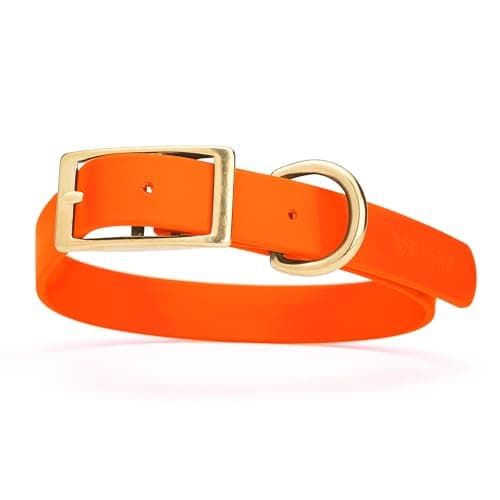
Biothane is polyester webbing with a TPU or PVC coating. That is the manufacturer’s own description. The polyester core carries all the strength — BioThane says so explicitly: “the tensile strength comes from the polyester webbing inside.” The coating is a sealed jacket.
What the jacket buys you is real and worth paying for:
- Waterproof — it does not absorb, so it does not get heavy or rot
- Stinkproof — BioThane’s FAQ says so in one word, and it is the honest reason people switch
- Wipes clean; disinfects with a 10% bleach solution
- Stays flexible in the cold, where a wet nylon strap freezes stiff
Published strength for the animal-gear grade (Beta 520 PET): 1,000 lb break strength in the standard 1 in profile. With a 200 lb buckle pull strength on the same spec sheet — which brings us to the point of this whole guide.
The hardware is the collar
Every number above describes a strap. Straps do not fail. Buckles and rings fail.
BioThane’s own spec sheet is the cleanest proof available: a strap rated to 1,000 lb, fastened by a buckle rated to 200 lb. Whatever the material, the collar is only as strong as the weakest metal part on it — and that is the spec almost nobody publishes.
What to look for, in order:
- Stainless steel — will not rust, will not plate off. The best answer.
- Solid cast metal — heavier than stamped, no seam to open under load.
- Welded rings, not split rings. A split ring is a wound spring; it can be opened by a hard sideways load. A welded ring cannot.
- Plated zinc — fine until the plating wears and the zinc corrodes.
- Acetal / plastic — cheap and light. Cracks in the cold.
Here is the frustrating part, and we are going to be straight about it: almost no manufacturer publishes ring type or buckle material. Not Ruffwear, not Blue-9, not 2 Hounds. Ruffwear at least names an alloy (6061-T6 aluminum V-ring), which is more than anyone else offers. Everyone else leaves you to inspect it yourself in the shop.
Which to pick, in one paragraph
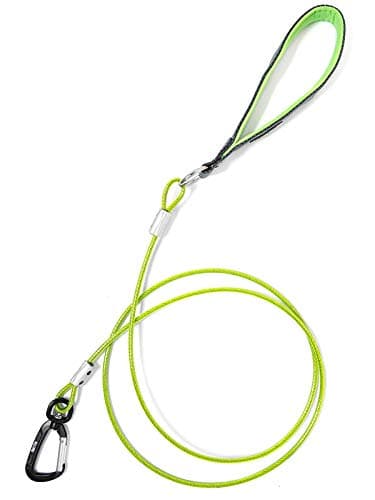
Swims, mud, snow, hunting, anything wet: biothane. One collar for the dog’s whole life, on a dog that stays reasonably dry: full-grain leather, from a maker who names the grade. Small dog, dry conditions, mostly a place to hang a tag: nylon is fine and there is no shame in it. A dog that eats leashes: steel cable, and see our heavy-duty leash roundup.
Once you have settled on a material, the specific picks are in our roundup of the most durable dog collars — where the biothane, leather and nylon options are scored side by side. If you are torn between the two premium materials, our biothane vs leather comparison settles it in a paragraph.
Material is one of two dimensions people shop on; width is the other. Width is also the one dimension this category reliably publishes, which makes it look more informative than it is: on the collars we have assessed, a stated width sits alongside a completely unpublished load rating every single time. What width does and does not fix is set out on are wide dog collars better.
Frequently asked questions
What is the most durable material for a dog collar?
It depends on conditions. Biothane — polyester webbing with a TPU or PVC coating — is the most durable in wet, muddy conditions: it is waterproof, stinkproof, wipes clean and stays flexible in cold. Full-grain leather is the most durable over years of dry wear and improves with age. Nylon is the cheapest and least durable because it absorbs water and odor.
What does denier mean on dog gear?
Denier is a measure of yarn mass — grams per 9,000 meters, under the ASTM D1907 standard. Higher denier means a heavier yarn. Crucially, it only compares like with like: 1000D polypropylene is not stronger than 500D nylon. It is a thickness measure, not a strength rating, and no manufacturer publishes abrasion or tear figures alongside it.
Is genuine leather good quality?
No. 'Genuine leather' is not a quality grade — it only certifies that the item is really leather. It carries no information about which layer of the hide was used, and leather split from the weaker lower layer can be sold under that label. Look for 'full grain', which names both the layer and the fact that the surface is uncorrected.
What is the difference between full grain and top grain leather?
Full grain is a type of top grain, not its opposite. 'Top grain' means the leather comes from the upper layer of the hide. 'Full grain' means that upper layer with its natural surface left uncorrected — not sanded or buffed. Corrected grain is the same layer with the surface polished to hide flaws. Full grain is the most durable because the strongest fibers sit right at the uncorrected surface.
Are welded rings better than split rings on a collar?
Yes. A split ring is essentially a wound spring, and a hard sideways load can force it open. A welded ring is a closed loop of metal and cannot open. The problem is that almost no manufacturer publishes which type they use — you generally have to inspect the collar yourself.
Sources
Every spec on this page traces to one of these. Where a manufacturer does not publish a figure, we say “not published” rather than estimating it.
- Denier explained — ASTM D1907 skein method (grams per 9,000 meters)
- Cordura — Classic fabric yarn sizes (330D / 500D / 700D / 1000D)
- Leather grades — full grain, top grain, corrected grain, splits
- BioThane — Beta 520 PET material spec (break strength, buckle pull strength)
- BioThane — what the material actually is (polyester core, TPU/PVC coating)
- Ruffwear — warranty terms (chewing excluded, no duration stated)