The Best Dog Bowls for Flat-Faced Breeds
Every slow feeder in this category is designed around a dog with a muzzle. For a Frenchie, a bulldog or a pug, the bowl's depth is the specification that decides whether the dog can eat out of it at all.
The verdict
Buy the Company of Animals Green Slow Feeder. It is the right answer for a short-muzzled dog for one structural reason: the food sits on a flat, open surface between upright bladesrather than down inside a molded maze, so a dog with no muzzle can reach every piece without pushing its face into a channel. It is also harder to defeat than a maze — there is no continuous groove for a tongue to sweep — it works with wet food, which most mazes do not, and the open structure is far easier to wash. If the dog does not gulp and you simply want a good bowl, buy the OurPets Durapet: wide, shallow, stainless, with a bonded rubber ring that stops it traveling across a tiled floor. The YETI Boomer 4 at 32 oz is the premium version of the same shape. The JASGOOD is the cheap experiment, and its removable insert is a genuine advantage here: if the maze turns out to be too deep for your dog, you still have a usable outer bowl. And the thing nobody will tell you: the bloat research that drives the whole raised-bowl debate was about large, deep-chested breeds. It does not transfer to these dogs.
Quick picks
The short answer, ranked and scored against our published durability rubric. Where a manufacturer does not publish a spec, we say so rather than estimating it.
| # | Photo | Product | What the maker publishes | Durability | Price |
|---|---|---|---|---|---|
| 1 | 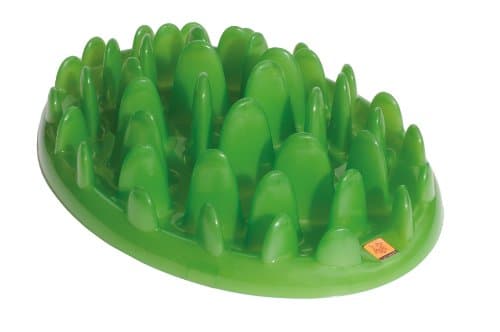 | Company of Animals Green Slow FeederThe grass-blade design that a bulldozer cannot simply push through |
| 55/100 | $32.50 · Amazon |
| 2 | 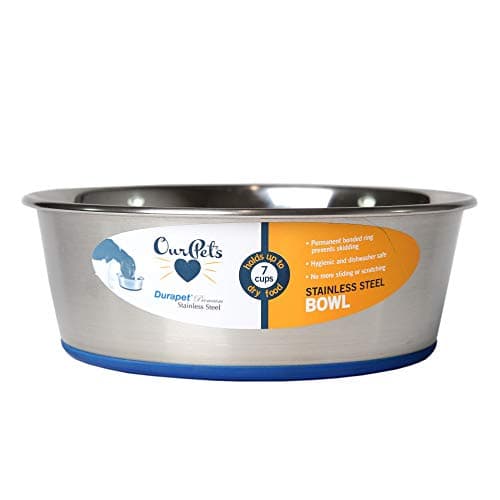 | OurPets Durapet Stainless Steel BowlThe sensible stainless bowl at a tenth of the price |
| 71/100 | $17.99 · Amazon |
| 3 | 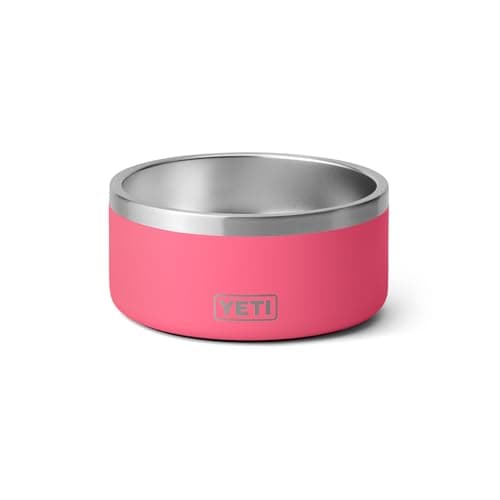 | YETI Boomer 4 Dog BowlThe same bowl for a smaller dog |
| 85/100 | $40.00 · Amazon |
| 4 | 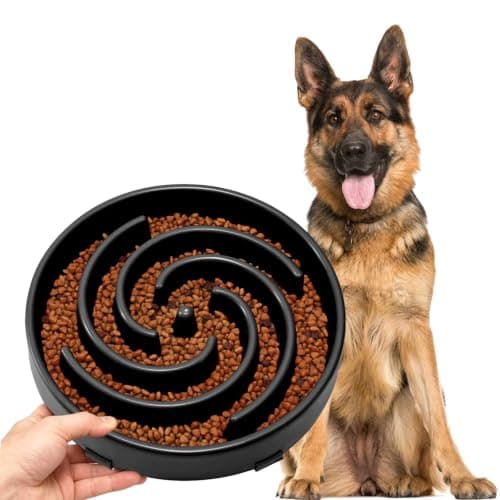 | JASGOOD Slow Feeder BowlThe cheapest way to find out whether a slow feeder helps your dog |
| 41/100 | $16.99 · Amazon |
Tap any row to jump to the full review. Specs are the manufacturer's own published figures; where a maker does not publish one we say "not published" rather than estimating it. Prices are pulled live from Amazon as of October 18, 2026; where we have no verified live price we show none rather than a stale number. #ad — how our links work.
The specification is depth, and nobody lists it
A French bulldog, an English bulldog, a pug, a Boston terrier and a Shih Tzu share one mechanical problem at dinner: there is almost no muzzle in front of the mouth. A dog with a normal muzzle eats out of a deep bowl by putting the front of its face into the bowl and leaving its eyes and nose clear. A flat-faced dog cannot. The mouth is essentially at the front plane of the face, so anything the dog has to reach down into presses on the whole face at once.
That turns the usual slow-feeder logic inside out. The industry competes on maze complexity — deeper channels, tighter spirals, harder patterns — because for a normal dog complexity is what slows eating down. For a flat-faced dog, complexity past a certain depth is not a challenge, it is a wall. The dog either works the top layer and abandons the rest, or it gets frustrated and starts shoving the bowl.
So the specification that matters is how far down the food is. And it is not published by anybody. No maker in this category states a channel depth. What you can establish from published information is the structure: whether the food sits in a molded recess or on an open surface. That is the whole basis for ranking this page.
Open surface versus molded maze
| Bowl | Where the food sits | Reach required |
|---|---|---|
| Green Slow Feeder | On a flat surface, between upright blades | Surface level — the dog picks between blades |
| OurPets Durapet | In a wide, shallow stainless bowl | Shallow |
| YETI Boomer 4 | In a 32 oz stainless bowl | Shallow for its capacity |
| JASGOOD | In a maze insert — removable | Into the channels, or none with the insert out |
| Molded maze bowls generally | Down inside molded channels | Into the bowl — the problem |
The full slow-feeder roundup ranks the whole field on mechanism and cleanability for a general dog, and the Outward Hound Fun Feeder wins there on pattern range and price. We have not carried it onto this page, because pattern range is exactly the wrong thing to optimize for a dog that cannot get into the pattern.
The raised-bowl question, answered honestly for these dogs
Search “raised dog bowl for a French bulldog” and you will find the elevated feeder industry answering a question that was asked about a different kind of dog.
The reason raised bowls are controversial at all is bloat — gastric dilatation and volvulus — and the research that made it controversial studied large and giant breeds with deep chests. We go through that evidence properly on should you use a raised dog bowl, and the conclusion there is specific to that population. It is not a conclusion about a 22 lb dog with a short, broad chest, and we are not going to pretend it transfers. Nobody has published equivalent data for this group.
What that leaves is the ordinary ergonomic case, which is small and real: a raised bowl means the dog is not craning its neck down, and for a dog with a short neck and a wide chest that can genuinely be more comfortable. A few inches is enough. It is a comfort adjustment, not a medical intervention, and anyone selling it to you as the latter on this breed group is getting ahead of the evidence. If you want one, our elevated feeder roundup ranks the field, and note that the stainless bowls those stands take are sold separately — the Durapet and the Boomer 4 are both candidates.
Air, and why gulping matters more here
The second half of the flat-faced bowl problem is breathing. These are dogs with crowded upper airways — that is what the shortened face means structurally — and a dog that is working hard to breathe while eating fast takes in air with the food. That is the case for slowing the meal down. It is also the case against a bowl the dog has to fight.
The two goals pull in opposite directions, and the way to satisfy both is a slow feeder with a shallow mechanism: the food is spread out and takes time to collect, but it is never out of reach. The upright-blade design does exactly that. A deep maze satisfies the first goal by failing the second.
The other half of the fix is not a product. Smaller meals more often, and water available separately rather than drunk down in one go after food, do more than any bowl. If your dog makes respiratory noise while eating, that is a conversation with a vet, not a shopping decision — no bowl on this page is a treatment for an airway.
Cleaning, which is why people abandon slow feeders
One practical thing decides whether a slow feeder is still in use in six months: whether you can clean it. A deep molded maze has enormous surface area, and wet food dries into it like grout. The documented pattern is that owners buy one, use it, find it a nuisance to wash and go back to a bowl.
An open-blade design is a flat object with fins on it. Both the Green Slow Feeder and the Outward Hound are stated dishwasher safe by their makers (top rack for the Fun Feeder), but the open structure is the one you will actually rinse under a tap in thirty seconds. Over a year that difference matters more than the mechanism does.
And stainless simply wins on surface. A hard, smooth, non-porous bowl that goes through a dishwasher is effectively a permanent object — the full argument is on best stainless steel dog bowls, along with the one real wear point: the bonded rubber ring on the base, which can separate after years of dishwasher heat.
The picks, ranked
1. Company of Animals Green Slow Feeder
Durability score 55/100Best for: The grass-blade design that a bulldozer cannot simply push through
The better mechanism, and the easier one to clean. Buy this one if your dog has already learned to defeat a maze bowl.
- Design
- Upright plastic 'grass blades' rather than a molded maze
- Material
- Food-safe plastic
- Care
- Dishwasher safe
- Published slow-down figure
- Not published as an independently verified figure
Pros
- The vertical-blade design is genuinely harder to defeat than a maze — a dog cannot get its tongue under the whole meal at once
- Flat, open structure is far easier to clean than a deep maze
- Works with wet food as well as kibble, which most mazes do not
Cons
- Larger footprint on the floor than a bowl-shaped feeder
- Blades are individually snappable by a chewer
- Higher price than the maze bowls
How we assessed it: on published materials, hardware specs and construction — not long-term chew-tested. We say so because it is true, and because a claim we cannot back is worth nothing to you.
#ad Price as of October 18, 2026; Amazon prices change often, so check before you buy. How our links work.
2. OurPets Durapet Stainless Steel Bowl
Durability score 71/100Best for: The sensible stainless bowl at a tenth of the price
The value answer, and honestly the one most people should buy. The premium bowls are better specified, not meaningfully better bowls.
- Material
- Stainless steel; alloy not published
- Base
- Bonded rubber non-slip ring
- Care
- Dishwasher safe
- Capacity
- Multiple sizes; per the live listing
Pros
- Does everything a stainless bowl needs to do at a fraction of the price of the premium options
- The bonded rubber ring genuinely stops the bowl traveling across a tiled floor
- Dishwasher safe and effectively indestructible
Cons
- The alloy is not published, only 'stainless steel', which covers a wide range of grades
- The bonded rubber ring can separate over years of dishwasher heat — the one wear point on an otherwise permanent object
How we assessed it: on published materials, hardware specs and construction — not long-term chew-tested. We say so because it is true, and because a claim we cannot back is worth nothing to you.
#ad Price as of October 18, 2026; Amazon prices change often, so check before you buy. How our links work.
3. YETI Boomer 4 Dog Bowl
Durability score 85/100Best for: The same bowl for a smaller dog
The small-dog version. Same argument, same premium, less capacity.
- Material
- Stainless steel, per YETI
- Capacity
- 32 oz (4 cups)
- Base
- Non-slip ring
- Care
- Dishwasher safe
Pros
- The right capacity for a small or medium dog, where the 8-cup bowl is simply a large object in the kitchen
- Same non-slip molded base and same material story
Cons
- Same premium pricing, on less bowl
- Too small for a large dog's water, which usually wants the larger size
How we assessed it: on published materials, hardware specs and construction — not long-term chew-tested. We say so because it is true, and because a claim we cannot back is worth nothing to you.
#ad Price as of October 18, 2026; Amazon prices change often, so check before you buy. How our links work.
4. JASGOOD Slow Feeder Bowl
Durability score 41/100Best for: The cheapest way to find out whether a slow feeder helps your dog
A low-risk experiment. If it works, buy a better one; if it does not, you have lost very little.
- Design
- Maze insert, some configurations with a stainless outer bowl
- Material
- Plastic insert; stainless outer on some configurations
- Care
- Dishwasher safe
- Published slow-down figure
- Not published
Pros
- A removable insert means the outer bowl can be used normally, which is genuinely useful if the slow feeder does not suit the dog
- Cheapest option here by a wide margin
Cons
- No published material or performance detail
- Removable inserts are one more thing for a bored dog to remove and chew
- Build quality is visibly below the branded options
How we assessed it: on published materials, hardware specs and construction — not long-term chew-tested. We say so because it is true, and because a claim we cannot back is worth nothing to you.
#ad Price as of October 18, 2026; Amazon prices change often, so check before you buy. How our links work.
How to choose, in order
- If the dog gulps: shallow slow feeder with an open structure. Not a deep maze.
- If the dog eats normally: a wide, shallow stainless bowl with a non-slip base. Nothing cleverer is required.
- If you are not sure: buy the one with the removable insert, so you end up with a usable bowl either way.
- Raise it a few inches if the dog has a short neck— as a comfort adjustment. Do not buy a raised feeder on the strength of bloat research that studied a different kind of dog.
On the figures we have not quoted
No maker in the slow-feeder category publishes an independently verified slow-down figure, and nobody publishes a channel depth. Both absences are stated on every product entry above rather than filled in with an estimate. Our scores are editorial judgments against the published durability rubric, not an aggregate of user ratings.
Frequently asked questions
What kind of bowl is best for a French bulldog?
A wide, shallow one. A flat-faced dog has almost no muzzle in front of its mouth, so anything it has to reach down into presses on the whole face at once. If the dog gulps, use a slow feeder with an open structure — upright blades on a flat surface, where the food is spread out but never out of reach — rather than a deep molded maze. If the dog eats at a normal pace, a shallow stainless bowl with a non-slip base is all that is needed.
Should a French bulldog have a raised bowl?
Only as a comfort adjustment, and only a few inches. The reason raised bowls are debated at all is bloat, and the research behind that debate studied large and giant breeds with deep chests. No equivalent data has been published for small brachycephalic dogs, so the finding does not transfer and we will not pretend it does. For a dog with a short neck and a broad chest, slightly raising the bowl can be more comfortable. That is the honest extent of the claim.
Do slow feeder bowls work for bulldogs?
The shallow ones do. The goal with a flat-faced dog is to spread the meal out so it takes longer to collect, without putting the food somewhere the dog physically cannot reach. An upright-blade feeder achieves that; a deep maze usually does not — the dog works the top layer and gives up, or starts shoving the bowl around. If you are unsure, a feeder with a removable maze insert lets you take the mechanism out and still have a usable bowl.
Why does my flat-faced dog gulp air when it eats?
Because these breeds have crowded upper airways as a structural consequence of the shortened face, and a dog that is working to breathe while eating quickly takes air in with the food. Slowing the meal down with a shallow feeder helps, and so do smaller meals more often. But if your dog makes respiratory noise while eating, that is a veterinary conversation rather than a shopping decision — no bowl is a treatment for an airway.
Sources
Every spec on this page traces to one of these. Where a manufacturer does not publish a figure, we say “not published” rather than estimating it.
- Company of Animals — maker site for the Green Slow Feeder (upright blade design, dishwasher safe)
- OurPets — maker site for the Durapet stainless bowl, including the bonded rubber non-slip base
- YETI — Boomer bowl product information: stainless steel construction, 32 oz capacity on the Boomer 4, non-slip ring, dishwasher safe
- Outward Hound — maker site for the Fun Feeder Slo Bowl, including the maze patterns and the non-slip base