The Best Dog Gear for Huskies
A Siberian husky is a dog bred to leave, to run, and to be warm doing it. Almost every gear mistake owners make with the breed comes from one of those three facts.
The verdict
Four pieces, one for each thing this breed does. For the collar, the Ruffwear Chain Reaction: a limited-slip collar with a metal chain control loop and an aluminum V-ring, because a double coat compresses and a flat collar fitted over fur is loose over skin. For walking, the Ruffwear Flagline, on the strength of six independent adjustment points— adjustment, not webbing strength, is what stops a dog reversing out. For containment, the ProSelect Empire, the one crate in this registry that publishes an actual steel gauge (20-gauge with 1/2 in reinforcing tubes) and has dual door latches rather than a single slide bolt. For heat, the Ruffwear Swamp Cooler, the only cooling vest whose maker publishes all three fabric layers and a UPF 50+ figure. And the thing that is not a product: do not shave the coat. The undercoat is insulation in both directions.
Three problems, not one
Gear advice for this breed is usually written as a shopping list. It is more useful as three questions, because a husky creates three distinct equipment problems and they have almost nothing to do with each other.
- It leaves.This is a breed with genuine escape drive, and it escapes laterally — out of collars, out of harnesses, out of crates — rather than through things.
- It insulates. A dense double coat changes how everything fits and how the dog sheds heat.
- It does not stop. Sustained work at pace is what the breed was selected for, which changes what you need on a hot day and what you need on a long line.
The coat problem, which no size chart accounts for
Here is the fitting failure specific to this breed, and it is the reason a correctly-measured collar still comes off.
A double coat has a dense undercoat under a coarser guard coat. Measure the neck over that coat and you measure the fur. Fit a flat collar to that measurement and it feels snug. Then the dog braces, drops its chin and reverses: the coat compresses under the strap, the effective circumference drops by a real margin, and the collar slides over the ears. Nothing failed. The collar was never actually fitted to the dog — it was fitted to the coat.
There are two honest fixes. Fit to the skin, which means pressing the strap down through the coat until you can feel the neck and setting two fingers of slack there — uncomfortably tight-looking, correct. Or remove the failure mode entirely with a limited-slip collar, which tightens to a stop when the dog reverses and no further. That is what the Chain Reaction is, and the reason it is the collar pick. Its control section is a metal chain rather than fabric, and its leash ring is an anodized aluminum V-ring.
One hard caveat on every limited-slip collar, including this one: it must never be left on an unsupervised or crated dog. The loop is a snag hazard. We set out the full case, including where the answer is simply no, on is a martingale collar safe for a puppy, and we rank the field on best martingale collars.
Escape is an adjustment problem, not a strength problem
The instinct when a dog gets out of a harness is to buy a stronger harness. It is the wrong instinct. A dog that reverses out is not breaking anything — it is finding slack and walking backwards through it. What stops that is geometry, and geometry is set by adjustment points.
The Flagline publishes six of them, the most of anything we have scored, and it specifies its front leash connection down to the fiber composition (87.5% UHMWPE, 12.5% nylon) which almost nobody in the category does. What Ruffwear does notpublish, for this or any harness, is a load rating — and its warranty excludes chewing damage outright. Both are worth knowing on a breed that is hard on gear.
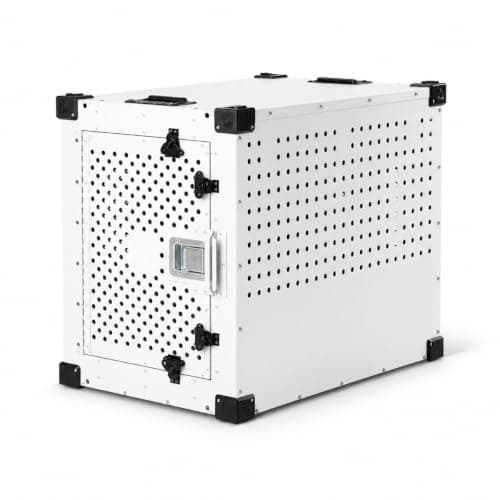
The same logic applies to the crate. A husky does not usually destroy a crate; it works the latch. That is why the crate pick is the one with dual door latchesand a published steel gauge rather than the heaviest thing available: a single slide bolt is the easiest closure in the category for a clever dog to defeat. The honest caveat on that pick is its warranty, which runs one year and explicitly excludes breakage or damage caused by the dog — on a crate sold for dogs that try to get out. We have the full version of that argument on escape-proof crates and the practical fixes on how to make a dog crate escape-proof.
Heat, and the one thing not to do
A double coat insulates in both directions. It keeps cold out and it keeps the dog’s own heat from radiating away, which is why a husky in a warm climate is a genuine heat-risk dog despite looking like it is built for the opposite.
The thing not to do is shave it. Removing the undercoat removes the air layer that moderates temperature in both directions and exposes skin that has never seen sun. The thing to do, if the dog works or walks in heat, is an evaporative cooling vest — with a clear-eyed understanding of the physics. Evaporative cooling depends on the vapor-pressure gradient between wet fabric and air, so it works well in dry heat and poorly in humidity, which is exactly when heat is most dangerous. That is not a defect in any product; it is how evaporation works, and we spell it out on are dog cooling vests worth it.
The Swamp Cooler is the pick because it is the only vest in the category whose maker publishes the whole layer stack — polyester air mesh outer, polyester felt reservoir, dry-weave lining — plus named ITW Nexus Waveloc buckles and a published UPF 50+ rating. No maker anywhere publishes how many degrees a vest removes from a dog, and we are not going to supply a figure that does not exist.
Running gear
If you are going to use the breed for what it was built for, two existing pages do the work better than a paragraph here can. For pulling work — canicross, bikejoring, scootering — the harness shape is completely different from a walking harness, and our pulling-harness roundup covers the X-back and freemotion designs that distribute load along the body. For recall work in open country, a long line is the tool, and the one rule that matters is on best dog long lines: a long line is handled gear, not an unattended tether.
Quick picks
The short answer, ranked and scored against our published durability rubric. Where a manufacturer does not publish a spec, we say so rather than estimating it.
| # | Photo | Product | Durability | Price |
|---|---|---|---|---|
| 1 | 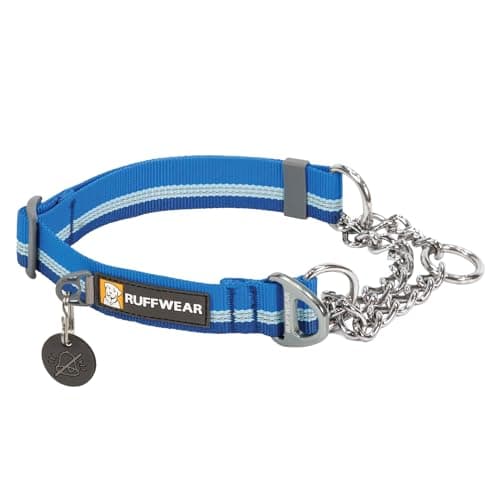 | Ruffwear Chain Reaction CollarA dog that backs out of a flat collar | 70/100 | $29.99 · Amazon |
| 2 | 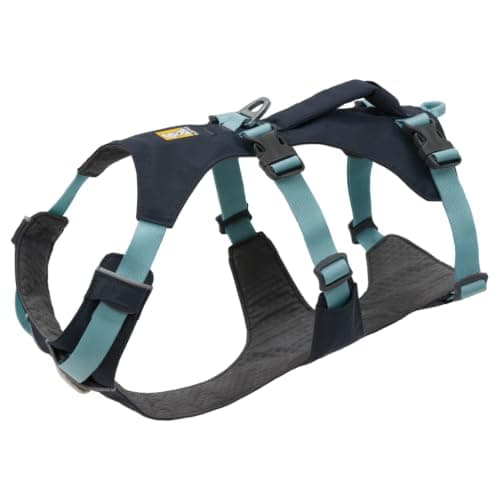 | Ruffwear Flagline HarnessSix adjustment points and a lift panel — the best-fitting escape-resistant harness | 81/100 | $69.99 · Amazon |
| 3 | 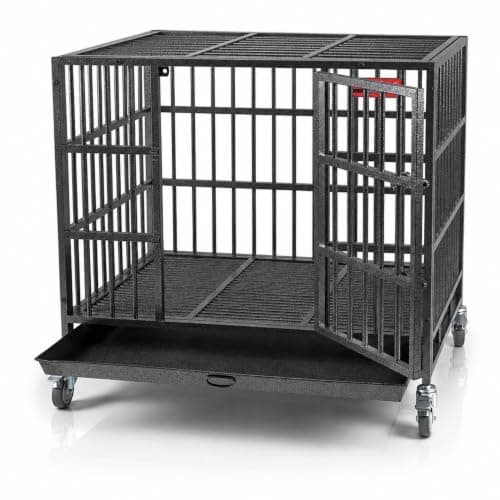 | ProSelect Empire Dog CageRaw steel strength per dollar | 73/100 | $389.85 · Amazon |
| 4 | 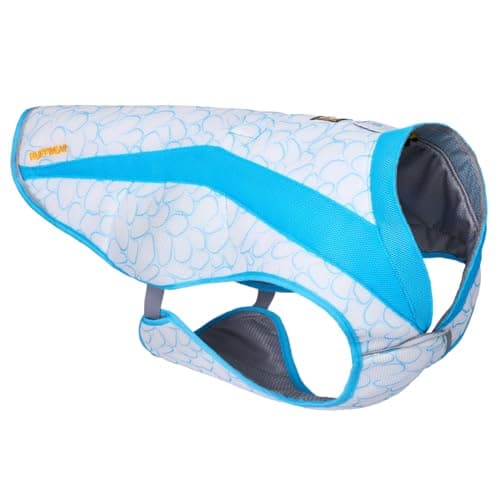 | Ruffwear Swamp Cooler VestThe only cooling vest here that publishes its whole layer stack | 79/100 | $74.99 · Amazon |
Tap any row to jump to the full review. Prices are pulled live from Amazon as of October 18, 2026; where we have no verified live price we show none rather than a stale number. #ad — how our links work.
The picks, ranked
1. Ruffwear Chain Reaction Collar
Durability score 70/100Best for: A dog that backs out of a flat collar
The right answer for a dog that slips its collar, with the standard martingale caveat: not for unsupervised wear.
- Design
- Martingale-style limited-slip with a chain control loop (Amazon listing)
- Hardware
- Metal chain loop, aluminum V-ring
- Load rating
- Not published
Pros
- The limited-slip loop tightens just enough to stop a dog reversing out of it
- Metal control loop instead of a fabric one
Cons
- A martingale must never be left on an unsupervised dog — the loop is a snag hazard
- No published load rating
How we assessed it: on published materials, hardware specs and construction — not long-term chew-tested. We say so because it is true, and because a claim we cannot back is worth nothing to you.
#ad Price as of October 18, 2026; Amazon prices change often, so check before you buy. How our links work.
2. Ruffwear Flagline Harness
Durability score 81/100Best for: Six adjustment points and a lift panel — the best-fitting escape-resistant harness
The best-fitting harness Ruffwear makes and the one we would put on an escape artist — six adjusters and a named high-strength front connection, on a deliberately light shell.
- Shell
- 150D polyester ripstop with DWR and PU coating
- Adjustment
- Six points
- Handle
- Padded, for balanced lifting
- Lift panel
- Load-dispersing chest/belly panel
- Buckles
- ITW Nexus Mach 1 side-release
- Rear leash ring
- Anodized 6061-T6 aluminum V-ring
- Front leash connection
- 87.5% UHMWPE / 12.5% nylon
- Sizes
- XXS (13–17 in) to L/XL (32–42 in) girth
- Lift load rating
- Not published
Pros
- Six independent adjustment points — the most of any harness we have scored, and adjustment is what actually stops a dog reversing out
- The front leash connection is specified to the composition: 87.5% UHMWPE, 12.5% nylon. UHMWPE is genuinely high-strength fiber and almost nobody names it
- Named ITW Nexus Mach 1 buckles and an anodized 6061-T6 aluminum V-ring
- Load-dispersing chest and belly panel means the lift handle is not just sewn to a strap
Cons
- 150D shell — half the denier of the cheaper Front Range's 300D, so this is the lighter fabric despite being the more capable harness
- No published load rating for the handle or the lift panel, on a harness sold for lifting
- Expensive
- Chewing excluded from the warranty, like everything else in Ruffwear's line
How we assessed it: on published materials, hardware specs and construction — not long-term chew-tested. We say so because it is true, and because a claim we cannot back is worth nothing to you.
#ad Price as of October 18, 2026; Amazon prices change often, so check before you buy. How our links work.
3. ProSelect Empire Dog Cage
Durability score 73/100Best for: Raw steel strength per dollar
The most steel for the money and the most honest spec sheet in the category — sold with a warranty that excludes the exact thing you are buying it for.
- Steel
- 20-gauge steel reinforced by 1/2 in diameter steel tubes
- Frame
- 3/4 in tube frame
- Latches
- Dual door latches
- Warranty
- 1 year — explicitly excludes 'breakage or damage caused by user or dog'
Pros
- It publishes an actual steel gauge — 20-gauge, with 1/2 in reinforcing tubes — which MidWest will not do
- Genuinely heavy, welded steel construction at a mid-range price
- Dual latches on the door
Cons
- The warranty is the category's central absurdity: this crate is sold 'for powerful dogs that are able to claw or chew their way out of other cages', and the warranty then excludes damage caused by the dog
- One year only
- Extremely heavy; the casters are doing real work
How we assessed it: on published materials, hardware specs and construction — not long-term chew-tested. We say so because it is true, and because a claim we cannot back is worth nothing to you.
#ad Price as of October 18, 2026; Amazon prices change often, so check before you buy. How our links work.
4. Ruffwear Swamp Cooler Vest
Durability score 79/100Best for: The only cooling vest here that publishes its whole layer stack
The best-documented cooling vest on the market — three named layers, named hardware and a published UPF figure — and still no manufacturer anywhere will tell you how many degrees it removes.
- Outer layer
- Polyester air mesh (bluesign approved)
- Middle layer
- Polyester felt — the water reservoir
- Lining
- Dry-weave polyester mesh (bluesign approved)
- Buckles
- ITW Nexus Waveloc side-release
- Zipper
- YKK Vislon
- Sun protection
- UPF 50+
- Sizes
- XXS–XL, 13–42 in girth
- Cooling performance figure
- Not published
Pros
- Publishes all three fabric layers by name — outer air mesh, polyester felt reservoir, dry-weave lining — which no other vest here does
- Named hardware: ITW Nexus Waveloc buckles and a YKK Vislon zipper, not unspecified plastic
- Light-colored shell with a published UPF 50+ rating, so it is reflecting solar load as well as evaporating
- Highest coverage in Ruffwear's cooling range, and the six-size run goes from 13 in to 42 in girth
Cons
- Ruffwear publishes no weight for it, and no figure at all for how much it actually cools a dog
- Like every evaporative vest, it loses most of its effect in high humidity — that is physics, not a defect, but nobody says it on the packaging
- Needs re-soaking whenever it dries out, with no signal that it has
- The most expensive vest in this roundup by a clear margin
How we assessed it: on published materials, hardware specs and construction — not long-term chew-tested. We say so because it is true, and because a claim we cannot back is worth nothing to you.
#ad Price as of October 18, 2026; Amazon prices change often, so check before you buy. How our links work.
Cold, and the one thing people over-buy
A husky does not need a coat. It needs the coat it already has, dry and unmatted. What it may need, in a city with salted sidewalks, is paw protection — and the honest version of that argument is on are dog boots worth it, which concludes that for salt and de-icer the cheaper answer is usually wax rather than boots. If you do want to compare the vests properly rather than taking our single pick, the cooling vest roundup scores the field on published layer specification and names the figure none of them publish.
The short version
- Collar: limited-slip, fitted to the skin and not to the coat. Off the dog when the dog is unsupervised or crated.
- Harness: buy adjustment points, not webbing strength. Six beats four.
- Crate:dual latches beat a single slide bolt, and a published steel gauge beats the phrase “heavy duty.” Read the warranty exclusions before you assume coverage.
- Heat: evaporative vest for dry heat, shade and timing for humidity, and do not shave the coat.
Frequently asked questions
Why does my husky slip out of its collar?
Almost always because the collar was fitted to the coat rather than to the neck. A dense double coat compresses under a strap, so a collar that felt snug over fur is loose over skin the moment the dog braces and reverses. Fix it either by pressing the strap down through the coat and setting two fingers of slack against the actual neck, or by using a limited-slip collar that tightens to a stop when the dog backs up. A limited-slip collar must never be left on an unsupervised or crated dog.
Do huskies need cooling vests?
They can benefit from one in dry heat, and a vest is close to useless in humidity — evaporative cooling depends on the vapor-pressure gradient between the wet fabric and the air, and in humid conditions that gradient largely disappears. No manufacturer publishes a figure for how much a vest cools an actual dog. The more important point is what not to do: do not shave the coat. The undercoat moderates temperature in both directions and shaving exposes skin that has never seen sun.
What kind of crate does a husky need?
One with dual door latches rather than a single slide bolt, because a husky works the closure rather than destroying the panels. Prefer a crate that publishes an actual steel gauge over one that says 'heavy duty' or 'professional-gauge' and then declines to give a number. Read the warranty before you rely on it: the heavy-duty crate category routinely excludes damage caused by the dog, which is the exact thing you are buying the crate for.
What harness is best for a husky that escapes?
The one with the most independent adjustment points, not the one with the strongest webbing. A dog that reverses out of a harness is finding slack and walking backwards through it, not breaking anything. The Ruffwear Flagline publishes six adjustment points, the most of any harness we have scored. Note that Ruffwear publishes no load rating for it and its warranty excludes chewing damage.
Sources
Every spec on this page traces to one of these. Where a manufacturer does not publish a figure, we say “not published” rather than estimating it.
- Ruffwear — Flagline product page: six points of adjustment, load-dispersing lift panel, 150D polyester ripstop shell, and the 87.5% UHMWPE / 12.5% nylon front leash connection
- Ruffwear — Swamp Cooler product page: the three named layers (polyester air mesh outer, polyester felt reservoir, dry-weave lining), ITW Nexus Waveloc buckles, YKK Vislon zipper and the UPF 50+ rating
- ProSelect / Boss Pet — Empire cage product page: 20-gauge steel with 1/2 in reinforcing tubes, 3/4 in tube frame, dual latches, and the 1-year warranty that excludes damage caused by the dog
- Ruffwear — warranty terms: defects in materials and craftsmanship; chewing, normal wear and alterations excluded