Are Dog Boots Worth It?
For most dogs, most of the time, no. For four specific situations they are the best money in this hub — and one of the four is not the one people buy them for.
The short answer. Worth it for sharp terrain, winter ice and de-icing salt, and protecting a healing paw. Not worth it for a dog that walks on grass and sidewalks in mild weather — a healthy dog’s pads are a working surface, and for most dogs they are enough.
And the one everybody gets wrong: boots are not the answer to hot pavement.
Why boots are the wrong fix for a hot sidewalk
This is the most common reason people search for dog boots, and it is the case where the product is the weakest answer available.
The five-second test is the standard here and it is a good one: press the back of your hand to the surface, and if you cannot hold it there for five seconds it is too hot for a dog’s pads. Asphalt in direct sun gets far hotter than air temperature — Washington State University’s figures on surface heat are the usual reference — and it stays hot long after the sun is off it.
Now think about what boots do in that situation. They insulate the pad from the surface, which helps the pad. They also enclose the paw, and a dog’s paws are one of the few places it sheds heat. On a hot day you have insulated the radiator on an animal that is already struggling to lose heat, and the ground being that hot means the air is hot too.
The correct answers to hot pavement are free: walk early or late, walk on grass, shorten the walk. Boots are a distant fourth and they carry a real thermal cost. We say the same thing in dog boots vs paw wax, where wax is also not the answer — it is a barrier against salt and abrasion, not against heat.
The four cases where they earn their money
Sharp terrain. Scree, lava rock, shale, sharp shell, glacial moraine. Pads cut, and a cut pad two miles from the trailhead is the injury that ends the trip and possibly requires you to carry the dog. This is the strongest case for boots and the one the good ones are designed for.
Ice and de-icing salt. Two separate problems in one season. Ice balls form between the toes of long-coated dogs and are genuinely painful; road salt and chemical de-icers irritate and crack pads, and dogs then lick them off. A boot solves both at once, which nothing else does.
Protecting an injured or healing paw. Keeping a dressing dry and clean on a foot, or protecting a healing cut from grit. Straightforward, effective, temporary.
Traction indoors for an old dog. The one nobody mentions. A senior dog with weak hind legs slipping on hardwood or tile is a real and worsening problem, and rubber-soled boots give it grip. Indoors they are the blunt instrument, though — toe grips, non-slip socks and pad wax are built for that specific job, and Grey & Gentle compares them in its guide to traction gear for senior dogs. If mobility is the wider issue, see lifting and support harnesses and beds for senior dogs.
If you buy them, the outsole is the spec
A dog boot is a shoe, and the same thing matters: the sole. It determines grip on wet rock, puncture resistance and how long the boot lasts.
Almost nobody names theirs. Ruffwear specifies a Vibram outsole on the Grip Trex — a real, checkable, third-party specification — and a winter-specific Vibram compound and tread on the Polar Trex. Kurgo says “rubber” without a compound. Ultra Paws says “non-slip sole” without one. On a rubric that weights materials at 25%, that gap is the ranking.
The other thing to look at is the upper. A breathable mesh upper is right for warm-weather rock; an insulated upper with a taller gaiter is right for snow. They are different products and a dog that works in both seasons wants both.
Quick picks
The short answer, ranked and scored against our published durability rubric. Where a manufacturer does not publish a spec, we say so rather than estimating it.
| # | Photo | Product | Durability | Price |
|---|---|---|---|---|
| 1 | 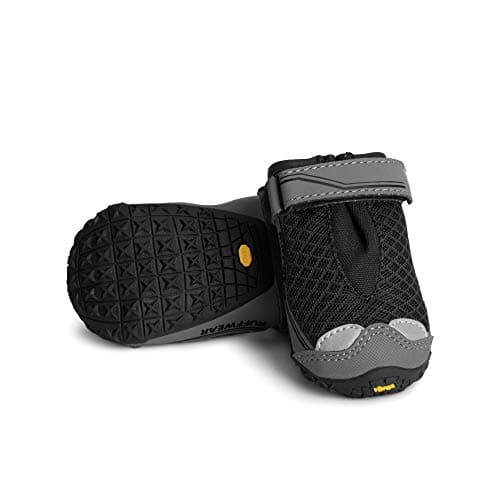 | Ruffwear Grip Trex BootsSharp rock and scree — the only boot here with a named outsole | 80/100 | $49.99 · Amazon |
| 2 | 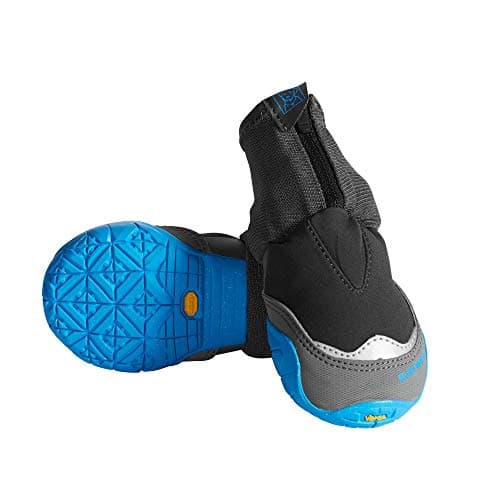 | Ruffwear Polar Trex BootsWinter — insulation and a taller gaiter over the same sole philosophy | 73/100 | $46.74 · Amazon |
| 3 | 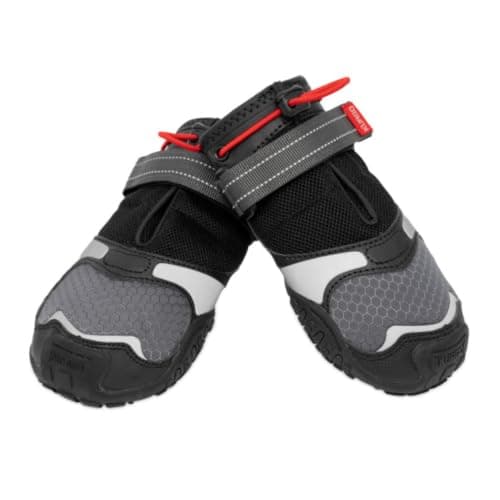 | Kurgo Blaze Cross Dog ShoesA mid-price boot with a lifetime defect warranty behind it | 67/100 | $37.49 · Amazon |
| 4 | 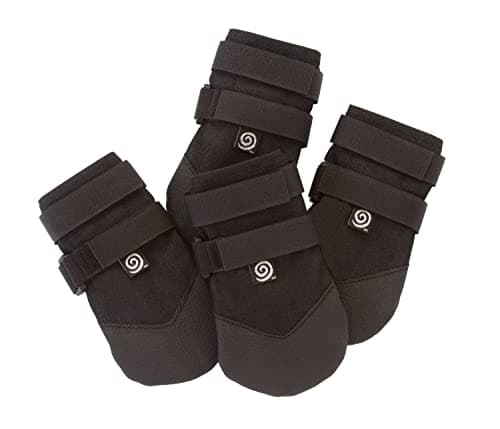 | Ultra Paws Durable Dog BootsA wide-opening boot for a dog that fights having its foot enclosed | 53/100 | $27.50 · Amazon |
Tap any row to jump to the full review. Prices are pulled live from Amazon as of October 18, 2026; where we have no verified live price we show none rather than a stale number. #ad — how our links work.
The picks, ranked
1. Ruffwear Grip Trex Boots
Durability score 80/100Best for: Sharp rock and scree — the only boot here with a named outsole
The reference boot for sharp ground, and the only one here whose sole is a specification rather than a description.
- Outsole
- Non-marking Vibram, lug pattern
- Upper
- 100% polyester tightly woven air mesh
- Closure
- YKK hydrophobic hook-and-loop cinch with hardware
- Sizing
- Eight widths, 1.50–3.25 in in 0.25 in steps
- How to measure
- Across the widest part of the paw when bearing weight
- Sold as
- Sets of two
- Weight
- Not published
Pros
- A named Vibram outsole — the only boot in this roundup where the rubber has an identity rather than an adjective
- Eight sizes in quarter-inch steps, which is the level of granularity boot fit actually requires
- Ruffwear publishes the correct measuring method: across the widest part of the paw, bearing weight
- YKK hydrophobic hook-and-loop, specified to maintain holding power when wet — the usual reason boots come off
Cons
- Sold in sets of two, so a full set of four is two purchases and most dogs need two different sizes
- No published weight
- Ruffwear's standard warranty excludes chewing, which is exactly how boots most often die
- Air mesh upper is built for breathability, not for warmth — this is a summer and rock boot, not a winter one
How we assessed it: on published materials, hardware specs and construction — not long-term chew-tested. We say so because it is true, and because a claim we cannot back is worth nothing to you.
#ad Price as of October 18, 2026; Amazon prices change often, so check before you buy. How our links work.
2. Ruffwear Polar Trex Boots
Durability score 73/100Best for: Winter — insulation and a taller gaiter over the same sole philosophy
The right Ruffwear if the hazard is snow and cold rather than rock — but note that no dog boot on the market carries a published temperature rating.
- Outsole
- Vibram, winter-specific compound and tread
- Upper
- Insulated, with an extended gaiter
- Closure
- Hook-and-loop cinch
- Sold as
- Sets of two
- Weight
- Not published
- Temperature rating
- Not published
Pros
- A winter-specific Vibram compound rather than the same rubber in a warmer upper
- The extended gaiter is the feature that actually keeps snow out and the boot on
- Insulated, which the Grip Trex is deliberately not
Cons
- Ruffwear publishes no temperature rating, so 'winter boot' is a category rather than a claim you can check
- Sold in twos, like the Grip Trex
- Considerably warmer than most dogs need for ordinary winter pavement walking — this is a snow-country boot
How we assessed it: on published materials, hardware specs and construction — not long-term chew-tested. We say so because it is true, and because a claim we cannot back is worth nothing to you.
#ad Price as of October 18, 2026; Amazon prices change often, so check before you buy. How our links work.
3. Kurgo Blaze Cross Dog Shoes
Durability score 67/100Best for: A mid-price boot with a lifetime defect warranty behind it
The sensible mid-price choice, with the caveat that the part doing the work — the sole compound — is the part Kurgo will not name.
- Outsole
- Rubber; compound not published
- Upper
- Not published in detail
- Closure
- Hook-and-loop strap
- Warranty
- Kurgo lifetime warranty on manufacturing defects
- Warranty exclusions
- Wear and tear; misuse; damage from abuse or accidents
Pros
- Kurgo's lifetime defect warranty is the longest in the boot category
- Roughly a quarter less than the Ruffwear
- Sold as a set of four rather than in pairs, which is genuinely more convenient
Cons
- The rubber compound is not named, so there is no way to compare the sole to a Vibram one
- Wear and tear — which is what happens to boots — is explicitly outside the free warranty and routed to paid replacement
- Fewer size increments than the Ruffwear's quarter-inch run
How we assessed it: on published materials, hardware specs and construction — not long-term chew-tested. We say so because it is true, and because a claim we cannot back is worth nothing to you.
#ad Price as of October 18, 2026; Amazon prices change often, so check before you buy. How our links work.
4. Ultra Paws Durable Dog Boots
Durability score 53/100Best for: A wide-opening boot for a dog that fights having its foot enclosed
The easy-on boot, and a reasonable everyday winter choice — but not the boot to take onto scree.
- Outsole
- Non-slip sole; compound not published
- Upper
- Not published in detail
- Closure
- Double hook-and-loop straps
- Sold as
- Set of four
- Warranty
- Not published
Pros
- Double straps give two independent points of tension, which helps on a leg shape that defeats a single cinch
- Sold as a set of four
- A wide opening makes them among the easiest boots here to get onto an unwilling foot
Cons
- No named sole compound and no published upper material
- No published warranty
- Built for pavement, salt and everyday protection rather than for sharp rock
How we assessed it: on published materials, hardware specs and construction — not long-term chew-tested. We say so because it is true, and because a claim we cannot back is worth nothing to you.
#ad Price as of October 18, 2026; Amazon prices change often, so check before you buy. How our links work.
Sizing, which is where boots actually fail
More dog boots fail on fit than on construction, and the fix is a two-minute job most people skip.
- Measure paw width, not length. Ruffwear sizes across 1.50 to 3.25 in of paw width, and width is what determines whether the boot binds or slides.
- Measure with the paw loaded. Stand the dog on a sheet of paper and mark either side of the paw with its weight on it. A lifted paw is narrower than a standing one, which is exactly how people buy boots a size too small.
- Measure the front and the back. Front paws are usually larger. Some makers sell mixed-size sets for this reason; if yours does not, size to the front.
- The closure has to be above the dewclaw and tight enough not to rotate. A boot that spins on the paw rubs, and a boot that comes off on a trail is often not found.
Nobody tells you about the first walk
A dog wearing boots for the first time walks like a cat in socks — high-stepping, shaking a foot, freezing. That is normal and it passes, but it does not pass on the trail.
Build it at home: boots on for a minute indoors with something good happening, then two, then a walk around the garden, then a short walk. Three or four short sessions is usually enough. The failure pattern is always the same — first outing is also the first time the dog has worn them, the dog refuses to move, the boots go in a drawer.
Two things to check every time
- Between the toes, after every use. Grit trapped inside a boot is worse than grit on an open paw, because it cannot work its way out. This is the most common boot-caused injury.
- Do not leave them on longer than the job. Boots trap moisture, and a paw held damp for hours softens. They are equipment for a task, not footwear for the day.
Our verdict
If your dog walks on grass, sidewalks and normal trails in mild weather: skip the boots and put the money into a well-fitted harness and a decent leash, which every dog uses every day.
If your dog hikes sharp ground, lives somewhere with salted winter roads, is recovering from a paw injury, or is old and slipping on hard floors: boots are among the best-value items in this hub. Buy the one that names its outsole, size by loaded paw width, and spend three evenings acclimatizing the dog before the first real walk. The full rankings are in the best dog boots.
Frequently asked questions
Are dog boots worth buying?
For four situations, yes: sharp terrain such as scree or lava rock, winter ice and de-icing salt, protecting an injured or healing paw, and traction indoors for an old dog slipping on hard floors. For a dog that walks on grass and sidewalks in mild weather, no — a healthy dog's pads are a working surface and for most dogs they are enough. Put the money into a well-fitted harness instead.
Do dog boots protect against hot pavement?
Poorly, and this is the case people most often buy them for. Boots insulate the pad from the surface but they also enclose the paw, and paws are one of the few places a dog sheds heat — so on a hot day you have insulated the radiator on an animal already struggling to cool itself. Use the five-second test: if you cannot hold the back of your hand on the surface for five seconds it is too hot, and the right answers are free — walk early or late, walk on grass, shorten the walk.
What should I look for in a dog boot?
The outsole, and almost nobody names theirs. Ruffwear specifies a Vibram outsole on the Grip Trex and a winter-specific Vibram compound and tread on the Polar Trex — real, checkable, third-party specifications. Kurgo says 'rubber' without a compound; Ultra Paws says 'non-slip sole' without one. After the sole, match the upper to the season: breathable mesh for warm-weather rock, insulated with a taller gaiter for snow.
How do I size dog boots correctly?
Measure paw width rather than length, and measure with the paw loaded — stand the dog on paper and mark either side of the paw with its weight on it, because a lifted paw is narrower than a standing one and that is exactly how people buy a size too small. Front paws are usually larger than rear, so size to the front unless the maker sells mixed sets. The closure must sit above the dewclaw and be tight enough that the boot cannot rotate.
Why won't my dog walk in boots?
Because the first outing is usually also the first time the dog has worn them. High-stepping, shaking a foot and freezing are all normal and they pass — but not on a trail. Build it at home: boots on for a minute indoors with something good happening, then two minutes, then the garden, then a short walk. Three or four short sessions is generally enough.
Can dogs wear boots all day?
No. Boots trap moisture and a paw held damp for hours softens, which makes it more vulnerable rather than less. They are equipment for a task, not footwear for the day. Check between the toes after every use as well — grit trapped inside a boot is worse than grit on an open paw because it cannot work its way out, and it is the most common boot-caused injury.
Sources
Every spec on this page traces to one of these. Where a manufacturer does not publish a figure, we say “not published” rather than estimating it.
- Ruffwear — Grip Trex boot specs (Vibram outsole; 100% polyester air mesh upper; paw-width sizing 1.50–3.25 in)
- Washington State University — protect your pet’s feet from heat and burns (asphalt temperature figures)
- The Kennel Club — the danger of hot pavements (the five-second test)
- Kurgo — lifetime warranty terms (manufacturing defects; wear and tear excluded)