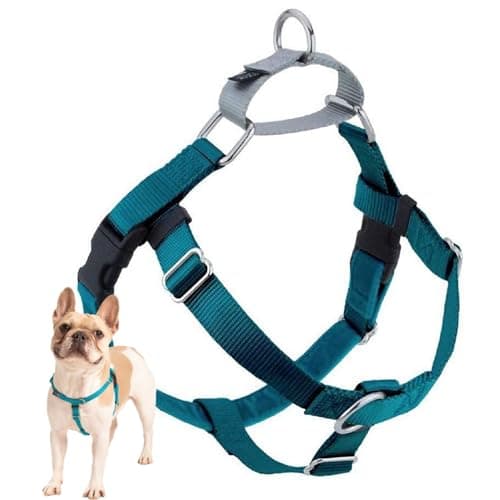
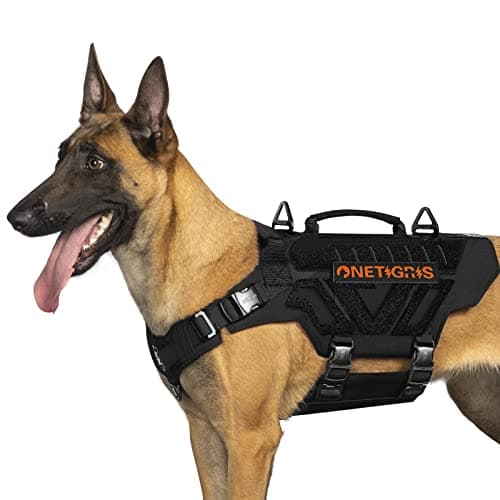
No-Pull Harness vs Head Halter
Both work by taking away the dog's ability to pull in a straight line. One does it with mechanical advantage and a training cost; the other does it with almost none of either.
Both tools attack the same problem from the same direction: a dog that cannot point its head and shoulders at where it wants to go cannot generate much forward force. The difference is where the redirect happens, how much mechanical advantage you get, and what you have to spend to get it.
Side by side
| Front-clip harness | Head halter | |
|---|---|---|
| Where it acts | Sternum, ahead of center of mass | Muzzle and behind the ears |
| Mechanical advantage | Moderate | High — the head is a long lever |
| Acclimation needed | Essentially none | Days to weeks, and some dogs never accept it |
| Main risk | Altered gait; chafing if badly fitted | Neck torque if the dog hits the end at speed |
| Public perception | Neutral | Frequently mistaken for a muzzle |
| Works on day one | Yes | Rarely |
What has been measured
The strongest single number available belongs to the harness. Johnson and Wynne (2024, PeerJ) measured pull force on 23 shelter dogs across a martingale collar, a front-connection harness, a Starmark polymer-prong collar and a metal prong collar. Dogs pulled significantly more on the martingale than on any of the other three (p < 0.001), and there were no statistically significant differences among those three. A front-clip harness measured as well as a metal prong collar.
Head halters were not in that trial, and we are not going to fill the gap with an assertion. What can be said from mechanics rather than from a study is uncontroversial: the head is a longer lever than the sternum, so a halter gives a handler more advantage over a very strong dog. That is the reason handlers of 120 lb dogs reach for one.
The 2026 Frontiers review of dog-worn equipment, which covers muzzles, collars, harnesses and leashes, does not address head collars at all — which is itself worth reporting. The evidence base here is thinner than either camp usually admits.
The head halter risk, stated fairly
The commonly raised concern is neck torque: a dog that hits the end of a leash at speed with a halter on has its head snapped sideways. We have not found a controlled study quantifying that in dogs, and we are not going to cite one that does not exist. What we can say is that the concern is mechanically coherent — a lever that gives you more advantage over the dog gives the leash more advantage over the dog’s neck — and that it argues for two specific practices rather than for avoiding the tool:
- Use a short leash with a halter, not a long one. Less run-up means less speed at the end of it.
- Use a double-ended connection. Clip one end to the halter and one to a harness ring, so the harness absorbs the shock and the halter only steers.
The second practice is standard among professional trainers who use halters, and it removes most of the objection.
The acclimation cost is the real dividing line
A front-clip harness works on the first walk. A dog puts it on, pulls, gets turned, and the physics does its job with no acclimation at all.
A head halter does not. Most dogs paw at it, rub their faces along the ground, or plant and refuse to walk. Getting past that takes days to weeks of conditioning — short sessions, food, taking it off before the dog objects — and a real proportion of dogs never fully accept it. That is not a small cost, and it is the reason most owners who buy a halter end up with it in a drawer.
So the honest framing is: the halter buys you more control at the price of a training project. If you will do the project, it is the more powerful tool. If you will not, the harness is the tool that will actually be on the dog.
Which one to buy
Front-clip harness if you want something that works immediately, if the dog is under about 80 lb, if anyone in the household who is not you will also be walking the dog, or if you have any doubt about following through on conditioning. This is most people, and it is why the harness is the default recommendation. The specific ones worth owning are in our no-pull harness roundup.
Head halter if the dog is genuinely stronger than the handler, if you have a specific plan and the patience for conditioning, and ideally with a double-ended leash into a harness so the halter steers and the harness takes the load.
Neither, on its own, is training. Both are management. A dog that has worn either for two years will still pull on a flat collar, because the equipment has been doing the work — which is fine, as long as you know that is the arrangement you have made.
Frequently asked questions
Is a head halter or a no-pull harness better?
A head halter gives more mechanical advantage, because the head is a longer lever than the sternum — which is why handlers of very large dogs reach for one. A front-clip harness gives less leverage but works on the first walk with no conditioning. Johnson & Wynne (2024) measured a front-connection harness as no different in pull force from a metal prong collar. For most owners the harness is the tool that will actually get used.
Are head halters dangerous for a dog's neck?
We could not find a controlled study quantifying neck injury from head halters in dogs, and we are not going to cite one that does not exist. The concern is mechanically coherent — more leverage over the dog also means more leverage on the dog's neck if it hits the end of the leash at speed. The standard professional mitigations are a short leash rather than a long one, and a double-ended leash clipped to both the halter and a harness so the harness absorbs the shock.
How long does it take a dog to get used to a head halter?
Days to weeks of deliberate conditioning — short sessions, food, and removing it before the dog starts objecting — and a real proportion of dogs never fully accept it. Pawing at the face, rubbing along the ground and refusing to walk are the normal first reactions. This acclimation cost, not effectiveness, is the main practical difference between a halter and a front-clip harness.
Do people think a head halter is a muzzle?
Frequently, yes, and it is worth knowing before you buy one. A head halter leaves the dog fully able to open its mouth, pant, drink and bite; it steers the head. But strangers routinely read it as a muzzle and change their behavior towards the dog accordingly. Some owners find that useful and some find it tiresome — either way it is a real part of using one.
Can I use a head halter and a harness together?
Yes, and it is the setup most professional trainers who use halters actually run. A double-ended leash clips to the halter and to a harness ring: the halter provides steering, and the harness takes any shock load if the dog lunges. It removes most of the neck-torque objection to halters while keeping the leverage that makes them useful on a very strong dog.
Sources
Every spec on this page traces to one of these. Where a manufacturer does not publish a figure, we say “not published” rather than estimating it.
- Johnson & Wynne (2024) — “Comparing efficacy in reducing pulling and welfare impacts of four types of leash walking equipment”, PeerJ 12:e18131
- Shih, Phillips, Mills, Yang, Georgiou & Paterson (2021) — “Dog Pulling on the Leash: Effects of Restraint by a Neck Collar vs. a Chest Harness”, Frontiers in Veterinary Science 8:735680
- Ridgway (2026) — “Health implications of dog-worn equipment: a review of known and alleged physical risks”, Frontiers in Veterinary Science 13:1711781
- Pauli, Bentley, Diehl & Miller (2006) — “Effects of the application of neck pressure by a collar or harness on intraocular pressure in dogs”, J. Am. Anim. Hosp. Assoc. 42(3):207–11