Are Orthopedic Dog Beds Worth It?
For the right dog, yes — and the word itself means nothing. Anyone can print it on anything, and the two measurements that would let you verify it are almost never published.
“Orthopedic” is not a specification
There is no standard, no test and no certifying body behind the word on a dog bed. Any manufacturer may print it on any bed. We have seen it applied to a three-inch slab of commodity polyfoam and to a seven-inch engineered core, in the same online category, at similar prices.
So the question is not whether “orthopedic” beds work. It is whether this particular bed provides support that does not bottom out — and there are two numbers that would answer that, both defined by an actual standard, and almost nobody publishes either.
The two numbers that would settle it
Density (lb/ft³)
How much material is in a given volume of foam. It is the single best predictor of how long foam holds its shape, because low-density foam has less material to compress and it does not recover.
For context, the furniture industry treats roughly 1.8 lb/ft³ as a threshold for longer-lasting seat foam. Most dog bed foam is well below that, and the number is essentially never published. In our own product research, Laifug is the only bed brand we found that publishes a foam density at all — which is why it appears in our orthopedic bed roundup despite being a less familiar name than several competitors.
ILD / IFD (firmness)
Indentation Load Deflection: the force required to compress a foam sample by 25% of its thickness. It is the firmness figure, and it is measured under ASTM D3574, the standard test method for flexible cellular materials.
Density and ILD are independent. A foam can be dense and soft, or light and firm. A bed sold as “firm and supportive” with neither figure published is telling you nothing at all.
What to use instead, since the numbers are absent
- Solid core, not shredded fill. Shredded foam migrates. It moves out from under the heaviest part of the dog — which is precisely the part needing support — and the bed develops a hollow. A single solid slab cannot do that.
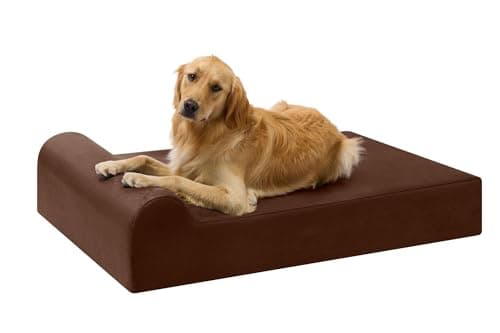
- Thickness, honestly stated. A big dog on a three-inch bed compresses it to the floor at the hips, which is the whole failure. Big Barker’s seven inches is the headline example of buying thickness deliberately.
- An egg-crate topper is not an orthopedic bed. A convoluted layer over polyfill is a comfort layer on a soft bed, and it is the most common thing sold under the word.
- The no-flatten warranty. In the absence of a density figure, a long no-flatten warranty is the manufacturer’s own bet on its foam. Big Barker’s ten-year term is the strongest in the category, and — as we found across the whole warranty audit — a warranty is the one claim a company must back with money.
Which dogs genuinely benefit
Clearly worth it:
- Large and giant breeds, at any age. Pressure is force over area, and a 110 lb dog concentrates a great deal of force on its elbows and hips. This is the group for which a thin bed measurably bottoms out.
- Senior dogs and dogs with diagnosed joint disease. The AVMA notes that difficulty rising and reluctance to jump are among the signs owners report with arthritis; a bed that is firm enough to push off is easier to get out of than a soft one that swallows the dog.
- Any dog sleeping on a hard floor, particularly a thin-coated or bony one prone to pressure calluses on the elbows.
- Post-operative recovery, on veterinary advice.
Probably not worth the premium: a young, light, sound dog on a carpeted floor. It will be comfortable on almost anything, and the money is better spent on a bed that survives it — which for a chewer means our chew-proof roundup rather than this one.
The height point nobody mentions
For an old dog, how easy the bed is to get out of matters at least as much as how comfortable it is to lie on. This gets left out of every orthopedic bed comparison we have read.
A thick, firm bed sits higher off the floor and gives the dog something solid to push against. A soft bed at floor level requires the dog to stand up from the lowest possible position with nothing to brace on — which for a dog with hind-end weakness is the hardest movement of its day, repeated several times.
Bolsters cut both ways here: a head rest is genuinely comfortable, and a bolster on the side the dog exits from is an obstacle. On a dog that struggles to rise, look for a bed with at least one open side.
The honest answer
Yes, for a big or old dog — and buy on construction, not on the word. Solid core rather than shredded, genuine thickness, and a long no-flatten warranty. If the maker publishes a density figure, that is a strong signal about the whole product, because almost nobody does.
No, if the dog also chews it. An expensive orthopedic bed opened by a chewer is an expensive bed and a foam-ingestion risk. For that dog the sequence is: solve the chewing, then buy the support. Our orthopedic roundup includes the one bed that seriously attempts both, and orthopedic versus memory foam covers the foam-type question.
Frequently asked questions
Are orthopedic dog beds actually worth it?
For large breeds, senior dogs, dogs with diagnosed joint disease and any dog sleeping on a hard floor, yes — but buy on construction rather than on the word, because 'orthopedic' is not a regulated term and any maker can print it on anything. For a young, light, sound dog on carpet, the premium buys very little and the money is better spent on a bed that survives the dog.
What foam density should a dog bed be?
Higher is better, and almost nobody publishes it. Density in lb/ft³ is the best predictor of how long foam holds its shape, because low-density foam has less material to compress and does not recover. The furniture industry treats around 1.8 lb/ft³ as a threshold for longer-lasting seat foam; most dog bed foam is well below that. In our product research, Laifug was the only bed brand we found publishing a density figure at all.
What is ILD on a dog bed?
Indentation Load Deflection — the force needed to compress a foam sample by 25% of its thickness, measured under ASTM D3574, the standard test method for flexible cellular materials. It is the firmness figure. Critically, it is independent of density: foam can be dense and soft, or light and firm. A bed sold as 'firm and supportive' with neither figure published is telling you nothing.
Is shredded foam or solid foam better in a dog bed?
Solid, clearly, for support. Shredded foam migrates out from under the heaviest part of the dog — exactly the part that needs support — and the bed develops a hollow at the hips and shoulders. A single solid slab cannot do that. Shredded fill is cheaper to manufacture and easier to ship, which is why it is common, but it is a comfort fill rather than a support core.
How thick should an orthopedic dog bed be?
Thick enough that the dog does not compress it to the floor at the hips, which for a large dog rules out most three-inch beds. Big Barker's seven inches is the clearest example of buying thickness deliberately, and its ten-year no-flatten warranty is the manufacturer's own bet that the foam will hold. In the absence of published density figures, a long no-flatten warranty is the best available proxy for foam quality.
Does bed height matter for an old dog?
Yes, and it is left out of nearly every comparison. For an arthritic dog, how easy the bed is to get out of matters as much as how comfortable it is to lie on. A thick firm bed sits higher and gives the dog something solid to push against; a soft floor-level bed requires standing up from the lowest possible position with nothing to brace on. Look for at least one open side, since a bolster on the exit side is an obstacle.
Sources
Every spec on this page traces to one of these. Where a manufacturer does not publish a figure, we say “not published” rather than estimating it.
- ASTM D3574 — standard test methods for flexible cellular materials (the tests that define foam density and ILD)
- Big Barker — 10-year no-flatten warranty terms
- AVMA — arthritis in pets: owner information on signs and management
- Bully Beds — chew-proof bed warranty (200 days; the bed must be “completely unusable with the cover and foam destroyed and in pieces”)