Dog Car Restraint Laws in the United States
Almost every version of this list online is a paraphrase of a paraphrase. This one quotes the statutes and links them, and says plainly where we could not read a primary text.
There is no federal law
Start here, because it explains the mess. No federal law requires a pet to be restrained in a moving vehicle. There is no national standard, and — as we cover in our crash-certification explainer — there is no federal safety standard for pet restraints either. The only independent certification that exists in the category is the Center for Pet Safety’s, and it is a private program, not a regulation.
So restraint law is state law, and it arrives through four different doors: explicit pet restraint statutes, distracted-driving provisions, open-bed transport statutes, and parked-car statutes. Most owners only know about the first, which is the smallest category.
Door one: states that restrain pets explicitly
Three states are consistently identified as requiring a dog to be secured in a moving vehicle — Rhode Island, New Jersey and Hawaii. Rhode Island is the one whose text we could read in full, and it is worth quoting because the wording is more specific than the summaries suggest.
Rhode Island — R.I. Gen. Laws § 31-22-28
The statute makes it unlawful to transport an animal “on or in an open air motor vehicle” unless the animal:
- “Is kept in an enclosed area of the motor vehicle”, or
- “are under the physical control of a person other than the operator”, or
- “are placed in the motor vehicle and safely restrained by a harness manufactured for the purpose of restraining animals by means other than neck restraints”
Two details in that third clause matter and are almost never reported. It requires a harness, not a seat belt clipped to a collar — and it specifies “by means other than neck restraints,” which rules out attaching the restraint to a collar at all. Penalties are a fine of not more than $50 for a first offense and not more than $200 for each subsequent offense. The section was adopted in 1992.
Hawaii — Haw. Rev. Stat. § 291C-124
Hawaii gets there sideways, through an obstruction statute rather than an animal statute:
“While operating a motor vehicle, no person shall hold in the person’s lap, or allow to be in the driver’s immediate area, any person, animal, or object which interferes with the driver’s control over the driving mechanism of the vehicle.”
Note what that does and does not do. It prohibits a dog in the driver’s lap or immediate area where it interferes with control. It does not, on its face, require a dog in the back of the car to be restrained at all.
New Jersey
New Jersey is widely reported as requiring pets to travel in a carrier or wearing a restraint, enforced through its animal-cruelty provisions, with fines commonly quoted from $250 upwards. We were not able to read a single primary section that states the requirement in those terms, so we are reporting it as widely reported rather than as quoted — and we would encourage anyone relying on it to check the current New Jersey code directly.
Door two: distracted driving
This is the larger and less visible category. Several states reach the same outcome through general distracted-driving law: an unrestrained animal that interferes with the driver is a distraction, and a distraction is already an offense. Massachusetts and Minnesota are commonly cited examples.
The practical consequence is worth understanding. In a distracted-driving state you are not ticketed for failing to restrain the dog; you are ticketed for the driving. Which means the offense usually only surfaces after something has gone wrong — at which point the loose dog is also part of the accident report.
Door three: open truck beds, and the strictest text in the country
California’s Vehicle Code § 23117 is the most specific animal-transport statute we found anywhere, and it applies to something a great many owners do without thinking. It prohibits transporting an animal in the load space of a vehicle on a highway unless one of four conditions is met:
- the space is enclosed, or
- it has side and tail racks at least 46 inches high, measured vertically from the floor, or
- the vehicle has an installed means of preventing the animal being discharged, or
- the animal is cross-tethered to the vehicle, or protected by a secured container or cage, in a manner that prevents it being thrown, falling or jumping from the vehicle.
The statute exempts livestock, and dogs used for ranching or farming purposes traveling in rural areas or to livestock auctions.
Forty-six inches is taller than most people picture. A standard pickup bed side is nowhere near it. And a single tether is not compliance — the text says cross-tethered, which means two attachment points from opposite sides, precisely so the dog cannot reach the edge. If you cross-tether, use a harness rather than a collar. The statute does not say that; physics does.
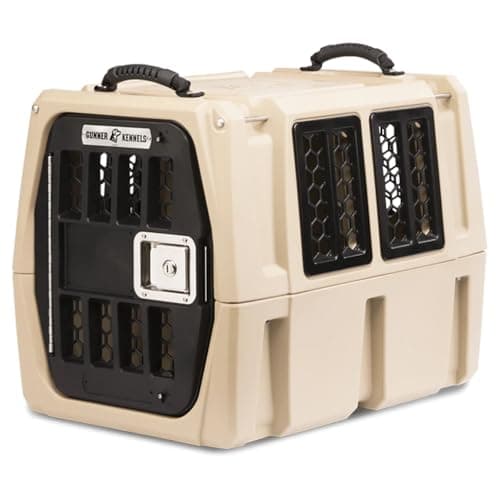
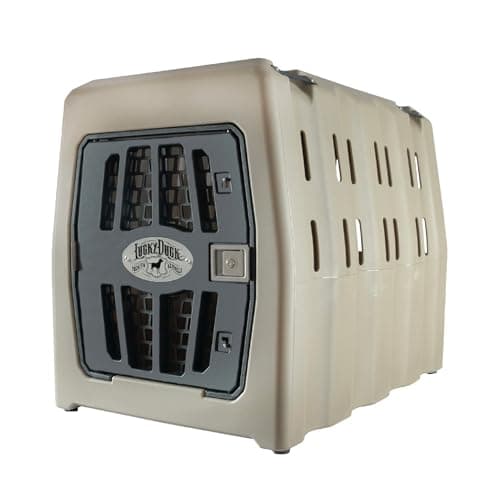
The container route has the same catch: the statute says a secured container or cage, and a crate that can slide to the tailgate is not secured. Which crates are built for an open bed, and how to strap one down to rated anchors, is in the best dog crates for truck beds.
Door four: parked cars — the biggest body of law by far
This is where most of the actual legislation is. The Animal Legal & Historical Center at Michigan State University counts 32 states plus the District of Columbia with laws addressing animals left unattended in parked vehicles, and it separates them by who is permitted to intervene:
- Civilian rescue with civil immunity — roughly sixteen states, including Arizona, California, Colorado, Florida, Massachusetts, Ohio, Oregon, Tennessee and Wisconsin, give any individual immunity for forcible entry under stated conditions.
- Law-enforcement rescue only — a similar-sized group, including Illinois, Maryland, Minnesota, Nevada, New York, North Carolina, Pennsylvania, Rhode Island, Virginia and Washington, restricts forcible entry to officers.
- A statute with no rescue provision — New Jersey and West Virginia.
- No protection at all — including Alabama, Alaska, Arkansas, Hawaii, Idaho, Iowa, Kentucky, Mississippi, Missouri, Montana, Nebraska, New Mexico, Oklahoma, South Carolina, Texas, Utah and Wyoming.
The immunity states almost always attach conditions — a reasonable belief of imminent danger, a requirement to call law enforcement first, using no more force than necessary, and remaining with the animal. Read your own state’s conditions before you break a window, because immunity that you did not qualify for is not immunity.
The AVMA’s own position needs no statute: “Never leave a pet in the car, even in the shade or with windows cracked,” because “cars can overheat quickly to deadly temperatures, even when the weather isn’t severe.”
What we would actually do, regardless of your state
The legal minimum is a poor target here, because in most states the legal minimum is nothing at all. The physics does not care which state you are in: an unrestrained 60 lb dog in a 30 mph impact arrives at the seat in front of it with the force of a small motorcycle.
- A crate or a certified harness, not a tether to a collar. Rhode Island wrote the neck-restraint exclusion into its statute for a reason.
- Check what is actually certified. Certification is issued per product and per dog weight — a harness certified with a 75 lb dog is not certified for your 110 lb dog. Our crash-tested harness roundup and crate roundup list what the Center for Pet Safety has actually certified, rather than what packaging claims.
- Back seat or cargo area, never the front. An airbag deploys at a speed that is survivable for an adult human and is not survivable for a dog.
- If you are still deciding between a crate and a harness, that trade-off is its own page: harness versus crate.
Frequently asked questions
Is it illegal to drive with an unrestrained dog?
There is no federal law requiring a pet to be restrained in a moving vehicle, so it depends on your state. Rhode Island, New Jersey and Hawaii are the three consistently identified as requiring restraint, and several more — Massachusetts and Minnesota among them — reach the same outcome through general distracted-driving provisions. In most states an unrestrained dog is not itself an offense until it contributes to one.
What does Rhode Island's dog restraint law actually require?
R.I. Gen. Laws § 31-22-28 makes it unlawful to transport an animal on or in an open air motor vehicle unless the animal is kept in an enclosed area, is under the physical control of someone other than the driver, or is 'safely restrained by a harness manufactured for the purpose of restraining animals by means other than neck restraints.' That last clause specifically rules out attaching the restraint to a collar. Penalties are up to $50 for a first offense and up to $200 for each subsequent one.
Can a dog legally ride in the back of a pickup truck?
In California, only under conditions set by Vehicle Code § 23117: the load space must be enclosed, or have side and tail racks at least 46 inches high measured vertically from the floor, or the vehicle must have an installed means of preventing the animal being discharged, or the animal must be cross-tethered or in a secured container. Livestock and ranch or farm dogs traveling in rural areas are exempt. Other states vary widely and many have no provision at all.
Can I break a car window to rescue a dog?
In some states, with conditions. The Animal Legal & Historical Center counts 32 states plus D.C. with laws about animals in parked vehicles; roughly sixteen give any individual civil immunity for forcible entry, while a similar number restrict it to law enforcement. Immunity statutes almost always attach conditions — a reasonable belief of imminent danger, calling law enforcement first, using no more force than necessary, and staying with the animal. Read your own state's conditions, because immunity you did not qualify for is not immunity.
Is a dog seat belt that clips to a collar legal?
In Rhode Island, explicitly not — the statute requires a harness 'by means other than neck restraints.' Everywhere else it is generally not addressed by law, which is not the same as being safe. A tether to a collar concentrates the entire deceleration load on a dog's neck, which is why no crash-certified restraint in the Center for Pet Safety program works that way.
Is there a federal standard for dog car restraints?
No. There is no federal law requiring restraint and no federal safety standard for the restraints themselves. The Center for Pet Safety's certification program is a private, independent program rather than a regulation, and it is the only independent crash certification that exists in the category. Manufacturer 'crash tested' claims are self-reported unless CPS certification is stated.
Sources
Every spec on this page traces to one of these. Where a manufacturer does not publish a figure, we say “not published” rather than estimating it.
- RI Gen. Laws § 31-22-28 — transporting animals (open-air vehicles; harness requirement; $50/$200 penalties)
- HI Rev. Stat. § 291C-124 — obstruction to driver’s view or driving mechanism (animal in the driver’s immediate area)
- CA Vehicle Code § 23117 — transportation of animals; enclosure or restraint requirements (Animal Legal & Historical Center)
- Animal Legal & Historical Center — maps of states with laws protecting animals in parked cars (32 states + D.C.; which allow civilian rescue)
- AVMA — Warm weather pet safety (signs of heat stress; hot surfaces; never leave a pet in a car)
- AVMA — Pet safety in vehicles
- Center for Pet Safety — certified products (the only independent crash certification in the category)