Are Leather Dog Collars Safe?
The honest answer starts with what nobody will tell you: not one leather collar we have assessed publishes its tannage, and most will not state the grade either. So judge it on the four things you can actually check.
The verdict
For an everyday collar on a dry-living dog, leather is a sound and long-lasting choice, and the one we would buy is the Auburn Leathercrafters rolled collar— because it is the only collar in our registry that names its leather grade (full-grain bridle leather) and backs it with real construction detail: capped rivets, beveled and hand-polished edges, a nickel-plated buckle and dee ring, made in central New York State. The important caveats are not about the material being dangerous; they are about what is unknowable and what is situational. No leather collar we have assessed publishes its tannage, so we make no chemical-safety claim either way. Leather is the wrong collar for a dog that swims, because repeated soakings are what destroy it. And a buckle-and-tongue closure cannot be released in a hurry, which is a genuine consideration if your dog wears a collar unsupervised.
Start with what nobody publishes
Search this question and you will find a great deal of confident writing about vegetable tanning, chrome tanning and what is or is not in the finish. We are not going to add to it, because the evidence is not there to support it. Across every leather collar in our registry the picture is the same:
- Tannage: never published.Not by one seller, on one listing. “Veg tanned” appears in marketing copy across the category without a tannery, a process or a standard behind it.
- Grade: published once.Auburn Leathercrafters states full-grain bridle leather. Soft Touch, Mendota and Perri’s all sell leather collars whose listings do not state the grade — and grade is the single specification that determines how long a leather collar lasts.
- Hardware material: mostly not published.Auburn states bright nickel-plated buckle and dee ring. Mendota and Perri’s publish a buckle and a D-ring without saying what either is made of.
So the responsible version of the answer is this: we cannot tell you a leather collar is chemically safe, because nobody has published the information that would let anyone say so, and we will not pretend otherwise. What we can do is tell you which mechanical risks are real, which are overstated, and what to look at instead. If material choice is the decision you are actually making, read our collar materials guide and leather against nylon alongside this page.
1. The closure, which is the real safety decision
Almost every leather collar uses a buckle and tongue, like a belt. It is the most traditional closure, it has no plastic to crack in cold, and it is why Mendota — a maker whose business is field and gundog gear rather than fashion — still builds them that way. It also cannot be released quickly.
That matters in one specific scenario: a collar that snags while you are not there. If your dog wears a collar unsupervised in a crate, in a yard with fencing, or around other dogs at play, a closure you can open instantly is worth more than a traditional one. The nylon side of the market offers quick-release buckles for exactly this reason. Leather generally does not, and that is a trade-off to make deliberately rather than discover.
One closure rule holds regardless of material and is worth stating because it is routinely broken: a limited-slip or martingale collar must never be left on an unsupervised dog, because the loop is a snag hazard. That applies to leather martingales exactly as it does to the webbing ones we rank.
2. The hardware, which is what actually breaks
A leather collar does not usually fail through the leather. It fails at the buckle, at the D-ring, or at the rivets holding them in. Three things to look at:
- Plating versus solid metal. Auburn uses bright nickel-plated buckle and dee ring, and states so; plating wears through eventually, which is an honest limitation of a collar that is otherwise built to outlive the dog. Solid stainless is better and rarer.
- Rivets, and whether they are capped. Capped rivets have no exposed edge against the dog. Auburn specifies them. It is a small construction detail that tells you what kind of shop built the collar.
- Edge finishing.Beveled and hand-polished edges are the difference between a leather collar that conforms to the neck and one that abrades it. Padding is the other route to the same outcome — Soft Touch’s padded leather collar keeps the edge off the neck, and its Medium publishes real dimensions (20 in long by 1 in wide, for a 14.5-17.5 in neck), which is more than most of the category does.
3. Water, which is the thing that genuinely rules leather out
This is the clearest answer on the page. Leather needs conditioning and hates repeated soakings. A dog that swims, works water, or lives in genuine wet will destroy a leather collar, and no grade of leather changes that. It is not a safety problem so much as a suitability one — but a collar that has been soaked, dried hard and cracked is a collar closer to failing.
If that describes your dog, the material you want is coated webbing. BioThane sheds water, wipes clean and stays flexible in cold, and its material maker publishes a 1,000 lb core break strength for the 1 in Beta 520 profile — the only published strength figure anywhere in this category. Start with biothane against leather, and if it is a lead rather than a collar, the biothane alternatives covers the rest of the field.
4. Fit and width, which do more than material ever will
A correctly fitted collar of any material is safer than a badly fitted one of any other. Measure at the base of the neck where the collar actually sits, and fit it so two fingers slide under the strap — snug enough that the dog cannot reverse out of it, loose enough that nothing is compressed. On a long or double coat, choose rolled construction rather than a wide flat strap, which mats the coat where it sits; that is the whole argument of our page on collar width, and it is the reason the rolled collar is our first pick here.
And the rule that outranks all of this: a collar is for carrying identification and for everyday control. If the dog pulls hard, the load belongs on a harness instead — harness against collar is the comparison, and the no-pull harnesses are the equipment.
What to look for, in order
- A named grade.“Full-grain” or “bridle leather” from a maker willing to put it in writing. “Genuine leather” is a legal minimum, not a quality claim.
- Hardware you can identify. Stated metal, capped rivets, a buckle that is not plastic.
- A closure that matches how your dog lives. Traditional buckle for supervised walking; think hard before leaving any non-releasable collar on an unsupervised dog.
- Finished edges or padding.Beveled, polished, bound or padded — one of the four.
- Honest climate. Dry dog, leather. Wet dog, coated webbing.
Quick picks
The short answer, ranked and scored against our published durability rubric. Where a manufacturer does not publish a spec, we say so rather than estimating it.
| # | Photo | Product | Durability | Price |
|---|---|---|---|---|
| 1 | 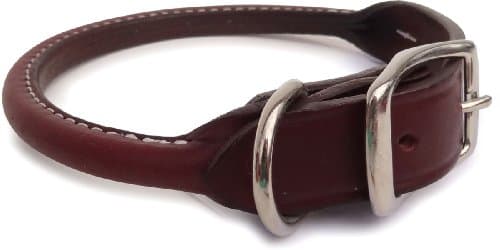 | Auburn Leathercrafters Rolled Leather CollarThe buy-it-for-life leather collar | 78/100 | $67.00 · Amazon |
| 2 | 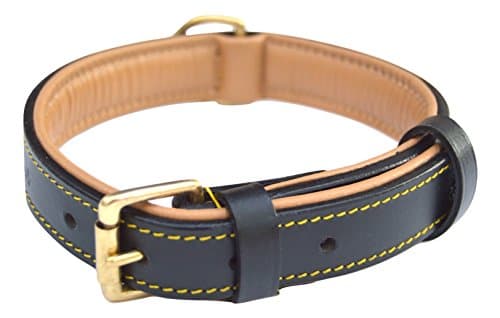 | Soft Touch Collars Padded Leather CollarA leather collar that will outlive the dog | 66/100 | Check price |
| 3 | 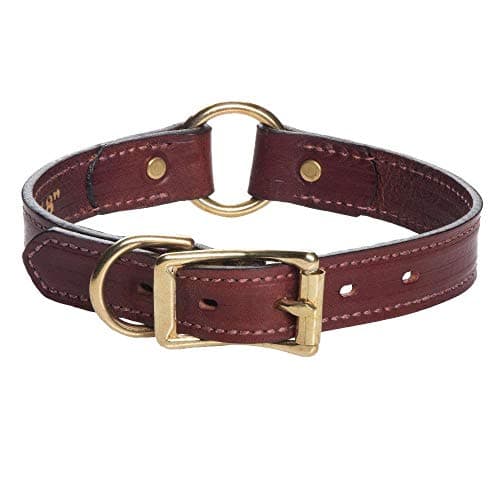 | Mendota Pet Leather Dog CollarA working leather collar from a field-gear maker | 67/100 | $44.49 · Amazon |
Tap any row to jump to the full review. Prices are pulled live from Amazon as of October 18, 2026; where we have no verified live price we show none rather than a stale number. #ad — how our links work.
The picks, ranked
1. Auburn Leathercrafters Rolled Leather Collar
Durability score 78/100Best for: The buy-it-for-life leather collar
The one collar here that names its leather grade, and that alone puts it ahead of every unlabeled 'genuine leather' collar on the market.
- Leather
- Full-grain bridle leather
- Hardware
- Bright nickel-plated buckle and dee ring; smooth capped rivets
- Construction
- Beveled and hand-polished edges; extended D-end pattern on large sizes
- Sizes
- 10–34 in; widths 1/2 to 1-1/4 in
- Made in
- Central New York State, USA
Pros
- Full-grain bridle leather — the top of the grade hierarchy, and Auburn names it, which almost no collar seller does
- Rolled construction resists matting the coat on long-haired dogs
- Capped rivets and beveled edges are real construction detail, not marketing
Cons
- Nickel-plated hardware, not solid stainless — plating wears through eventually
- No published break strength
- Sold in single-collar quantities at a real premium over mass-market nylon
How we assessed it: on published materials, hardware specs and construction — not long-term chew-tested. We say so because it is true, and because a claim we cannot back is worth nothing to you.
#ad Price as of October 18, 2026; Amazon prices change often, so check before you buy. How our links work.
2. Soft Touch Collars Padded Leather Collar
Durability score 66/100Best for: A leather collar that will outlive the dog
Leather is the buy-it-for-life material, but without a published grade you are trusting the seller — read our materials guide before you spend.
- Material
- Leather, padded (Amazon listing)
- Size on this listing
- Medium — 20 in long x 1 in wide, for a 14.5-17.5 in neck (Amazon listing)
- Leather grade
- Not published — see our collar materials guide on why that matters
- Hardware
- Not published
Pros
- Real leather softens and conforms to the dog rather than degrading
- Padding keeps the edge off the neck
Cons
- The listing does not state the leather grade, and grade is the whole story with leather
- Leather needs conditioning and hates repeated soakings — the wrong choice for a swimmer
How we assessed it: on published materials, hardware specs and construction — not long-term chew-tested. We say so because it is true, and because a claim we cannot back is worth nothing to you.
#ad We only show a price when we have a live one from Amazon. We don’t have one for this product right now, so we’re not going to guess. How our links work.
Search Amazon for the Soft Touch Collars Padded Leather Collar
3. Mendota Pet Leather Dog Collar
Durability score 67/100Best for: A working leather collar from a field-gear maker
A proper working collar from a proper working brand — and the grade of leather, which decides everything, is the thing nobody will state.
- Material
- Leather; grade not published on the listing
- Origin
- Made in the USA per Mendota
- Hardware
- Buckle and D-ring; material not published
- Warranty
- Not published in detail
Pros
- From a maker whose business is field and gundog gear rather than fashion, which shows in the hardware proportions
- Made in the USA, which Mendota states plainly
- Traditional buckle-and-tongue closure — no plastic to crack in cold
Cons
- The listing does not state the leather grade, which is the single specification that determines how long a leather collar lasts
- Hardware material not published
- No published warranty terms
How we assessed it: on published materials, hardware specs and construction — not long-term chew-tested. We say so because it is true, and because a claim we cannot back is worth nothing to you.
#ad Price as of October 18, 2026; Amazon prices change often, so check before you buy. How our links work.
Named and not ranked
Perri’s Leather.Built by a manufacturer whose main trade is horse tack, where leather has to survive weather and load daily, and padded and lined constructions run through the range. We would happily own one. It is not ranked here because the grade is not published and the hardware material is not published, so on the specific question this page asks it tells you no more than the cheaper options do — at a higher price. It appears in the leather collar roundup where the comparison is fairer.
Nameplate collars.If the reason you want leather is identification, a riveted plate is a better answer than a dangling tag, and the warranty picture is genuinely different — see the nameplate collars.
The bottom line
Leather is a buy-it-for-life material and a good everyday collar, and the mechanical risks people worry about are mostly fixable by buying a collar with finished edges, identifiable hardware and a correct fit. The two honest limitations are that it is the wrong material for a dog that lives wet, and that a traditional buckle cannot be released in a hurry. The one thing we will not do is tell you leather is chemically safe or unsafe, because across this entire category nobody publishes the tannage — and on a site that scores manufacturers on what they are willing to disclose, that silence is the finding.
Frequently asked questions
Are leather dog collars safe for dogs?
As everyday collars for a dog that lives mostly dry, yes - they are durable, they conform to the neck rather than degrading, and the mechanical risks are the ordinary ones you can inspect for. Two honest limitations: leather hates repeated soakings, so it is the wrong collar for a dog that swims, and a traditional buckle-and-tongue closure cannot be released quickly, which matters if your dog wears a collar unsupervised. On chemical safety we make no claim in either direction, because not one leather collar we have assessed publishes its tannage.
Are leather collars better than nylon?
Better at some things, worse at others. Leather softens and conforms to the dog instead of degrading, it has no plastic to crack in cold, and a well-made one will outlive several nylon collars. Nylon is cheaper, washable, available with quick-release buckles, and far better in the wet. The decision that actually matters is water: a dog that swims or works wet wants coated webbing, not leather. Our leather-versus-nylon comparison goes through it spec by spec.
What leather grade should a dog collar be?
Full-grain is the top of the grade hierarchy and bridle leather is the traditional harness-trade specification for straps under load - which is exactly what a collar is. Of the collars we have assessed, Auburn Leathercrafters is the only one that names its grade (full-grain bridle leather) and it also publishes the construction around it: beveled and hand-polished edges, capped rivets, a bright nickel-plated buckle and dee ring, an extended D-end pattern on large sizes. 'Genuine leather' is a legal description that permits almost anything, so an unlabelled 'genuine leather' collar is an unknown.
Can a dog wear a leather collar in water?
It can, and it will shorten the collar's life considerably. Leather needs conditioning and hates repeated soakings; a collar that has been soaked, dried hard and cracked is measurably closer to failing. For a dog that swims, works water or lives in real wet, coated webbing is the correct material - it sheds water, wipes clean and stays flexible in cold, and BioThane's material maker publishes a 1,000 lb core break strength for the 1 in Beta 520 PET profile, which is the only published strength figure in the whole category.
Is a leather collar strong enough for a big dog?
Bridle leather in a proper width is a traditional material for exactly that load, and Auburn's large sizes use an extended D-end pattern for it. But no leather collar we have assessed publishes a break strength, so 'strong enough' is a judgement rather than a specification. Judge it on the parts that fail: a stated hardware metal rather than an unstated one, capped rivets, and stitching or riveting that anchors the D-ring into the strap itself. And if the dog pulls hard, the load should be on a harness rather than on any collar, whatever it is made of.
Should my dog wear a leather collar all the time?
That is a closure question more than a material one. A buckle-and-tongue leather collar cannot be released in a hurry, so if your dog wears a collar unsupervised - in a crate, in a yard with fencing, or in play with other dogs - a quick-release closure is worth more than a traditional one. One rule is absolute regardless of material: a martingale or limited-slip collar must never be left on an unsupervised dog, because the loop is a snag hazard.
Sources
Every spec on this page traces to one of these. Where a manufacturer does not publish a figure, we say “not published” rather than estimating it.
- Auburn Leathercrafters — rolled collar: full-grain bridle leather, the 1/2 to 1-1/4 in width range, the 10-34 in size range, capped rivets and beveled edges
- Mendota Pet — maker page for the British-style check cord and the leather collar line (solid-braid polypropylene; made in the USA)
- Perri's Leather — maker page; equestrian leather goods trade origin
- BioThane — Beta 520 PET material data: the 1,000 lb core break strength and 200 lb buckle pull strength for the 1 in standard profile quoted throughout