The Best Dog Winter Coats
Nobody in this category will tell you how cold a coat is good to. Two makers will tell you how waterproof the shell is and how much insulation is in it - and that is the whole decision, plus one question about the harness your dog already wears.
The verdict
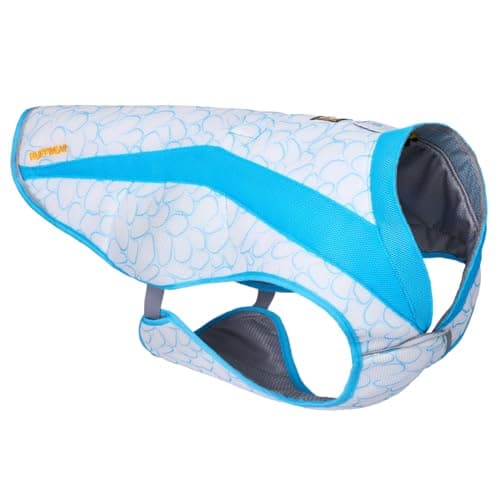
Buy the Ruffwear Powder Hound Waterproof Insulated Jacket. It is the only coat in this field you can buy on numbers: a 70D nylon ripstop shell rated at 10,000 mm with taped seams, and 250 g of recycled polyester insulationin the back and belly panels, with chest and back leash portals so it works over a harness. Read the name twice before you order, because Ruffwear sells a second jacket called the Powder Hound Insulated Jacket — a softshell, about thirty dollars cheaper, and weather-resistant rather than waterproof. For dry cold, brush and farm work the Carhartt Firm Duck chore coat is the better object: 12 oz cotton duck is the toughest fabric here and it adjusts with straps rather than a single girth number, but it soaks and stays cold once wet. The Climate Changer fleeceis not a winter coat at all — it is the layer that goes under one — and the Kurgo Loft is the sensible thirty-dollar answer, and the only coat here built around harness access rather than in spite of it.
Quick picks
The short answer, ranked and scored against our published durability rubric. Where a manufacturer does not publish a spec, we say so rather than estimating it.
| # | Photo | Product | The two numbers that exist | Durability | Price |
|---|---|---|---|---|---|
| 1 | 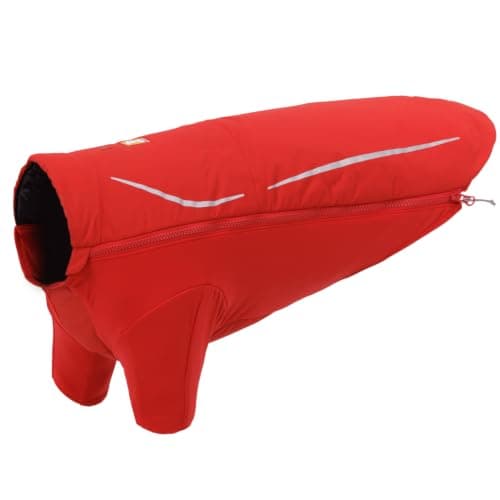 | Ruffwear Powder Hound Waterproof Insulated JacketA short-coated dog in genuinely wet cold |
| 77/100 | $109.99 · Amazon |
| 2 | 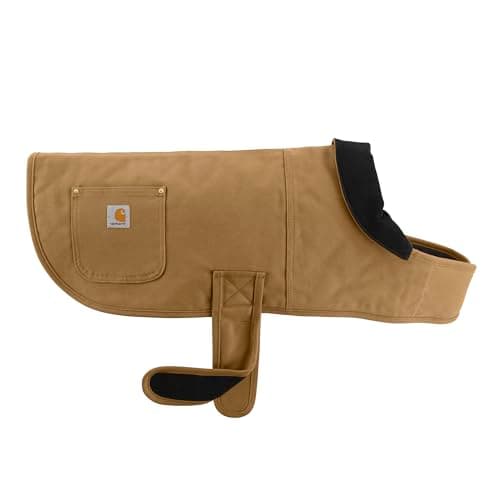 | Carhartt Firm Duck Insulated Dog Chore CoatDry cold, abrasion and a dog that lives outdoors with you |
| 63/100 | $56.09 · Amazon |
| 3 | 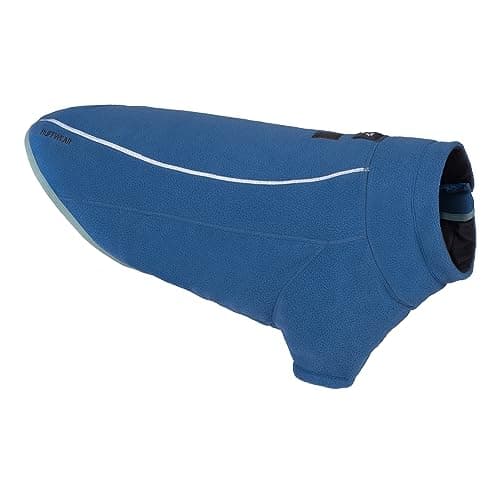 | Ruffwear Climate Changer Fleece JacketThe layer under a shell, or a cold-house dog |
| 58/100 | $41.99 · Amazon |
| 4 | 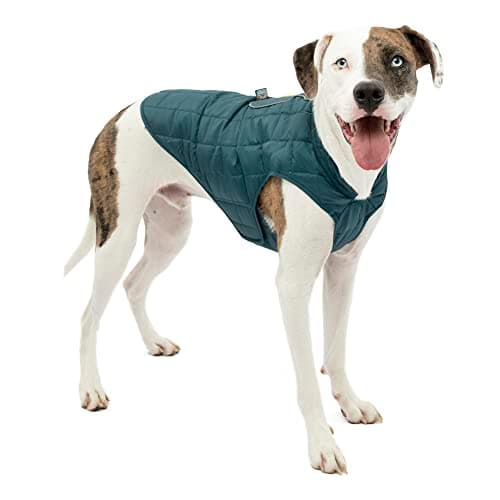 | Kurgo Loft Dog JacketA harness-wearing dog on a budget |
| 52/100 | $29.55 · Amazon |
Tap any row to jump to the full review. Specs are the manufacturer's own published figures; where a maker does not publish one we say "not published" rather than estimating it. Prices are pulled live from Amazon as of November 3, 2026; where we have no verified live price we show none rather than a stale number. #ad — how our links work.
The number you want does not exist
Nobody searching for a dog coat wants a denier figure. They want to know whether it is warm enough for their dog, in their winter. That number is not published by anybody, in any price bracket, and any listing that implies one is reading a retailer’s copy rather than a specification.
We ran into exactly the same wall on dog boots, where no maker publishes a temperature rating either, and the reason is the same in both cases: the variables sit in the dog, not the garment. Coat type, body fat, age, acclimatization and how long the dog is outside swamp whatever the fabric is doing. A figure that ignored all of that would be marketing with a decimal point in it.
So the honest approach is to buy on the two things that are published, both of which are properties of the garment rather than guesses about your dog:
- The shell’s waterproof rating, in mm.This is a standard hydrostatic-head figure borrowed from human outdoor kit, and it is the single most decisive spec in the category — because a wet insulated coat is worse than no coat. One product here publishes it: the Powder Hound, at 10,000 mm, with taped seams and a named PU finish. Everything else says “water-resistant” or “weather-resistant”, which are words, not ratings.
- The insulation weight, in grams per square meter.Again one product publishes it: 250 g of recycled polyester in the Powder Hound’s back and belly panels. Kurgo names its fill “polytech” and gives no weight; some retailer listings quote 140 gsm, which is not on Kurgo’s own page, so we do not report it as a spec. Carhartt gives “polyester batting” and no weight. The Climate Changer is the odd case where the insulation is the fabric, and Ruffwear does publish that: 260 g fleece.
What decides a winter coat, in order
- Waterproof or water-resistant. These are different products and the distinction is not pedantry. Water-resistant means the water gets through more slowly; in sleet or wet snow, slower is still through, and a soaked insulated coat holds cold water against the dog for the rest of the walk.
- Coverage, specifically the belly and the chest. A dog loses heat fastest from the thinly furred underside, which is also the surface that touches wet snow. A blanket-style coat that covers the back and nothing else is a rain cover, not a winter coat. Two products here insulate the belly panel and say so.
- Whether it works with the harness. The question nobody in this category asks and every owner faces at the door: your dog already wears a harness, and the coat has to be over it, under it, or built to let a lead through it. We treat this as a first-order criterion, not a feature.
- How it is sized. Girth only, girth plus back length, or neck plus chest with the back length left to vary. Mis-sizing is the most common reason a coat gets returned, and the three makers here do not even agree on which measurement matters.
- What the fabric does when it fails. Coated nylon delaminates and stops being waterproof; cotton duck abrades, fades and keeps working; fleece pills. For a coat that will meet brush and fence wire, that distinction is worth more than a rating.
- Care, and warranty. A coat that cannot go in a machine gets worn dirty, and a dirty insulated coat insulates worse. Three of these four publish a care instruction; one publishes a warranty.
The one-word difference you have to read for
This is the most expensive mistake available on this page, and it is Ruffwear’s fault rather than the buyer’s. There are two current Powder Hound jackets:
- Powder Hound Insulated Jacket— a softshell, sold around $77, described as weather-resistant with stretch StormSleeve panels.
- Powder Hound Waterproof Insulated Jacket— the one ranked first here, sold around $110, with the 10,000 mm shell, the PFAS-free PU finish, Bemis seam tape and 250 g of insulation.
One word, thirty-odd dollars, and the entire difference between a coat for a cold dry morning and a coat for a day of wet snow. If you are buying for genuinely wet cold, the word waterproof has to be in the product name you click.
While we are in Ruffwear’s paperwork: its own size chart for this jacket disagrees with itself at the L / XL boundary — the size selector and the Fit Guide tab give different girth ranges — and on a garment sized by one measurement that is not a trivial error. Measure the rib cage at its widest point, and if you land near 32 in or 36 in, order from the chart on the page you are actually buying from.
The coat-and-harness problem
Every dog that needs a coat in winter is also wearing something to be walked by, and the combinations are genuinely awkward. There are three workable arrangements and one bad one.
Harness under the coat, lead through a portal. The best answer, and only two products here support it. Ruffwear puts leash portals on the chest andthe back, which covers both a front-clip no-pull harness and a back-clip one. Kurgo’s two-way zipper opens from either end to expose a harness ring or a collar, which is a cheaper and cleverer solution than it sounds for a thirty-dollar jacket.
Harness over the coat.Works, and costs you fit. A harness sized to the dog is now sized to the dog plus 250 g of insulation, and every strap sits a centimeter further out than it was adjusted for. If you do this, re-check the fit with the coat on rather than assuming the previous adjustment holds — the measuring method is on how to measure a dog for a harness.
Collar only, coat over the body. Fine for a short street walk on a dog that does not pull. Not fine on a dog that does, for the reasons set out on harness against collar.
The bad one: a harness worn over a coat on a dog that pulls hard.The coat becomes the load path. Fabric bunches under the straps, the harness slides, and the adjustment you set is not the adjustment the dog is wearing. If your dog pulls, put the harness on the dog and the coat over it with the lead coming through a portal — which is precisely why we score portals as hardware rather than as a nice touch.
Which dogs actually need one
Worth being blunt, because this category sells a great many coats to dogs that are already wearing one. A dense double coat with a full undercoat is insulation that regrows itself every autumn, and adding a jacket over it mostly compresses the undercoat and flattens the loft that was doing the work. We make the same point in the opposite direction about summer gear on the husky gear guide, where coat compression is the specific fitting failure that matters.
The dogs a coat genuinely changes the day for:
- Short, single-coated dogs— pointers, vizslas, whippets, boxers, staffies. Little undercoat, thin fur over muscle, and a visible difference in how long they are willing to stand still outside.
- Lean, low-body-fat dogs of any coat type, and the sighthounds in particular.
- Old dogs and very young ones, who regulate less well and move less to generate heat.
- Any dog that is going to be wet and stationary— a boat, a blind, a sideline, a tailgate. This is the case where the waterproof rating matters more than the insulation, and where a double coat is not enough either, because a saturated undercoat is a cold compress.
And a dog that swims in cold water is a different problem again: wet fur does not insulate, the garment that helps is a neoprene vest rather than an insulated coat, and the field is ranked on the hunting vest roundup.
The picks, ranked
1. Ruffwear Powder Hound Waterproof Insulated Jacket
Durability score 77/100Best for: A short-coated dog in genuinely wet cold
The only coat in this field you can buy on numbers rather than on adjectives — and the one whose name you have to read twice.
- Shell
- Waterproof 70D nylon ripstop rated at 10,000 mm, PFAS-free PU finish, Bemis seam tape, 58% recycled (Ruffwear)
- Insulation
- 250 g polyester, 100% recycled, in the back and belly panels (Ruffwear)
- Lining
- 30D polyester (Ruffwear)
- Sleeves
- StormSleeves — 4-way stretch, 71% polyester / 29% spandex
- Zipper
- Full-length YKK Vislon
- Leash access
- Chest and back leash portals, for use over most harnesses
- Sizing
- Chest girth at the widest point of the rib cage: XXS 13-17 in through XL 36-42 in. Ruffwear's size selector and its Fit Guide disagree at the L / XL boundary
- Care
- Cold wash, gentle cycle, mild detergent, hang to dry (Ruffwear)
- Temperature rating
- Not published. No maker in this category publishes one
- Warranty
- Ruffwear warrants defects in materials and craftsmanship with no stated duration; chewing, normal wear and alterations are excluded
Pros
- The only coat here with a published waterproof rating (10,000 mm) and a published insulation weight (250 g) — every other maker in the field describes warmth with adjectives
- Two leash portals, chest and back, so it works over a harness instead of forcing you to choose between the coat and the harness
- Taped seams and a named PU finish, which is what separates a waterproof shell from a water-resistant one
- Sleeves cover the shoulders and upper legs, the part of a short-coated dog that a blanket-style coat leaves bare
- A named zipper (YKK Vislon) — a small thing, and the component most likely to fail on a dog coat
Cons
- Ruffwear sells two jackets whose names differ by one word: the softshell 'Powder Hound Insulated Jacket' at roughly $77 is weather-resistant, NOT waterproof, and it is a different product from this one
- Ruffwear's own sizing chart contradicts itself at the L / XL boundary, which on a garment sized by a single girth figure is not a trivial error
- Sleeves are genuinely polarizing; some dogs will not accept them and no amount of specification fixes that
- Easily the most expensive thing on this page, and the warranty has no stated duration
- No garment weight published, so there is no way to compare its bulk against anything else
How we assessed it: on published materials, hardware specs and construction — not long-term chew-tested. We say so because it is true, and because a claim we cannot back is worth nothing to you.
#ad Price as of November 3, 2026; Amazon prices change often, so check before you buy. How our links work.
2. Carhartt Firm Duck Insulated Dog Chore Coat
Durability score 63/100Best for: Dry cold, abrasion and a dog that lives outdoors with you
The right coat for dry cold, brush and chores, and the wrong one for sleet. Buy it for the canvas, not for the paperwork.
- Shell
- 12 oz firm-hand 100% ringspun cotton duck (retailer listings). Carhartt's own US product page returns 403 to automated requests, so every figure here is retailer-stated
- Insulation
- Polyester batting behind a quilted nylon lining (retailer listings). No fill weight published
- Water
- Sold as 'weather resistant'. Retailer descriptions disagree — one says waterproof, another describes a water-repellent coating — so treat it as a canvas coat that sheds light wet, not a shell
- Collar
- Tuck-away corduroy-lined collar
- Adjustment
- Hook-and-loop straps at the chest and underbelly
- Sizing
- Carhartt's chart, as carried by retailers: M neck 18-23 in / chest 22-28 in / length 16 in; L 22-26 / 25-38 / 20; XL 24-29 / 30-45 / 24
- Temperature rating
- Not published
- Warranty
- Not published for this product
Pros
- 12 oz duck canvas is a published fabric weight, which almost nothing else in this category offers, and it is the most abrasion-resistant material on the page
- Hook-and-loop straps adjust on the dog rather than relying on a single girth number, which is forgiving on a deep-chested dog
- The corduroy-lined collar tucks away, so the coat is not fighting a collar or a harness at the neck
- Canvas degrades gracefully: it scuffs and fades where a coated nylon shell delaminates
Cons
- No fill weight, no waterproof rating, and Carhartt's own page is not readable, so the whole spec sheet is retailer-stated
- Retailer listings contradict each other on water resistance; one says waterproof, which for a cotton duck coat with no named membrane is not a claim we would repeat
- Cotton duck absorbs water and stays heavy and cold once soaked. This is a dry-cold coat, not a wet-cold coat
- Hook-and-loop collects coat hair and loses grip over a season, and it is the only closure on the garment
- Nothing published about a leash portal, so routing a lead means lifting the coat or running it underneath
How we assessed it: on published materials, hardware specs and construction — not long-term chew-tested. We say so because it is true, and because a claim we cannot back is worth nothing to you.
#ad Price as of November 3, 2026; Amazon prices change often, so check before you buy. How our links work.
3. Ruffwear Climate Changer Fleece Jacket
Durability score 58/100Best for: The layer under a shell, or a cold-house dog
The best midlayer here and not a coat. Buy it to go under something, or for a dog that is only cold indoors.
- Fabric
- 260 g 100% polyester fleece, 75% recycled, anti-pilling finish (Ruffwear)
- Weather protection
- None. Ruffwear calls it quick-drying and publishes no water resistance of any kind
- Zipper
- Full-length YKK Vislon; polyester tricot collar lining
- Leash access
- None published. There is a light loop for Ruffwear's Beacon, which is not a leash portal
- Sizing
- Chest girth XXS 13-17 in through XL 36-42 in, with published back-length and neck ranges per size (Ruffwear)
- Care
- Cold wash, gentle cycle, mild detergent, hang to dry (Ruffwear)
- Warranty
- Ruffwear's standard terms: defects in materials and craftsmanship, chewing and normal wear excluded
Pros
- 260 g is a real fleece weight, published, and it is the figure that tells you what the garment actually does
- Quick-drying fleece under a waterproof shell is the warmest combination on this page for a genuinely cold day
- Published girth, back-length AND neck ranges per size — the most complete size chart in the category
- Sleeves without a shell, which is the right garment for a short-coated dog in a cold house or a cold car
Cons
- It is not a winter coat. There is no shell, no coating and no wind resistance, and wet fleece in wind is worse than no coat at all
- No leash portal, so with a harness you are layering over or under rather than routing through
- Ruffwear's own between-size advice contradicts itself: one section says choose the smaller size, the sizing guide says size up for a relaxed fit
- At roughly $42 it costs more than the insulated, water-resistant Kurgo jacket that outranks it on weather
How we assessed it: on published materials, hardware specs and construction — not long-term chew-tested. We say so because it is true, and because a claim we cannot back is worth nothing to you.
#ad Price as of November 3, 2026; Amazon prices change often, so check before you buy. How our links work.
4. Kurgo Loft Dog Jacket
Durability score 52/100Best for: A harness-wearing dog on a budget
The sensible cheap one, and the only coat here designed around the harness your dog is already wearing.
- Shell
- 'Microtomic Ripstop material and polytech fill' (Kurgo). No denier and no fill weight published; some retailer listings state 140 gsm, which Kurgo does not
- Water
- 'Water-resistant' (Kurgo). No rating, no coating named
- Harness access
- '2-way zipper to access harness and/or collar' — the only dedicated harness access on this page besides the Ruffwear portals
- Reversible
- Yes, both faces are finished
- Reflectivity
- Reflective accents; placement not published
- Sizing
- Neck and chest, with back coverage explicitly variable: XS neck 14 in / chest 15-20 in; S 16 / 19-27; M 19 / 26-35; L 23 / 30-39; XL 26 / 35-45 (Kurgo)
- Care
- 'Machine wash gentle or hand wash. Air dry.' (Kurgo)
- Warranty
- Not published on Kurgo's page
Pros
- The two-way zipper for harness and collar access is a genuinely good piece of design and costs nothing extra
- Published neck AND chest ranges per size, and Kurgo is honest that back coverage varies rather than pretending one number fits
- Machine washable, which the Ruffwear fleece and the Kurgo food bag are not
- Reversible, which in practice means the dirty side can face in rather than being a style feature
- Under thirty dollars for an insulated, water-resistant, reflective coat
Cons
- 'Polytech fill' is a brand word, not an insulation weight. The 140 gsm figure on some retailer listings is not on Kurgo's own page, so we do not report it as a spec
- 'Microtomic Ripstop' is likewise a trade name with no denier behind it
- Water-resistant with no rating and no named coating: this coat handles a shower and not a day of sleet
- Kurgo publishes no warranty for it, and the lifetime guarantee that appears on retailer listings is not on the brand's own page
- An athletic cut means less rear and belly coverage than the Ruffwear or the Carhartt at the same size
How we assessed it: on published materials, hardware specs and construction — not long-term chew-tested. We say so because it is true, and because a claim we cannot back is worth nothing to you.
#ad Price as of November 3, 2026; Amazon prices change often, so check before you buy. How our links work.
Cotton duck against coated nylon
The Carhartt is the most interesting product on this page because it is the only one not built from the human-outdoor-kit playbook, and the trade is clean enough to state in two sentences. Twelve-ounce cotton duck is tougher than anything else here — it takes brush, wire, tailgates and a dog that lies down on gravel, and it ages by fading rather than by delaminating. And it absorbs water. Once a duck coat is soaked it is heavy, cold and slow to dry, and no amount of water-repellent finish changes what cotton does over a few hours of sleet.
That makes it the right coat for a specific and common situation: a dog that is outside with you in dry cold, around a property, a yard, a truck or a field. It is the wrong coat for a wet-coast winter, and we would not buy it for a dog that will be standing in snow for an hour.
One honesty note on its spec sheet, because it is a spec sheet we could not read at the source. Carhartt’s own US product page returns a 403 to automated requests, so the 12 oz figure, the quilted nylon lining, the corduroy-lined tuck-away collar and the size chart all come from retailer listings. Those listings also disagree about water resistance — one calls the coat waterproof, another describes a water-repellent coating — and for a cotton duck garment with no named membrane, “waterproof” is not a claim we are willing to repeat.
Three makers, three sizing systems
There is no standard here, and the differences are big enough to produce a return:
- Ruffwear sizes on chest girthat the widest point of the rib cage, and publishes a back-length range alongside it. XXS 13–17 in through XL 36–42 in. Clean, except for the L / XL contradiction noted above.
- Kurgo sizes on neck and chestand states outright that back coverage varies — M is a 19 in neck and a 26–35 in chest. That is honest about something most makers quietly ignore: two dogs with identical chests can have four inches of difference in back length.
- Carhartt publishes neck, chest and body length— M at 18–23 in neck, 22–28 in chest, 16 in length — which is the most complete of the three, and it belongs to the coat that adjusts with hook-and-loop straps rather than depending on the chart being right.
Practical rule: measure the rib cage at its widest, measure from the base of the neck to the base of the tail, and then buy from the chart on the page you are ordering from rather than from a size letter you remember from a harness. A “medium” in this category spans a 22 in chest and a 35 in chest depending on whose medium it is.
The layering answer, and why the fleece ranks where it does
The Climate Changer is ranked third and it is not a winter coat. We have ranked it anyway because it is the best-specified garment here after the Powder Hound — 260 g fleece, 75% recycled, published — and because the warmest combination available on this page is the fleece under the waterproof shell, which is exactly what Ruffwear says it is for.
What it must not be is the only layer on a wet day. Fleece has no wind resistance and no water resistance at all; wet fleece in wind is a cooling garment, which is roughly what a cooling vest does on purpose in July. For a cold house, a cold car or a dry still morning it is the right thing and it dries fast. For sleet it is the wrong thing on its own.
What we did not rank, and why
Hurtta’s Expedition Parka is the product most European owners would expect to see here, and we have left it out deliberately. Hurtta’s current catalog product is the Expedition Parka II; the live Amazon listings we found are titled “Expedition Parka” without the II, at prices well below the current model. Specifications exist for the Parka II — a 300D recycled polyester shell with a Houndtex membrane and a 135 g knit lining — and we are not willing to attach them to a listing we cannot confirm is that product. If a current-generation Hurtta resolves to a live listing we can match to a spec sheet, it belongs on this page, and it will be added rather than implied.
We also did not rank any “dog snowsuit” or four-legged coverall. The ones we found publish nothing at all, and a garment that encloses all four legs introduces a fit failure — a dog that cannot extend a stride — that no specification sheet addresses.
Which one for your dog
- Wet cold, short-coated dog, wearing a harness. The Powder Hound Waterproof, and check that the word waterproof is in the title when you order.
- Dry cold, working or farm dog, brush and gravel. The Carhartt Firm Duck chore coat. Toughest fabric here, adjusts with straps, and genuinely not for sleet.
- A cold house, a cold car, or a layer under a shell. The Climate Changer fleece.
- Thirty dollars, and the dog wears a harness every walk. The Kurgo Loft. Water-resistant rather than waterproof, and the two-way harness zipper is the best cheap idea in the category.
- A husky, malamute, Samoyed or other full double coat. Probably none of them. Read the husky guidefirst; the gear that changes those dogs’ winter is traction and a long line, not insulation.
The bottom line
One maker in this category publishes a shell rating and an insulation weight, and that maker also sells two similarly named jackets of which only one is waterproof. That is the whole page in a sentence. If you want to buy a dog coat on evidence rather than on a photograph of a dog on a mountain, the Powder Hound Waterproof is the only option with numbers to check — and if your winter is dry, the Carhartt is a better object for less money, with a spec sheet you have to read from a retailer.
Then pack it where you can find it in February. A coat, a towel and a sealed bag of food live in the same place for the same reason, and the bags worth using are on the dog gear bag roundup.
Frequently asked questions
What is the best winter coat for a dog?
The Ruffwear Powder Hound Waterproof Insulated Jacket, because it is the only coat in this field whose maker publishes the two figures that decide the question: a 70D nylon ripstop shell rated at 10,000 mm with taped seams and a PFAS-free PU finish, and 250 g of recycled polyester insulation in the back and belly panels. It also has chest and back leash portals, so it works over a harness rather than fighting it. Watch the name: Ruffwear's softshell 'Powder Hound Insulated Jacket' is a different, cheaper, weather-resistant product.
How cold is too cold for a dog without a coat?
No maker publishes a temperature rating for a dog coat, and we are not going to invent one - the variables that decide it sit in the dog rather than the garment: coat type and undercoat, body fat, age, acclimatization, and how long the dog is actually outside and whether it is moving. What you can buy on are the garment's own published properties: the shell's waterproof rating in mm and the insulation weight in grams. Judge the dog by behavior - a dog that will not stand still, lifts its feet, or wants to turn for home is telling you something a number would not.
Waterproof or water-resistant - does it matter on a dog coat?
It is the most decisive difference in the category. Water-resistant means water gets through more slowly, and on a wet-snow day slower is still through; a soaked insulated coat then holds cold water against the dog for the rest of the walk, which is worse than no coat. Only one product here publishes a waterproof rating (10,000 mm, with taped seams and a named PU finish). Everything else in this field says 'water-resistant' or 'weather resistant' with no rating and no coating named.
Can a dog wear a coat over a harness?
Yes, and the better arrangement is usually the other way around: harness on the dog, coat over it, lead out through a portal. Two products here support that - Ruffwear puts leash portals on the chest and the back, which covers front-clip and back-clip harnesses, and the Kurgo Loft has a two-way zipper that opens from either end to expose a harness ring or collar. A harness worn over a coat is workable but loses fit, because the straps are now adjusted around the insulation rather than the dog; re-check the fit with the coat on. The one combination to avoid is a harness over a coat on a dog that pulls hard, where the fabric becomes the load path and the harness slides.
Do huskies and other double-coated dogs need winter coats?
Usually not, and a coat can work against them. A full double coat with an undercoat is insulation that regrows every autumn, and a jacket over it compresses the undercoat and flattens the loft doing the work. The exception is a double-coated dog that is going to be wet and stationary for a long period, because a saturated undercoat stops insulating - and in that case the waterproof shell matters more than the insulation. For the rest of a northern-breed winter, traction and a long line change more than a coat does.
Is the Carhartt dog chore coat waterproof?
No, and retailer listings are inconsistent about it - one calls it waterproof, another describes a water-repellent coating. It is a 12 oz firm-hand cotton duck coat with polyester batting and a quilted nylon lining, sold as 'weather resistant', with no membrane named and no rating published. Cotton duck is the toughest fabric on this page and it absorbs water: once soaked it is heavy, cold and slow to dry. Buy it for dry cold, brush and chores, not for a day of sleet. Note also that Carhartt's own US product page is not readable by automated requests, so every figure here is retailer-stated.
Is a fleece enough for winter?
On its own, only in dry still cold or indoors. Fleece has no shell, no wind resistance and no water resistance - Ruffwear publishes 260 g of polyester fleece for the Climate Changer and makes no weather claim for it at all - and wet fleece in wind cools a dog rather than warming it. As a layer under a waterproof shell it is the warmest combination available here, which is exactly what Ruffwear says it is for. As the only layer on a sleet day it is the wrong garment.
How do I size a dog coat?
Measure the rib cage at its widest point for girth, and from the base of the neck to the base of the tail for back length, then buy from the chart on the page you are ordering from. There is no standard in this category: Ruffwear sizes on girth (XXS 13-17 in through XL 36-42 in), Kurgo sizes on neck and chest and states explicitly that back coverage varies, and Carhartt publishes neck, chest and body length. A 'medium' spans a 22 in chest in one chart and a 35 in chest in another. One further wrinkle worth knowing: Ruffwear's own size selector and Fit Guide disagree at the L / XL boundary, so if your dog measures near 32 or 36 in girth, read the chart twice.
Why isn't the Hurtta Expedition Parka on this list?
Because we could not match a specification to the listing. Hurtta's current catalog product is the Expedition Parka II, and the live Amazon listings we found are titled 'Expedition Parka' without the II, at prices well below the current model. Specifications exist for the Parka II - a 300D recycled polyester shell with a Houndtex membrane and a 135 g knit lining - and attaching those figures to a listing we cannot confirm is that product would be exactly the kind of guess this site exists to avoid. If a current-generation Hurtta resolves to a live listing we can match to a spec sheet, it belongs here.
Sources
Every spec on this page traces to one of these. Where a manufacturer does not publish a figure, we say “not published” rather than estimating it.
- Ruffwear — Powder Hound Waterproof Insulated Jacket product page: the waterproof 70D nylon ripstop rated at 10,000 mm with a PFAS-free PU finish and Bemis seam tape, 250 g of 100% recycled polyester insulation in the back and belly panels, the 30D polyester lining, the 4-way stretch StormSleeves, the full-length YKK Vislon zipper, the chest and back leash portals, the girth-based size chart (and its internal disagreement at the L / XL boundary), and the cold gentle wash care instruction
- Ruffwear — Climate Changer Fleece Jacket product page: 260 g 100% polyester fleece at 75% recycled content with an anti-pilling finish, the YKK Vislon zipper and polyester tricot collar lining, the girth / back-length / neck size chart, the light loop for the Beacon (which is not a leash portal), and the page's own contradictory between-size advice
- Ruffwear — warranty terms: defects in materials and craftsmanship, with no stated duration; chewing, normal wear and alterations excluded
- Kurgo (PetSafe Brands) — Loft Dog Jacket product page: the Microtomic Ripstop shell with polytech fill, the water-resistant claim with no rating, the reversible construction, the 2-way zipper for harness and collar access, the reflective accents, the neck-and-chest size chart with the explicit note that back coverage varies, and the machine-wash-gentle care instruction. No warranty and no fill weight are stated
- Tractor Supply — retailer listing for the Carhartt Firm Duck Insulated Dog Chore Coat, the readable source for the 12 oz firm-hand ringspun cotton duck shell, the polyester batting behind a quilted nylon lining, the tuck-away corduroy-lined collar, the hook-and-loop chest and underbelly straps, and Carhartt's M / L / XL neck, chest and length chart. Carhartt's own US product page returns 403 to automated requests