Is a Martingale Collar Safe for a Puppy?
On a handled walk, yes - and for a puppy that can already reverse out of a flat collar it is the safer choice. Left on an unsupervised puppy it is the most hazardous collar in the house.
The verdict
Yes — on a walk, with an adult holding the leash, and sized so the closed loop is snug rather than slack. For a puppy that has already learned it can reverse out of a flat collar, a limited-slip collar is the safer option, because the alternative is a loose collar and a loose puppy near a road. Two rules are absolute and neither is negotiable: a martingale comes offwhenever the puppy is crated, left alone or playing with another dog — the control loop is a snag hazard — and it gets re-measured every two to three weeks, because a growing neck turns a correctly fitted martingale into a loose one faster than anyone expects. For a puppy specifically, the PetSafe martingale with a quick-snapis the practical pick because you can fit it without dragging it over the head during the sensitive handling weeks — accepting, honestly, that the quick-snap puts a plastic buckle in the load path. If you would rather have no buckle at all, the Blueberry continuous loop is the structurally correct layout at the lowest price.
What a martingale is, in one paragraph
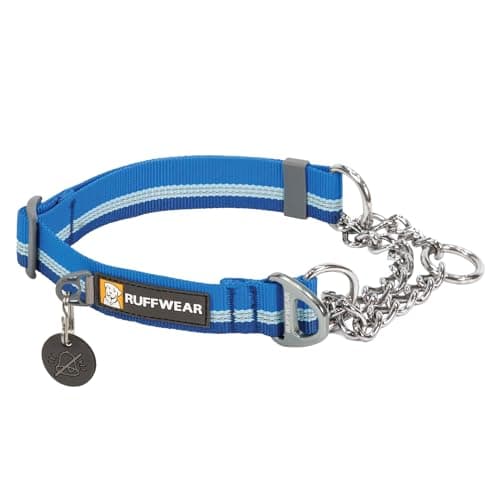
Two loops. A main loop sits on the neck; a smaller control loop carries the leash clip. Pull the leash and the control loop draws the main loop closed to a stopbuilt into the length of the webbing — then it stops. Release and it opens again. That mechanical limit is the entire difference between a martingale and a slip lead or a choke chain, which have no limit at all. The field is ranked in full on our martingale collar roundup; this page answers the puppy question.
When it is safe, and when it is not
| Situation | Martingale? | Why |
|---|---|---|
| Handled walk, leash attached | Yes | Closes to a stop under tension; stops a puppy reversing out near traffic |
| In a crate | No | The control loop catches on a crate bar. Flat ID collar or nothing |
| Unsupervised in the house or yard | No | Snags on furniture, fencing, branches, deck boards |
| Playing with another dog | No | The highest-risk case of all — a jaw through a dangling loop |
| Tethered, tied or left on a long line | No | Nothing limits the load when nobody is holding the other end |
The practical consequence is that a puppy needs twocollars, not one: a flat buckle collar carrying the ID tag, which lives on the dog, and a martingale that goes on for walks and comes off afterwards. That is not an upsell — it is the only arrangement in which both collars are being used safely.
The sizing trap nobody warns you about
A martingale only works when the closed loop is correct. Most fitting advice describes the open loop, which is why so many martingales fail in exactly the way they are supposed to prevent.
- Measure the neck with a soft tape, snug, where the collar will sit.
- Measure over the ears. Widest point of the skull. For a continuous-loop martingale the open loop has to clear this, and the closed loop must be smaller than it.
- Set the stop. Pull the control loop closed by hand. The main loop should now sit snug on the neck. If you can slide a flat hand under the webbing with the collar fully closed, it is too long and the puppy can still back out of it.
- Re-check every two to three weeks.This is the part that catches people. A puppy’s neck grows continuously, and the failure direction is always the same: what was snug becomes slack, and a slack martingale is a flat collar with extra hardware.
Because of that growth, buying a single expensive martingale to last through puppyhood is the wrong purchase. Buy an adjustable one you will genuinely re-check, or buy cheaply twice. The full measuring method, including why over-the-ears is the number that matters, is in how to measure a dog.
Quick-snap or continuous loop: a real trade-off
A continuous-loop martingale has no buckle anywhere — which removes the single most common failure point in any collar, and means it goes over the head every single time. A quick-snap martingale adds a buckle so you can put it on without handling the puppy’s head, and that buckle sits in the load path.
The honest reading of the registry: the PetSafe quick-snap uses an acetal plastic buckle and does not specify its rings, and that plastic buckle reintroduces exactly the weak point a continuous loop avoids. The Blueberry is a continuous loop with polyester webbing — structurally the right layout — but it will not tell you what its rings are made of, and the rings are where a martingale takes its load. The Mighty Paw states stainless steel hardware and carries a lifetime-of-the-product warranty, with excessive chewing and cutting explicitly excluded, which for a teething puppy is the exclusion that matters.
For a young puppy, going over the head twice a day is a real cost: these are the weeks you are teaching a dog that hands near its face are fine, and fighting a collar over its ears works against that. That is why the quick-snap gets the nod here despite the plastic — with the expectation that you move to a continuous loop, or to a harness, once the dog is strong enough for the buckle to matter.
When the answer is a harness instead
A martingale solves one problem: a dog that backs out of a flat collar. It does not solve pulling, and it is not a training device. If your puppy is already pulling hard, or you are doing long-line work, or the dog is a build that simply cannot be held by a collar at all, the answer is a harness — and on a growing dog a harness has the additional advantage of adjusting over a much wider range than a collar does. Start with the small-dog harnesses, and read harness against collar and no-pull harness against head halter before buying anything marketed as a training tool. We do not recommend aversive equipment anywhere on this site.
Quick picks
The short answer, ranked and scored against our published durability rubric. Where a manufacturer does not publish a spec, we say so rather than estimating it.
| # | Photo | Product | Durability | Price |
|---|---|---|---|---|
| 1 | 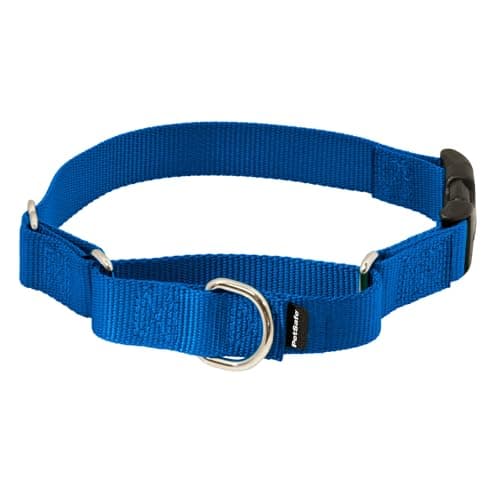 | PetSafe Martingale Collar with Quick SnapA martingale you can put on without going over the head | 48/100 | $7.99 · Amazon |
| 2 | 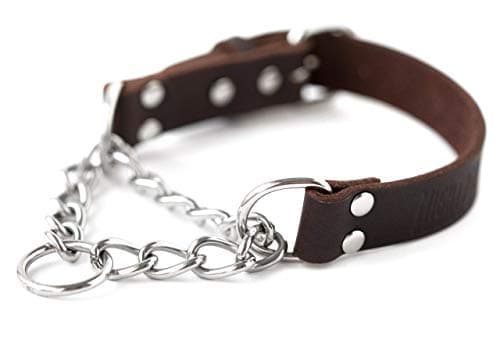 | Mighty Paw Martingale CollarStainless hardware on a limited-slip collar, cheap | 69/100 | $14.39 · Amazon |
| 3 | 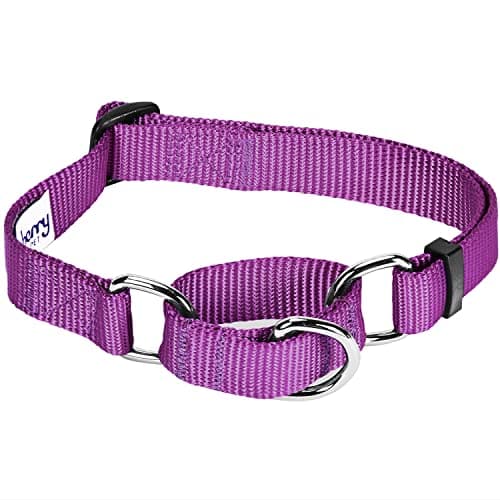 | Blueberry Pet Martingale CollarThe cheapest continuous-loop martingale | 51/100 | Check price |
Tap any row to jump to the full review. Prices are pulled live from Amazon as of October 18, 2026; where we have no verified live price we show none rather than a stale number. #ad — how our links work.
The picks, ranked
1. PetSafe Martingale Collar with Quick Snap
Durability score 48/100Best for: A martingale you can put on without going over the head
The convenient martingale. Understand that the convenience is a plastic buckle in the load path, and decide whether you want that on a dog that backs out.
- Type
- Limited-slip martingale with a quick-snap buckle
- Webbing
- Nylon; denier not published
- Hardware
- Acetal quick-snap buckle; rings not specified
- Limits closure
- Yes — tightens to a stop, not indefinitely
Pros
- The quick-snap buckle solves the main practical objection to martingales, which is having to post them over the dog's head every time
- Limited-slip by design: it tightens to a stop rather than continuing to close, which is what separates a martingale from a choke
- Cheapest collar in this roundup
Cons
- A plastic quick-snap buckle reintroduces the exact failure point a martingale's continuous loop avoids
- No published webbing or hardware specification
- The buckle is on the load path, unlike a buckle-free martingale
How we assessed it: on published materials, hardware specs and construction — not long-term chew-tested. We say so because it is true, and because a claim we cannot back is worth nothing to you.
#ad Price as of October 18, 2026; Amazon prices change often, so check before you buy. How our links work.
2. Mighty Paw Martingale Collar
Durability score 69/100Best for: Stainless hardware on a limited-slip collar, cheap
Stainless hardware and a lifetime warranty for under twenty dollars; just do not expect the warranty to cover a chewer.
- Hardware
- Stainless steel (Amazon listing)
- Design
- Martingale limited-slip
- Warranty
- Lifetime of the product — but excessive chewing is explicitly excluded
Pros
- Stainless hardware at this price is unusual — it will not rust or plate off
- Mighty Paw's warranty runs for the lifetime of the product and needs no registration
Cons
- The warranty explicitly excludes excessive chewing and cutting
- No published webbing spec
- Martingale — not for unsupervised wear
How we assessed it: on published materials, hardware specs and construction — not long-term chew-tested. We say so because it is true, and because a claim we cannot back is worth nothing to you.
#ad Price as of October 18, 2026; Amazon prices change often, so check before you buy. How our links work.
3. Blueberry Pet Martingale Collar
Durability score 51/100Best for: The cheapest continuous-loop martingale
The structurally correct martingale layout at the lowest price. What it will not tell you is what the rings are made of.
- Type
- Limited-slip martingale, continuous loop
- Webbing
- Polyester; denier not published
- Hardware
- Rings; material not published
- Warranty
- Not published in detail
Pros
- No buckle in the load path — a continuous loop is structurally the strongest martingale layout
- Very inexpensive, and available in a wide size range
Cons
- Goes over the head every time, which is the trade-off for having no buckle
- Ring material not published, and the rings are where a martingale takes its load
- No published warranty
How we assessed it: on published materials, hardware specs and construction — not long-term chew-tested. We say so because it is true, and because a claim we cannot back is worth nothing to you.
#ad We only show a price when we have a live one from Amazon. We don’t have one for this product right now, so we’re not going to guess. How our links work.
The bottom line
A martingale is safe on a puppy in one configuration: on a walk, on a leash, in your hand, sized so the closed loop is snug. In every other configuration it is the most hazardous collar in the house, and the control loop is why. Keep a flat ID collar on the dog, put the martingale on for walks, take it off at the door, and re-measure every two to three weeks until the dog stops growing. Buy cheaply and twice rather than expensively once — and remember that the teething exclusion in every warranty we read means no warranty is going to cover the thing a puppy is most likely to do to it.
Frequently asked questions
Is a martingale collar safe for a puppy?
On a handled walk, yes, and for a puppy that already reverses out of a flat collar it is the safer choice - the alternative is a loose collar and a loose puppy near a road. It is not safe left on. A martingale must come off whenever the puppy is crated, unsupervised, tethered or playing with another dog, because the control loop is a snag hazard. Size it so the closed loop is snug rather than slack, and re-measure every two to three weeks while the dog is growing.
At what age can a puppy wear a martingale collar?
There is no age threshold; there is a handling requirement. A martingale is appropriate as soon as the puppy is being walked on a leash by someone holding it, provided the collar is correctly sized and comes off afterwards. What changes with age is sizing frequency: a young puppy's neck grows continuously, and a martingale that was snug last month is slack this month. Re-check the closed loop every two to three weeks, and expect to replace or re-adjust the collar several times before the dog is full grown.
How tight should a martingale collar be on a puppy?
Judge the closed loop, not the open one. Pull the control loop closed by hand: the main loop should then sit snug on the neck. If you can still slide a flat hand under the webbing with the collar fully closed, it is too long, and the puppy can back out of it - which defeats the only reason to own a martingale. For a continuous-loop design the open loop also has to clear the widest part of the skull, so measure over the ears as well as around the neck.
Can you leave a martingale collar on a dog all the time?
No. This applies to adult dogs as well as puppies. The control loop that makes a martingale work is a snag point: on a crate bar, a fence, a deck board, a branch, or another dog's jaw during play. The standard arrangement is two collars - a flat buckle collar carrying the ID tag that stays on the dog, and a martingale that goes on for walks and comes off at the door.
Is a quick-snap or a continuous-loop martingale better for a puppy?
For a young puppy, the quick-snap, for one specific reason: during the weeks you are teaching a dog that hands near its face are fine, dragging a collar over its ears twice a day works against you. The honest cost is that a quick-snap puts a buckle in the load path - PetSafe's is acetal plastic - which is exactly the weak point a continuous loop avoids. Move to a continuous loop, or to a harness, once the dog is strong enough for that buckle to matter.
Is a martingale collar the same as a choke chain?
No. A correctly sized martingale closes to a mechanical stop built into the length of its control loop and then stops, and it opens again as soon as leash tension comes off. A choke chain and a slip lead have no limit - they keep closing as long as the load continues. That difference is the whole point of the design. The hazard with a martingale is not the tightening, it is the dangling control loop when nobody is holding the leash, which is why it comes off whenever the dog is unsupervised.
Sources
Every spec on this page traces to one of these. Where a manufacturer does not publish a figure, we say “not published” rather than estimating it.
- Mighty Paw — warranty terms: lifetime of the product, with excessive chewing and cutting explicitly excluded
- BioThane — Beta 520 PET material data: the 1,000 lb break strength for standard 1 in webbing, the 200 lb buckle pull strength, and the statement that tensile strength comes from the polyester core rather than the coating